会员制仓储超市

Search documents
谁说山姆是中产?
3 6 Ke· 2025-12-29 07:42
Core Insights - The article discusses the perceived betrayal of middle-class consumers by Sam's Club, highlighting their dissatisfaction with the introduction of lower-tier brands and changes in product quality, which they believe devalues their membership experience [1][13]. Group 1: Membership and Pricing Strategy - Sam's Club raised its membership fee from 150 yuan to 260 yuan in 2016, targeting a specific consumer segment and claiming that the value provided would exceed the price increase [3]. - The value proposition for members is estimated to save around 5,000 yuan annually based on a 10% discount on purchases [4]. - The membership fee serves as a significant source of cash flow, allowing Sam's Club to maintain low product margins while ensuring profitability [11]. Group 2: Market Positioning and Competition - Sam's Club is positioned as a "mass-market discount supermarket" rather than a high-end retailer, with a focus on low prices and limited product selection [9][12]. - The article compares Sam's Club to high-end supermarkets like La Grande Épicerie de Paris and Waitrose, emphasizing that true high-end retailers offer a different shopping experience and product quality [5][7]. - Sam's Club's strategy includes expanding into lower-tier markets, evidenced by its recent growth in smaller cities and the introduction of more accessible brands [13][24]. Group 3: Product Strategy and Customization - Sam's Club offers a range of products categorized as private label, exclusive items, and customized products, which are tailored to meet specific consumer preferences [14][16]. - The introduction of lower-cost brands and products has sparked controversy among middle-class consumers, who feel that their expectations for quality are being compromised [1][32]. - The company has made efforts to localize its supply chain, with a significant portion of its products sourced from domestic suppliers, reflecting a strategy to cater to local consumer preferences [31][32]. Group 4: Expansion and Future Outlook - Sam's Club aims to double its membership in the next 8-10 years, indicating a strong growth strategy focused on increasing market penetration [24]. - The use of front warehouses and partnerships with delivery services has enhanced operational efficiency and allowed for rapid expansion without the need for numerous physical stores [19][21]. - The company is adapting to the competitive landscape by localizing its management and supply chain, which is essential for capturing a larger share of the Chinese market [25][31].

谁说山姆是中产?
远川研究所· 2025-12-29 07:35
Core Viewpoint - The article discusses the perceived betrayal of middle-class consumers by Sam's Club, highlighting the rapid descent of the brand into lower-tier markets and the resulting devaluation of its membership card, which has sparked a movement to protect the brand's image and product offerings [3][5]. Group 1: Membership and Brand Positioning - Sam's Club raised its membership fee from 150 yuan to 260 yuan in 2016, emphasizing exclusivity and targeting middle-class consumers [5]. - The value proposition for members is estimated to save around 5,000 yuan annually based on a 10% discount margin, suggesting that the membership fee is justified by the savings [6]. - Sam's Club is positioned as a "mass-market discount supermarket" rather than a high-end retailer, with a focus on cost-effectiveness and a limited SKU selection [12][14]. Group 2: Market Strategy and Expansion - Sam's Club has been expanding aggressively into lower-tier cities, with reports of single-store sales reaching 500 million yuan, significantly outpacing traditional supermarkets [15]. - The introduction of popular brands and a new local executive reflects a strategic shift towards appealing to a broader consumer base, which has led to controversy among existing middle-class members [25][26]. - The company aims to double its membership in the next 8-10 years, indicating a strong growth trajectory in the Chinese market [25]. Group 3: Product Offerings and Consumer Perception - Sam's Club's product categories include private label items, exclusive products, and customized offerings, which are designed to cater to a wide range of consumers [16][18]. - The brand's strategy includes localizing its supply chain, with approximately 70% of products sourced from domestic suppliers, which aligns with the growing demand for local products [32]. - The perception of Sam's Club as a high-end supermarket is challenged by its actual pricing and product offerings, which often undercut traditional supermarkets [12][34].


山姆押注北方城市,多个新店曝光
3 6 Ke· 2025-08-11 11:23
Group 1 - Sam's Club is expanding its presence in northern China, with new store openings planned in cities such as Beijing, Harbin, Xi'an, and Zhengzhou [1][2][3] - Currently, northern cities account for only 1/8 of Sam's Club's total stores in China, indicating significant room for growth in this region [2] - Specific projects include a new store in Xi'an expected to open in September 2025, and the first Sam's Club in Harbin, with plans for a store in Zhengzhou by 2026 [2][3] Group 2 - Beijing has the highest number of Sam's Club locations in northern China, with 4 stores currently open, 3 under construction, and 2 planned [5][6] - The existing stores in Beijing vary in size, with the largest being the Shijingshan store at 19,000 square meters [5] - The new stores under construction in Beijing include the Changping, Fangshan, and Haidian locations, with the Changping store set to be the largest in the city [6] Group 3 - Sam's Club has experienced rapid growth in China, with over 50 stores now operating, and plans for further expansion [7][8] - The company's strong performance is attributed to its high-quality products, efficient operations, and a robust online sales strategy, with over 50% of sales coming from online channels [7][9] - The upcoming openings include 7 new stores in various cities, including Guangzhou and Shanghai, indicating a focus on both first-tier and second-tier cities [8][9]
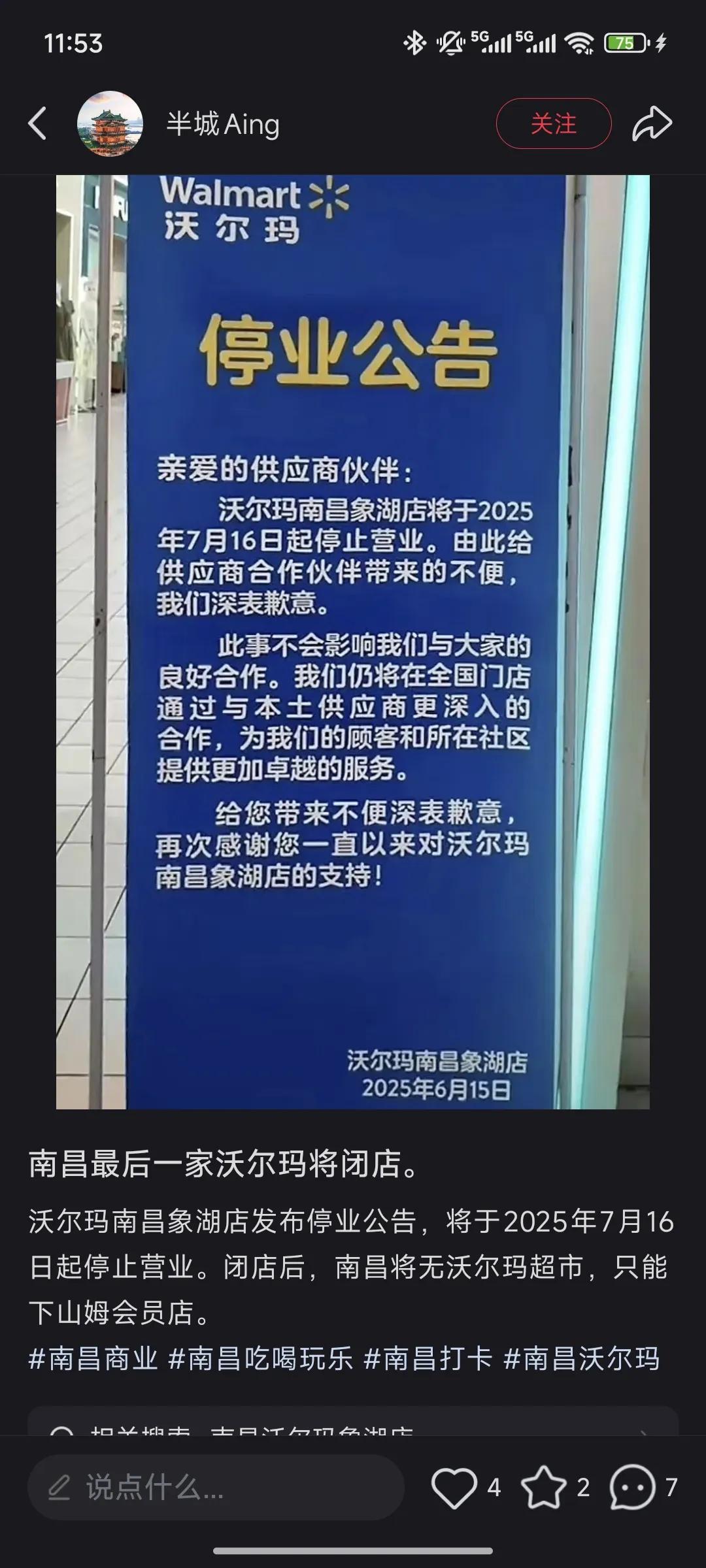
南昌最后一家沃尔玛关闭,独霸全球的零售巨头在中国也玩不动了?
3 6 Ke· 2025-06-16 09:41
Core Insights - Walmart is set to close its Nanchang Xianghu store on July 16, 2025, marking the end of its 22-year presence in the city, reflecting broader changes in the retail industry [1][6] - The company is adapting to market changes by expanding its drone delivery service in the U.S. and focusing on its Sam's Club membership stores in China, which are experiencing strong growth [6][9] Retail Industry Trends - Traditional retail, particularly large-format stores, is facing significant challenges due to the rise of e-commerce and changing consumer shopping habits [6][9] - Walmart's large-format stores in China have seen a decline, with the number of stores dropping from 412 in fiscal year 2020 to 280 by the first quarter of fiscal year 2026, a nearly 30% decrease over five years [6][9] Walmart's Strategic Adjustments - The closure of at least eight Walmart large-format stores across various cities in China highlights a trend of downsizing in this segment [9] - In contrast, Sam's Club is expanding rapidly, with plans to open six new stores in 2024, bringing the total to over 60 by the end of the year [12][14] - Sam's Club employs a "store-warehouse cloud integration" model, managing 8-15 front warehouses per store, achieving a 50% online sales ratio in 2024 [12][14] Membership Model Success - Sam's Club offers a curated selection of approximately 4,000 SKUs, significantly fewer than traditional large-format stores, and has a high membership renewal rate of 92% [14] - The company is also targeting affluent county towns for expansion, indicating a shift in strategy to capture new market segments [12][14] Future Outlook - Walmart is actively restructuring its business model in China, focusing on the growth potential of membership-based warehouse stores and community small stores [15][16] - The company's ability to adapt to the challenges posed by e-commerce and consumer upgrades will be crucial for its future growth in the Chinese market [15][16]