
传染效应

Search documents
美国金融板块周五再度爆发抛售潮,发生了什么?
Feng Huang Wang· 2026-02-27 22:42
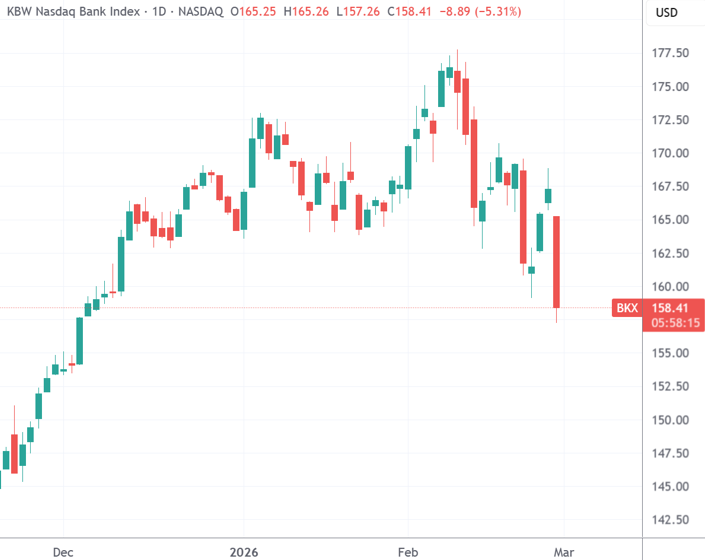
Group 1 - The U.S. banking, asset management, and financial services sectors faced heavy selling pressure, with the KBW Bank Index dropping over 5%, nearing its largest single-day decline since April of the previous year [1] - Major Wall Street firms such as Goldman Sachs and Morgan Stanley saw declines exceeding 7%, while Wells Fargo, Citigroup, and Bank of America dropped over 5% [1] - Concerns about financial system risks stemming from artificial intelligence and the collapse of the UK mortgage company MFS have shaken confidence in the private credit industry [1][3] Group 2 - Financial technology company Block announced layoffs of over 10,000 employees, reducing its workforce to below 6,000, citing increased productivity from AI as the reason [3] - The collapse of MFS has raised new concerns regarding the quality of private credit, with Apollo Global Management, Jefferies, and TPG identified as creditors of MFS [3][4] - MFS is reported to have a "double pledging" issue, potentially leading to a £930 million shortfall in its £1.2 billion debt, which has parallels to previous bankruptcy cases that caused significant losses for misled institutions [4] Group 3 - Jefferies shares fell over 10%, while Apollo Global Management dropped more than 8%, with KKR and TPG also experiencing declines [4] - The credit card and payment service provider American Express saw a decline of over 6%, as the market sold off assets sensitive to credit [5] - Truist Securities highlighted that the market is focused on American Express due to its direct reflection of potential white-collar unemployment risks [5]






理解新型货币类产品脆弱性的框架
美联储· 2026-01-26 09:30
Investment Rating - The report does not explicitly provide an investment rating for the industry or products discussed [2]. Core Insights - New types of near-money products, such as digital currency market funds (MMFs), money market exchange-traded funds (MMETFs), and stablecoins, may have transformative impacts on finance, offering significant benefits but also possessing vulnerabilities similar to other near-money assets [4][6]. - A framework is introduced to analyze the vulnerabilities of these new products by comparing their characteristics with those that lead to the vulnerabilities of MMFs, focusing on liquidity transformation, threshold effects, monetary functions, contagion risks, and the presence of reactive investors [4][7][34]. Summary by Sections Introduction - Near-money assets are central to the financial system and economy, with new non-bank products potentially providing enhanced liquidity and lower costs for a wide range of transactions [6][11]. Background on Near-Money Products - **MMFs**: These funds invest in short-term assets and maintain stable share prices, regulated under SEC rules. As of September 2025, U.S. MMFs managed assets totaling $7.7 trillion, with institutional funds comprising over half [14][15]. - **MMETFs**: Launched in 2024, these funds combine features of MMFs and ETFs, allowing shares to be traded on exchanges. As of September 2025, MMETFs had approximately $4 billion in net assets [20][21]. - **Tokenized MMFs**: These represent shares in MMFs on a blockchain, potentially offering advantages like low-cost, instant settlement. By September 2025, tokenized MMFs had nearly $1.5 billion in net assets [24][25]. - **Stablecoins**: Created in 2014, these digital assets aim to maintain a stable price, with a market capitalization reaching about $300 billion by September 2025, dominated by Tether (USDT) and USD Coin (USDC) [29][30]. Framework for Analyzing Vulnerabilities - The framework assesses vulnerabilities based on established MMF vulnerabilities, focusing on structural and non-structural characteristics that contribute to financial instability [34][35]. - Key features analyzed include: - **Liquidity Transformation**: The conversion of illiquid assets into liquid liabilities, which can lead to rapid redemptions during stress [35]. - **Threshold Effects**: Sudden changes in expected returns when certain thresholds are crossed, prompting early redemptions [36]. - **Monetary Attributes**: The perception of safety and liquidity that influences how products are used as cash management tools [37]. - **Contagion Effects**: The risk that issues in one product can lead to redemptions in similar products [39]. - **Reactive Investor Base**: The tendency of certain investors, particularly institutions, to redeem quickly in response to perceived risks [42]. Analysis of Vulnerabilities in New Products - The report applies the framework to assess the vulnerabilities of MMETFs, tokenized MMFs, and stablecoins, highlighting that while these products may exhibit some vulnerabilities similar to MMFs, their structural characteristics can differ significantly [50][58].