伪私募

Search documents
聪明人是如何识破“伪私募”的?这份防坑指南值得收藏!
私募排排网· 2026-03-24 10:00
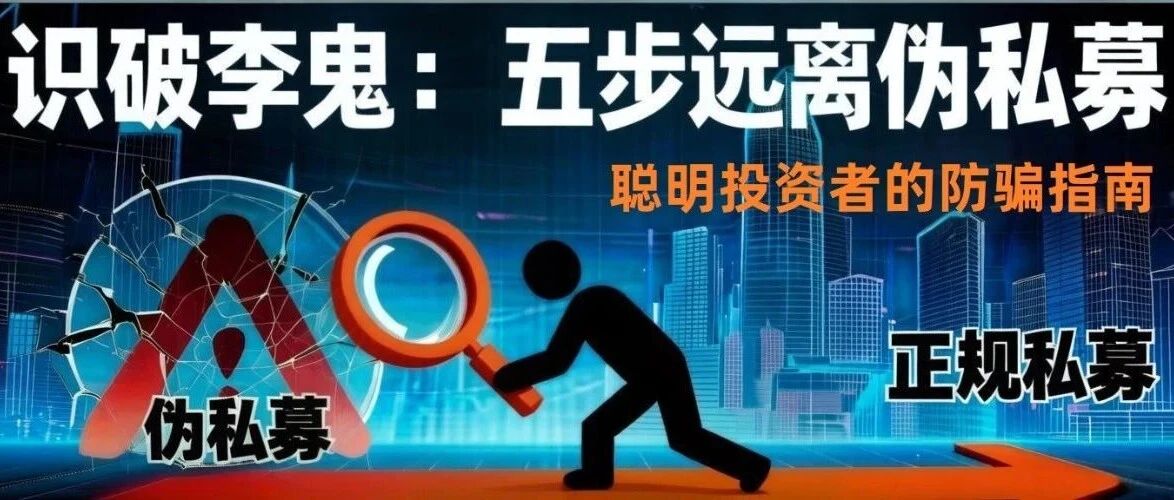
Core Viewpoint - The article emphasizes the importance of identifying "pseudo-private equity" funds that disguise themselves as legitimate private equity, posing risks to investors and disrupting market order [2]. Group 1: Characteristics of Legitimate Private Equity - Legitimate private equity funds have three core characteristics: they are non-publicly raised, target specific qualified investors, and do not promise capital protection or guaranteed returns [2][3]. - Non-public fundraising means that private equity cannot be promoted through mass media channels such as newspapers, radio, television, or social media [2]. - Private equity funds are only available to qualified investors, who must meet specific financial criteria, such as having financial assets of at least 3 million yuan or an average annual income of at least 500,000 yuan over the past three years [3]. - Legitimate private equity managers do not guarantee capital preservation or minimum returns, and any claims of "risk-free" or "guaranteed returns" are indicative of fraud [3]. Group 2: Five Steps to Avoid "Pseudo-Private Equity" - Investors should verify the qualifications of the private equity fund by checking the registration status on the official website of the Asset Management Association of China [4]. - It is crucial to critically assess the promised returns and ensure they align with market norms, as excessively high returns often indicate significant risks or scams [6]. - Investors must confirm that the minimum investment amount for a single private equity fund is 1 million yuan and that the proper procedures for qualifying investors have been followed [7]. - Before transferring funds, it is essential to verify that the receiving account is the fund's or its sales agency's fundraising account, avoiding personal or corporate accounts [7]. - Any public solicitation for investment through social media or other channels violates the non-public principle of private equity and is likely a scam [8].

防非微短剧之“谨防伪私募基金”︱“3·15”投资者保护
重阳投资· 2026-03-12 07:33
Core Viewpoint - The article emphasizes the misconception that having a registration number equates to official approval, highlighting the need for awareness regarding the distinction between registration and actual regulatory approval in the context of private equity investments [1]. Summary by Sections - The article features a micro-drama titled "Beware of Pseudo Private Equity," produced by Yicai and the China Securities Investor Service Center, which aims to educate investors about the risks associated with unregulated investment schemes [1]. - A guest speaker, Shu Taifeng, a partner at Shanghai Chongyang Investment, discusses the importance of understanding the difference between registration and approval, addressing common investor misconceptions [1].

以“禅易投资法”行非法集资,千亿玄学投资骗局覆灭
Xin Lang Cai Jing· 2026-01-25 14:33
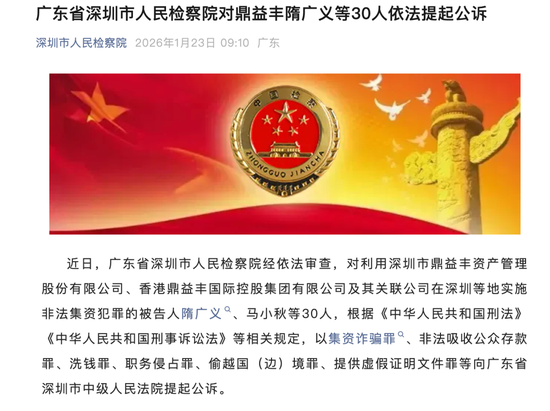
Group 1 - The core members of Dingyifeng, including Sui Guangyi and Ma Xiaoqiu, have been prosecuted for crimes related to illegal fundraising and public deposit absorption [1][2][4] - Dingyifeng Asset Management Co., Ltd. was registered as a private fund manager in 2015 and claimed to have developed a unique investment method, attracting many investors with promises of high returns [1][4][8] - The company has been repeatedly flagged by local regulatory authorities for illegal fundraising risks in 2023, indicating a broader issue within the private fund sector [1][8] Group 2 - The Shenzhen Public Security Bureau has taken criminal coercive measures against key individuals involved in Dingyifeng for their participation in fraudulent activities [5][12] - The regulatory environment is tightening, with increased scrutiny on private fund managers, leading to a significant number of "pseudo-private" and "chaotic private" funds being penalized [6][14] - The industry is undergoing a process of elimination, with a shift towards compliance and regulation as a priority for private fund managers [7][14]