
低价游

Search documents
年轻人勇闯「3元香港游」低价团
36氪· 2026-02-17 05:01
Core Viewpoint - The article discusses the emergence of extremely low-priced one-day tours to Hong Kong, highlighting the shift in the tourism market from luxury shopping to budget-friendly experiences, raising concerns about the sustainability and ethics of such pricing strategies [5][41]. Group 1: Low-Cost Tour Dynamics - A significant number of low-priced one-day tours to Hong Kong have appeared on second-hand trading platforms, with prices ranging from 1.99 to 38.9 yuan, including transportation, meals, and guided tours [5][10]. - The popularity of these tours is evident, with the top-selling link attracting 39,000 views and over 4,000 inquiries [5]. - The cost of these tours has drastically decreased, with prices dropping from 18.8 yuan last September to as low as 3 yuan in January [15][18]. Group 2: Tourist Demographics and Behavior - The demographic of tourists is shifting, with the "00s" generation becoming a significant part of the visitor base, as evidenced by a rise from 28% to 35% in the 23 years and younger category among travelers from mainland China to Hong Kong [18]. - Tourists are increasingly prioritizing budget experiences over luxury, with many opting for low-cost tours despite initial skepticism about their legitimacy [9][15]. Group 3: Economic Implications and Industry Challenges - The Hong Kong tourism industry is facing fundamental challenges, as visitor numbers increase but spending decreases, with tourists focusing more on low-cost experiences rather than high-end shopping [41][42]. - The article notes that the low-cost tour model relies heavily on upselling additional services and products, with tour guides receiving commissions from sales, indicating a potential conflict of interest [20][29]. - The Hong Kong Tourism Board has clarified that it does not endorse such low-priced tours and warns travelers to be cautious of misleading promotions [39]. Group 4: Future of Tourism in Hong Kong - Experts suggest that the tourism industry in Hong Kong needs to rethink its positioning and offerings, as the city transitions from a luxury shopping destination to a more accessible travel option for budget-conscious visitors [42]. - The article concludes that while low-cost tours may appeal to certain demographics, they may not be sustainable for the long-term health of the tourism market, especially as consumer preferences evolve towards deeper experiences rather than mere sightseeing [41][43].


“中国游客在泰国旅游时被威胁购物”,我使馆提醒
券商中国· 2025-10-14 23:27
Core Viewpoint - The Chinese Embassy in Thailand has reported an incident where Chinese tourists were threatened to shop during their visit, leading to an investigation of the involved travel agency by Thai authorities [1]. Group 1 - The tour guide involved in the incident was found to hold a Chinese passport but lacked the necessary qualifications to operate as a tour guide in Thailand [1]. - The guide attempted to coerce tourists into shopping to earn commissions from their purchases, prompting the Thai authorities to take action against the travel agency [1]. - The Chinese Embassy has advised tourists to avoid "low-cost tours" and to select reputable travel agencies with proper outbound travel operating qualifications [1]. Group 2 - Tourists are encouraged to sign formal contracts and ensure that the travel products they choose are reasonably priced [1]. - According to Thai law, foreign nationals are prohibited from working as tour guides in Thailand [1]. - In case of disputes, tourists are advised to maintain evidence and contact the Thai tourism police hotline or the embassy for assistance [1].

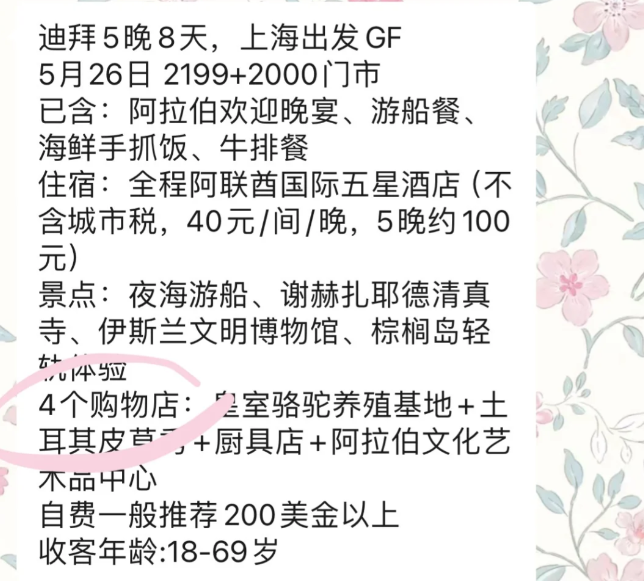
土豪聚集的迪拜也被“低价游”攻陷了
Hu Xiu· 2025-07-30 10:04
Core Viewpoint - Dubai, traditionally known for luxury tourism, is now experiencing a surge in low-cost travel options, raising concerns about the sustainability and quality of the tourism market [1][22]. Group 1: Low-Cost Travel Trends - Travel agencies report that low-cost packages to Dubai have become rampant, with prices for 6-day trips dropping to as low as 1,000 to 2,000 yuan, significantly below the normal price range of 6,000 to 7,000 yuan [2][4]. - Social media is filled with advertisements promoting these low-cost travel options, indicating a growing trend in budget tourism [3]. Group 2: Reasons for Low Prices - The low prices are attributed to government subsidies aimed at boosting the local economy, which raises questions about the viability of such pricing strategies [4][22]. - Travel agencies employ various methods to maintain profitability, including charging service fees of 2,000 to 3,000 yuan and implementing hidden costs for attractions and services [6][7][8]. Group 3: Market Dynamics - The increase in direct flights due to favorable policies has led to an oversupply of airline seats, prompting agencies to offer low-cost packages to minimize losses [15][16]. - Some travel agencies, facing poor recovery in other markets, have shifted focus to Dubai, mistakenly believing it to be an easy market for low-cost travel [17]. Group 4: Target Demographics - The primary consumers of low-cost travel packages are often inexperienced travelers from lower-tier cities, who may not fully understand the implications of such deals [18][19]. Group 5: Market Impact - The prevalence of low-cost travel is damaging not only to consumer rights but also to the overall market, which was once thriving for established travel agencies [19][24]. - The low-cost travel trend is disrupting the market environment, potentially harming quality service providers and leading to a chaotic pricing landscape [24]. Group 6: Future Outlook - The Middle East tourism market is projected to grow, with total tourism consumption expected to reach $350 billion by 2030, maintaining an annual growth rate of 7% [25]. - Despite the challenges posed by low-cost travel, there is a shift towards high-quality, customized travel experiences, with a decline in large group tours [27][28].
体重轻可半价旅游?警惕低价游新套路
Bei Jing Qing Nian Bao· 2025-05-07 23:17
Core Viewpoint - Recent internet marketing activities claiming to support the "Weight Management Year" policy are identified as a new tactic for "low-cost travel" promotions, misleading consumers into potential additional charges and vague offers [1][2] Group 1: Consumer Warnings - The Beijing Consumer Association has issued a warning to consumers about verifying the authenticity of travel product information and choosing official channels for tourism activities [2] - Consumers are advised to be cautious of "low-cost travel" and "free travel" promotions, which often lead to forced consumption and false itineraries [2] - It is recommended to sign formal contracts that clearly outline service details, including itinerary arrangements and cost breakdowns, to avoid ambiguous terms [2] Group 2: Recommendations for Consumers - Consumers should retain proof of purchase, such as contracts, receipts, and communication records, to protect their rights [2] - It is important to remain skeptical of shopping recommendations from tour guides and avoid impulsive purchases based on enticing offers [2] - In case of disputes, consumers are encouraged to first negotiate with the service provider and, if unresolved, to file complaints with consumer associations or relevant regulatory bodies [2]