低波动性股票

Search documents
“极度拥挤”警报拉响!小摩警告:这六只投机性成长股面临走势逆转风险
Zhi Tong Cai Jing· 2025-12-18 12:54
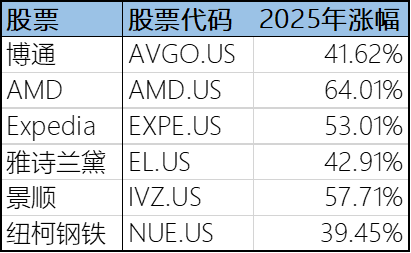
Core Viewpoint - Recent volatility in the US stock market highlights the risks warned by JPMorgan strategists, indicating that some stocks that have seen significant gains this year are facing "extreme crowding" [1] Group 1: Speculative Growth Stocks - JPMorgan identified six speculative growth stocks: Broadcom (AVGO.US), AMD (AMD.US), Expedia (EXPE.US), Estée Lauder (EL.US), Invesco (IVZ.US), and Nucor (NUE.US), warning that their performance is vulnerable to major macroeconomic events [1] - The stock price increases for these companies in 2025 are as follows: Broadcom 41.62%, AMD 64.01%, Expedia 53.01%, Estée Lauder 42.91%, Invesco 57.71%, and Nucor 39.45% [2] Group 2: Market Trends and Investor Behavior - The S&P 500 index fell by 1.2%, marking its fourth consecutive day of decline after reaching a historical high last week, with technology stocks leading the sell-off as investors rotate out of "winner" sectors [3] - JPMorgan's quantitative analysts noted that the "crowding" in high-volatility, high-risk stocks has reached the 99th percentile, indicating an extreme level that could lead to sharp sell-offs as investors seek to hedge [3] - Kaplan from JPMorgan stated that these companies are more sensitive to shocks, making them susceptible to sudden repricing [3] Group 3: Investment Strategies - For clients looking to capitalize on current market conditions, Kaplan suggested a strategy of buying put options on speculative stocks while establishing long positions in lower-volatility stocks [4] - Suggested low-volatility stocks include Cigna (CI.US), Pfizer (PFE.US), and Verizon (VZ.US), contrasting with the speculative growth stocks [5] Group 4: Market Sentiment - The recent decline in momentum stocks may be attributed to a temporary rotation of funds rather than a significant shift in market dynamics, as evidenced by Micron Technology's (MU.US) strong earnings that boosted AI concept stocks [5] - The Chief Investment Officer of Adapt Investment Managers noted that only true asset owners, such as retail investors and large institutions, can drive the market beyond short-term technical corrections, requiring substantial fundamental changes for position liquidation [5]