
AI热潮

Search documents
存储短缺,会在2026年引发停产吗?
芯世相· 2026-03-30 06:52
Core Viewpoint - The article discusses the significant price increases and shortages in the memory chip market, driven by the rising demand for high-bandwidth memory (HBM) due to the AI boom, leading to a phenomenon termed "RAMageddon" [3][4]. Group 1: Causes of Memory Chip Shortage - The memory chip shortage is attributed to the complex transformation in the tech industry, particularly the increasing demand for HBM from companies like Nvidia and AMD, which is essential for the performance of AI models [3]. - Major semiconductor manufacturers are reallocating production capacity to HBM, resulting in decreased output of traditional DRAM and NAND chips, creating a supply-demand imbalance across various industries [4]. Group 2: Impacts on Industries - The high costs and limited supply of DRAM, NAND, and HBM are forcing companies to adopt different strategies to maintain production continuity while avoiding significant disruptions [5]. - Companies are facing profit compression as they absorb higher costs without immediately passing them on to consumers, particularly in sectors like consumer electronics and automotive [6]. - Price increases are becoming inevitable, with manufacturers like Dell and Lenovo planning to raise product prices by up to 20% in 2026, and IDC predicting a 14% increase in global smartphone average prices [7]. Group 3: Strategies to Cope with Shortages - Some manufacturers are considering redesigning products to reduce memory requirements, although this approach is costly and time-consuming, and may risk product quality and user experience [10]. - The automotive industry is also feeling the impact, with companies like Tesla indicating that DRAM shortages will affect production in 2026, leading to strategic allocation of resources to higher-margin vehicles [13]. - Consumer electronics manufacturers are signaling that DRAM shortages could constrain production, with expectations of flat or declining product shipments in the near term [12].


氦气危机,将如何冲击全球半导体产业?
财联社· 2026-03-23 09:19
Core Viewpoint - The recent attack by Iran on Qatar's natural gas export facilities poses significant risks to the global energy market and the technology supply chain, particularly due to the critical role of helium in semiconductor manufacturing and other advanced industries [4][5]. Group 1: Helium Supply and Impact - Qatar supplies approximately 30% of the world's helium, primarily from the Ras Laffan facility, which is the largest liquefied natural gas plant globally [5][7]. - Following the Iranian drone attacks, QatarGas announced a 14% reduction in helium export volume due to severe damage to its facilities, with repair expected to take years [7][10]. - Helium prices have doubled since the outbreak of conflict in the Middle East, with potential for further increases as supply tightens [10][12]. Group 2: Helium's Role in Semiconductor Industry - Helium is essential for semiconductor manufacturing, particularly for cooling wafers during the etching process, where it helps maintain consistent temperatures [12][18]. - There are currently no viable alternatives to helium for its cooling applications in semiconductor production, making it irreplaceable [12][18]. - The medical industry also relies on helium for cooling superconducting magnets in MRI machines, indicating a broad impact across multiple sectors [12]. Group 3: Transportation and Storage Challenges - Helium's atomic properties make it difficult to store and transport, as it can easily leak from containers [13]. - Specialized containers used for helium storage can only maintain liquid helium for 35-48 days, and there are currently about 200 such containers stranded in the Middle East [14]. - The logistics of transporting these containers to alternative supply sources could exacerbate shortages in the short term [14]. Group 4: Global Semiconductor Industry Response - The U.S. is the largest helium producer, with an estimated 81 million cubic meters produced last year, but geopolitical tensions have affected supply from other major producers like Russia [16]. - In the event of a helium shortage, semiconductor manufacturers may prioritize the production of higher-margin AI chips over lower-margin components, potentially leading to increased prices for consumer electronics [17][20]. - South Korean companies, which import about 65% of their helium from Qatar, are at risk and are actively seeking alternative sources to mitigate supply disruptions [18][20].

一图看懂 | 三星罢工概念股
市值风云· 2026-03-19 10:14
Core Viewpoint - A potential strike by Samsung Electronics' union members could exacerbate the global semiconductor supply tightness, particularly impacting various industries such as automotive, computers, and mobile phones due to the ongoing AI boom [4]. Group 1: Union Strike Details - Over 66,000 union members of Samsung Electronics voted, with 93.1% in favor of a strike, planned for late May [4]. - The strike is driven by dissatisfaction over salary disparities with SK Hynix and demands to eliminate bonus caps linked to operating profits [4]. Group 2: Impact on Semiconductor Industry - Samsung is a significant player in the storage chip market, and a strike could intensify the supply constraints in the semiconductor sector [4]. - The potential strike may affect various companies involved in storage chip design, manufacturing, module production, equipment and materials supply, distribution, and downstream applications [4].
金融期货周报-20260313
Jian Xin Qi Huo· 2026-03-13 11:44
1. Report Industry Investment Rating No relevant information provided. 2. Core Viewpoints of the Report - For the stock index, the current major contradiction lies in the external market. The escalation of the US - Iran conflict has reignited inflation concerns. Although the panic has been released, the stock index will gradually return to the domestic fundamentals, but geopolitical uncertainties remain. During the performance disclosure period, market sentiment is expected to be cautious. It is recommended to adopt a high - selling and low - buying strategy, and be more optimistic about IF and IC with stronger profit certainty and more relevance to new - quality productivity [12]. - For treasury bonds, inflation concerns have suppressed the bond market. The situation in the Middle East has not eased, and the rise in oil prices has led to inflation concerns. The market is affected by factors such as export data and regulatory policies. It is recommended to pay attention to the steepening strategy, and there may be a small - scale rebound in the bond market next week [36][51][93]. - For shipping indices, the shipping market is affected by the Middle East situation. Although the supply of container shipping capacity is high, the slowdown of the Red Sea re - navigation plan can relieve the pressure. The short - term geopolitical conflict may cause the index to strengthen, but it may also experience a significant correction. It is advisable to short the off - season contracts near the delivery period and go long on the peak - season contracts [111]. 3. Summary According to Related Catalogs Stock Index Market Review - At the beginning of the year, the A - share market had a "good start" due to factors such as the appreciation of the RMB and the rise of the Hong Kong stock market. However, regulatory measures to cool down the market led to a weakening of market sentiment. Subsequently, factors such as the nomination of the next Fed chairman, the US - Iran conflict, and the two sessions affected the market. From March 9th to 13th, the A - share market showed a shrinking and consolidating pattern, with different performances among major indices [7][8][9]. - The current major contradiction is the external market. The US - Iran conflict has escalated, and inflation concerns have resurfaced. Domestically, there are no unexpected policies from the two sessions. The trading volume in the two markets has shrunk, and the stock index will gradually return to the domestic fundamentals. It is recommended to adopt a high - selling and low - buying strategy, and be more optimistic about IF and IC during the performance disclosure period [12]. 成交持仓分析 - This week, the trading volume of stock index futures has shrunk. The average daily trading volumes of IF, IH, IC, and IM are 105,300, 44,500, 152,200, and 202,100 lots respectively, with changes of - 23,200, - 16,000, - 38,900, and - 29,800 lots compared with last week. - The positions of stock index futures have generally decreased. The average daily positions of IF, IH, IC, and IM are 274,000, 106,700, 296,300, and 377,400 lots respectively, with changes of - 8,300, - 4,400, - 13,400, and - 8,700 lots compared with last week [13]. 基差、跨期价差及跨品种价差分析 - **基差**: This week, the basis has narrowed. The basis of CSI 300, SSE 50, CSI 500, and CSI 1000 are - 11.14, 0.15, - 26.0, and - 27.29 points respectively, with a narrowing of 3.30, 2.85, 11.73, and 9.77 points compared with last week. The annualized basis rates of the corresponding contracts are - 12.27%, 0.27%, - 16.23%, and - 17.09% respectively [18]. - **跨期价差**: As of March 13th, the spreads between the next - month and current - month contracts of IF, IH, IC, and IM are all negative. The spreads of IF and IH have narrowed, while those of IC and IM have widened. The spreads between the current - quarter and current - month contracts are also negative, with different changes in each variety [20][21]. - **跨品种价差**: The performance of large - cap stocks is relatively better, especially the CSI 300 index. The ratios of CSI 300/SSE 50, CSI 1000/CSI 500, CSI 300/CSI 1000, and SSE 50/CSI 1000 are at different historical percentile levels, with corresponding changes [24]. 行业板块概况 - **CSI 300 and CSI 500 sub - industry trends**: In the CSI 300, the utility, energy, and industrial sectors led the rise, while the materials, real estate, and pharmaceutical sectors led the decline. In the CSI 500, the utility, consumer, and pharmaceutical sectors led the rise, while the raw materials, information, and optional sectors led the decline [27]. - **First - level industry gains and losses**: The coal, power equipment, and building decoration sectors led the rise, while the national defense and military industry, petroleum and petrochemical, and comprehensive sectors led the decline [29]. 估值比较 As of March 13th, the rolling price - to - earnings ratios of CSI 300, SSE 50, CSI 500, and CSI 1000 are 14.2607, 11.5251, 37.6349, and 50.5938 times respectively, and are at the 86.38%, 80.09%, 87.98%, and 83.62% percentile levels in the past ten years [31]. Treasury Bonds This Week's Market Review - **Treasury bond futures market**: Inflation concerns have suppressed the bond market. The situation in the Middle East has not eased, and the rise in oil prices has led to inflation concerns. The export data has exceeded expectations, and regulatory policies have also affected the market. The performance of futures is weaker than that of spot bonds, and there is no positive arbitrage space for each contract. It is recommended to pay attention to the steepening strategy [36][39][51]. - **Bond spot market**: This week, most of the spot yields of treasury bonds have increased. The yields of ultra - long - term bonds have risen significantly. The yields of US treasury bonds have also increased across the board [65]. - **Funding situation**: At the beginning of the month, the funding pressure is not large, and the central bank has mainly carried out net repurchases. As the tax period approaches, the funding situation has tightened marginally [73][78]. - **Interest rate derivatives**: This week, the yields of most swap varieties have declined, and the liquidity expectation is stable [85]. Market Analysis - **Recent market logic**: The PMI in February was affected by the Spring Festival and was weaker than expected. However, the high - frequency economic indicators after the Spring Festival showed a fast resumption of production, and the overseas export demand was still strong. The implementation of the "Shanghai Seven Measures" may boost the real estate market in the "Golden March" season. The short - term situation in the US - Iran is unclear, which has increased inflation expectations and brought liquidity shocks. It is necessary to pay attention to the upcoming economic data [88]. - **This week's fundamental situation**: The inflation and import - export data in February and January - February have exceeded expectations, partly due to the Spring Festival misalignment. The inflation has improved significantly, and the PPI may turn positive. The export has shown strong resilience, and it is expected to maintain a strong performance this year [89][90]. - **Next week's bond market outlook**: The self - regulatory management of inter - bank deposits may release a batch of allocation demand. The tax - period disturbance and the release of January - February economic data next week may be short - term negative factors, and there may be a small - scale rebound [93]. Next Week's Open - Market Maturities and Important Economic Calendar Next week, important economic data such as China's January - February economic data and the Fed's interest - rate decision will be released, and the tax - filing deadline in March will also be reached [95]. Shipping Index Market Review The shipping index has fluctuated significantly due to the rapid change in the Middle East situation. The index adjusted at the beginning of the week but then recovered. The container shipping futures on the European route have all risen this week, with the largest increases in the near - month contracts of May and June [96]. 集运市场情况 - **Spot market**: The transportation demand on the European route has been flat and not significantly affected by the Middle East situation, but the supply - chain shock has pushed up the freight rate. The quotes for April have been significantly increased, but the cargo volume is still light [103]. - **Supply - demand fundamentals of container shipping**: In terms of supply, the container shipping capacity in Europe in March is still significantly higher than the same period in previous years, and the potential capacity is also increasing. The actual capacity has decreased slightly in March but will increase in April. The Red Sea re - navigation plan has been postponed, which can relieve the pressure on the European route. In terms of demand, the overseas demand is still strong, but the inflation in Europe may lead to a weakening of macro - demand [107][108]. Market Outlook The container shipping market is still in the off - season after the Spring Festival. Although the Red Sea re - navigation plan has been postponed, the supply of container shipping capacity is still high. The short - term geopolitical conflict may cause the index to strengthen, but it may also experience a significant correction. It is advisable to short the off - season contracts near the delivery period and go long on the peak - season contracts [111].
电力涨停潮!牛股七连板!硬核利好来袭,电力ETF华宝(159146)放量猛涨2.64%,开年四连阳创新高!
Xin Lang Cai Jing· 2026-02-27 11:40
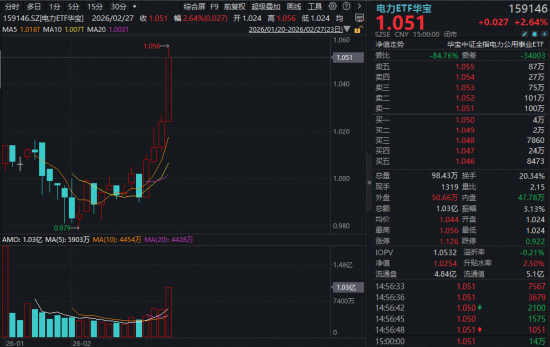
Core Viewpoint - The power sector is experiencing a significant surge, with multiple stocks hitting their daily limits, driven by strong market sentiment and the influence of AI-related developments [1][5]. Group 1: Stock Performance - Yuhuan Energy Holdings has achieved seven consecutive limit-ups, while Gannan Energy and Huayin Power have recorded three and two consecutive limit-ups, respectively [1][5]. - Several other stocks, including Xiexin Energy, Fuling Power, and Jinkai New Energy, have also reached their daily limits, with Gansu Energy, Leshan Power, Yongtai Energy, and Jiantou Energy rising over 5% [1][5]. Group 2: ETF Performance - The Electric Power ETF Huabao (159146) has increased by 2.64%, reaching a new high since its listing, and has recorded four consecutive daily gains since the beginning of the year, with a single-day trading volume exceeding 100 million yuan [1][5]. - The ETF's closing price on February 27 was 1.051, with a trading range between 1.024 and 1.056 [2][6]. Group 3: Market Drivers - The surge in the power sector is attributed to two main factors: the increase in AI model token usage, which has surpassed that of the U.S., and the "HALO trading" phenomenon, which emphasizes the essential nature of energy and power assets in the face of AI advancements [3][7]. - The cost of electricity, which constitutes 60%-70% of AI operational expenses, is significantly lower in China compared to the U.S. and Europe, creating a profitable model for exporting AI services while keeping electricity production domestic [3][7]. Group 4: Investment Recommendations - Investors are encouraged to consider the Electric Power ETF Huabao (159146), which focuses on the public utility sector, including thermal, hydro, wind, nuclear, and solar power, offering both dividend and growth potential [3][7]. - The concentration of leading stocks in the power sector is expected to benefit from the growth in AI computing power and favorable electricity reform policies [3][7].
美国强大的终极秘密似乎找到了!美国越乱,美国就越好?
Sou Hu Cai Jing· 2026-02-27 09:43
Group 1 - The U.S. economy exhibits extreme polarization, with AI becoming the core focus of capital investment, leading to significant financial activity in the tech sector [2][4] - Despite severe social issues and a struggling real economy, the U.S. stock market continues to reach historical highs, driven by the AI investment boom and the rising value of virtual currencies [4][9] - The U.S. has seized a leading position in the blockchain sector, controlling over 90% of the global on-chain traceability market, which enhances its technological and regulatory advantages [7] Group 2 - The financial sector benefits from expansive fiscal and monetary policies, which are key drivers of the stock market's rise, even amid concerns of a potential bubble similar to the internet bubble of 30 years ago [10][11] - The concentration of wealth at the top allows the U.S. to offer high salaries and quality research environments, maintaining its leadership in AI and biotechnology [12] - The unique operational logic of the U.S. transforms domestic conflicts and global dynamics into opportunities for capital appreciation, despite the underlying social and economic disparities [11][12]

英伟达市值一夜蒸发了一个英特尔谁在唱空英伟达?
Xin Lang Cai Jing· 2026-02-27 08:01
Group 1 - Nvidia's latest quarterly earnings report exceeded market expectations, yet the stock price still declined by 5.46%, resulting in a market value loss of over $250 billion, nearly equivalent to Intel's market capitalization of $227.1 billion [1] - Nvidia reported revenue of $68.1 billion for the latest quarter, representing a 73% year-over-year increase, marking a historical high [1] - The company projected a midpoint revenue forecast of $78 billion for the first quarter of fiscal year 2027, which is significantly above analysts' average predictions of $66 billion for the fourth quarter and $72 billion for the next quarter [1] Group 2 - On the same day as Nvidia's stock decline, other semiconductor stocks also experienced losses, with AMD down 3.41%, Broadcom down 3.19%, and TSMC down 2.82% [1]

韩国股市“领涨全球”的秘密武器:当总统“曾经是韭菜”
Hua Er Jie Jian Wen· 2026-02-23 02:35
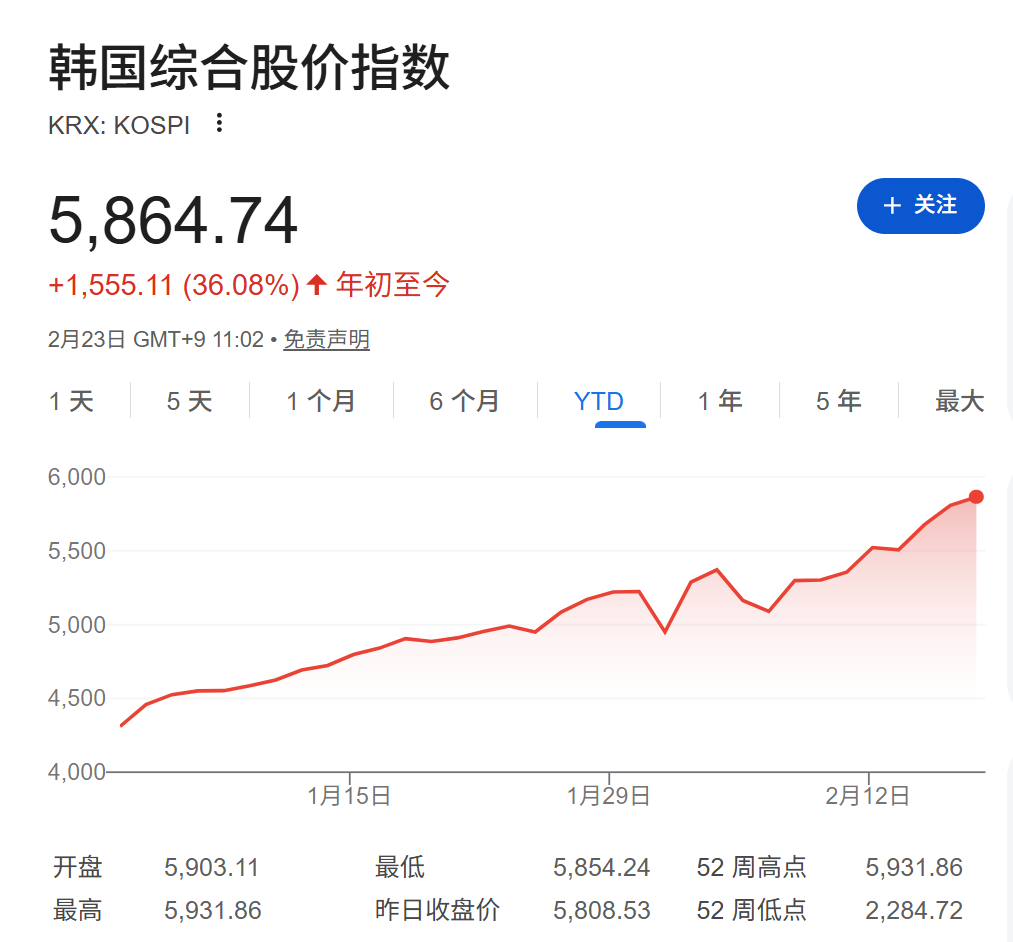
Core Insights - The article discusses the transformation of South Korea's stock market under President Lee Jae-myung, who has implemented aggressive financial reforms aimed at promoting fairness and accountability in corporate governance [1][6]. Group 1: Market Performance - Since Lee Jae-myung took office in June 2022, the KOSPI index has surged by 115%, with a year-to-date increase of 36% as of the 23rd of the month [1][3]. - The recent market rally has made Lee a "people's hero" among 14 million retail investors, with his approval rating reaching 63% in mid-February, the highest in over three months [3]. Group 2: Reforms and Policies - Lee has introduced reforms such as equal shareholder rights and enhanced board accountability, which have contributed to the stock market's growth [1][6]. - The government has revised regulations to expand fiduciary responsibilities, encourage dividends, and increase enforcement against market violations [6]. Group 3: Economic Context - Despite the stock market's rise, South Korea's economy contracted in the fourth quarter, highlighting challenges in reversing economic trends [7]. - There is a growing concern among analysts that the stock market's performance may not translate into broader economic growth, with many retail investors remaining cautious [7]. Group 4: Future Challenges and Agenda - The real estate market remains overheated, and the government is taking steps to curb speculation while accelerating new housing construction [8]. - Lee's administration plans to address issues such as stock buybacks, insider trading, and the delisting of unprofitable companies as part of its agenda [8].
创盛亚洲投资集团董事长温文浩回顾2025年港股IPO市场
Sou Hu Cai Jing· 2026-02-20 09:39
Market Overview - The IPO market in Hong Kong has shown a strong recovery, leading the global IPO fundraising rankings with a total of HKD 286.71 billion in 2025, a year-on-year increase of 225.9% [4] - The number of new listings reached 119, including 114 IPOs, marking a 62.9% increase compared to the previous year [4] IPO Market Characteristics Issuance Structure - The distribution of IPOs includes 8 super-large (over HKD 10 billion), 4 large (HKD 5-10 billion), 21 medium (HKD 2-5 billion), and 81 small (under HKD 2 billion) offerings, indicating growth across both large and small enterprises [4] Key Data - The Hang Seng Index rose by 27.77% over the year, outperforming major global stock markets, with total trading volume and average daily trading volume reaching historical highs [4] Investment and Intermediary Landscape Investment Institutions - 78.07% of IPOs included cornerstone investors, with total investments reaching HKD 106.60 billion, a record high [4] Intermediary Institutions - Chinese securities firms dominated the underwriting market, with CICC leading with 41 IPOs, followed by CITIC Securities and Huatai International [4] Policy and Filing Dynamics - In 2025, 187 companies completed the filing process for overseas listings, a 19.1% increase year-on-year, with 139 companies listing in Hong Kong, doubling from the previous year [4][5] Market Trend Outlook - The trend of technology companies going public in Hong Kong is expected to continue into the first half of 2026, supported by the influx of capital from both domestic and international sources [4] - The AI boom is driving ongoing interest in IPOs within the technology and semiconductor sectors, while healthcare and consumer sectors remain focal points for the market [4]

在AI眼镜的“战国时代”,做一名激进的落地先锋
Feng Huang Wang Cai Jing· 2026-02-12 13:24
Core Insights - The AI glasses market is transitioning from a niche product to mass production, with companies like Qiu Guo Plan aiming to provide innovative solutions in this space [1] - The company emphasizes the importance of practical applications for AI technology, warning against speculative bubbles if AI fails to deliver real-world value [1] Group 1: Technology and Performance - Qiu Guo Plan's flagship product, the Wigain AR glasses, features aggressive performance specifications, integrating Qualcomm's XR Gen1 and Gen2 chips with a processing power of 42 TOPS [2] - The company has made breakthroughs in self-developed diffraction waveguide technology, achieving an F50 field of view and aiming for F100 [2] - The glasses are designed to function as intelligent agents with capabilities for real-time SLAM spatial positioning, environmental awareness, and complex decision-making [2] Group 2: Market Strategy and Differentiation - Unlike many competitors focusing on gaming or entertainment, Qiu Guo Plan targets the traditional Chinese medicine health sector, presenting a unique cross-industry approach [3] - The company's "1+3+N" strategy includes one core platform (AI OS and intelligent agents), three core hardware products (AR glasses, smart watches, and smart rings), and multiple vertical scenarios focusing on office, health, and industrial applications [4][5][6] - The upcoming smart health watch will serve as a "health sensor," converting traditional Chinese medicine practices into quantifiable digital models, thus creating new opportunities in the health market [6] Group 3: Entrepreneurial Philosophy and Vision - The founder of Qiu Guo Plan embodies a new generation of Zhejiang entrepreneurs, characterized by practical realism and forward-thinking industry insights [7] - The company operates with a flat organizational structure, allowing for rapid responses to market demands, with the founder directly overseeing the R&D team [7] - The founder believes that maintaining a keen sense of market dynamics is crucial for success, especially as the mass production of AI glasses approaches [8]
