供应链绑定

Search documents
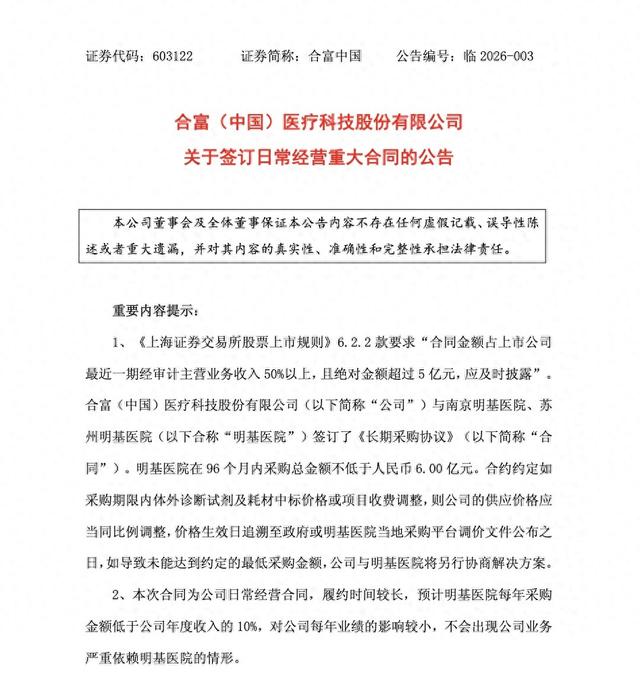
上市满月即签6亿合约:明基医院与合富中国的双向妥协与隐忧
Guan Cha Zhe Wang· 2026-01-27 06:41
Core Viewpoint - The recent long-term procurement contract worth 600 million yuan between Mingji Hospital and Hefei China reflects both companies' operational anxieties, with Mingji Hospital needing to implement its expansion plans and Hefei China facing significant performance declines due to industry pressures [1][5][8]. Group 1: Company Performance - Hefei China is experiencing a significant downturn, with a projected revenue decline of 26.67% to 689 million yuan for 2025 and a shift from a net profit of 27.57 million yuan to a loss between 25 million and 36 million yuan [5][7]. - The company's losses are attributed to the implementation of centralized procurement policies in the in vitro diagnostics industry, which have drastically reduced procurement prices and squeezed sales revenue and gross margins [7][11]. - Despite cost control measures, Hefei China is unable to reduce fixed expenses proportionally to its declining revenue, leading to continued financial strain [7][11]. Group 2: Strategic Implications - The partnership between Mingji Hospital and Hefei China is driven by Mingji's urgent need for a stable supply chain to support its expansion plans following its recent IPO, where it raised approximately 555 million HKD [8][11]. - Mingji Hospital's operational model is limited by its higher pricing compared to public hospitals and a narrow customer base, which constrains its growth potential [11][15]. - The exclusive supply agreement with Hefei China may limit Mingji Hospital's ability to negotiate prices and manage costs effectively, especially in a context of increasing centralized procurement [11][12]. Group 3: Contractual Risks - The eight-year procurement agreement includes clauses for price adjustments based on market fluctuations, which could significantly impact Hefei China's profit margins and overall financial health [12][15]. - Payment terms require Hefei China to front nearly four months of payment for supplies, increasing its cash flow pressure amid ongoing losses [13][15]. - The lack of clear fallback provisions in the contract raises concerns about potential disputes and the overall stability of the partnership [12][14].