
医疗集采

Search documents
蓝帆医疗20260317
2026-03-18 02:31
Summary of the Conference Call for 蓝帆医疗 (Blue Sail Medical) Company Overview - **Company**: 蓝帆医疗 (Blue Sail Medical) - **Industry**: Medical Devices, specifically focusing on cardiovascular products and protective gloves Key Points Industry and Business Performance - **Cardiovascular Business**: Expected to turn profitable by 2025, with a focus on expanding hospital coverage to over 3,000 and achieving a million-level implant volume. Self-developed products are projected to account for 50% of sales, with gross margins potentially recovering to over 60% [2][4] - **Protective Gloves Business**: Anticipated to achieve stable profitability by Q1 2026, driven by geopolitical factors and raw material price increases. Prices for nitrile gloves are expected to rise by over $7 per box, and PVC gloves by $2-3 per box [2][7] - **Investment in Thailand**: A $200 million investment from Thailand aims to address energy cost issues by acquiring a local power plant and constructing a new facility, which will significantly reduce production costs [2][5] Financial Performance and Projections - **Historical Losses**: The company faced losses from 2021 to 2024, with amounts of 400 million, 300 million, 200 million, and 100 million respectively. Strategies to mitigate losses include expanding market access and increasing self-developed product sales [4][6] - **Future Profitability**: By 2025, the company expects to achieve profitability exceeding 100 million, with a gross margin recovery to 60% [4][6] Strategic Initiatives - **Forward Stockpiling Strategy**: The company has stockpiled low-cost nitrile latex to benefit from price increases expected in 2026, with inventory sufficient until May 2026 [2][7][11] - **International Expansion**: The cardiovascular business is expanding internationally, with an overseas sales team of over 200 people and projected overseas revenue exceeding 800 million RMB by 2025 [2][12] Challenges and Responses - **Energy Costs**: High energy costs have been a significant challenge. The investment from Thailand is expected to alleviate this issue by integrating energy supply and improving production efficiency [5][6] - **Market Dynamics**: The company is navigating a challenging market environment, including price fluctuations due to geopolitical tensions and tariff policies [4][5][18] Market Trends and Pricing - **Price Increases**: The company anticipates significant price increases in gloves due to raw material cost pressures and market dynamics, with nitrile gloves expected to see a price increase of $7 or more per box [7][22] - **Demand Resilience**: Despite price increases, demand for gloves remains strong, with inventory levels low and customers expected to replenish stock quickly [15][22] Future Outlook - **High-Quality Development Cycle**: The company is entering a new growth phase, benefiting from demographic trends and increasing disease prevalence. The cardiovascular sector is expected to grow at double-digit rates [4][30] - **Strategic Partnerships**: The company is focusing on strategic partnerships and investments to enhance its product offerings and market presence, particularly in the cardiovascular space [12][30] Conclusion - **Long-term Vision**: 蓝帆医疗 aims to become a respected global company in the medical field, leveraging its experience and strategic initiatives to navigate challenges and capitalize on growth opportunities [30][31]

医疗耗材行业报告:国产PFA前景可期
Xiangcai Securities· 2026-03-03 08:27
Investment Rating - The report maintains an "Overweight" rating for the electrophysiology-related medical consumables sector [5] Core Insights - There is a strong demand for cardiac electrophysiology technology due to the high prevalence of cardiovascular diseases in China, which ranked first among all causes of death in urban and rural residents in 2020 [2][12] - The electrophysiology technology is continuously evolving, with significant clinical advantages demonstrated through improved techniques such as three-dimensional mapping and various ablation methods [3][4] - Domestic PFA (Pulsed Field Ablation) technology presents an opportunity for local companies to catch up with foreign brands, as it is better suited to the Chinese clinical environment [4][5] Summary by Sections 1. Strong Clinical Demand for Cardiac Electrophysiology - Cardiovascular diseases have a high mortality rate, indicating a rigid clinical demand for treatment [12][13] - Cardiac electrophysiology technology is widely used for diagnosing and treating arrhythmias, with a focus on rapid arrhythmias [17][23] 2. Continuous Iteration of Electrophysiology Technology - The technology has seen significant improvements, with three-dimensional mapping providing more accurate diagnostics [3] - Various ablation techniques, including radiofrequency and cryoablation, are well-established, while PFA is rapidly developing with substantial clinical potential [3][4][55] 3. Market Growth Potential and Increasing Domestic Market Share - The domestic electrophysiology market is experiencing rapid growth, with low product penetration and unmet demand [5][50] - Historically dominated by foreign brands, the market is seeing an increase in competitiveness from domestic companies, particularly in the PFA segment [50][54] 4. PFA Technology as a Game Changer - PFA technology is advancing quickly, offering clinical advantages such as safety and efficiency, which could lead to increased adoption [55] - The approval of multiple PFA products in China is expected to accelerate market penetration and commercialization [61][63] 5. Investment Recommendations - The report suggests focusing on leading domestic companies in the electrophysiology sector, such as Huatai Medical and Microelectrophysiology, as they are likely to benefit from the growing market and technological advancements [5][54]
硕世生物2025年预亏扩大,应收账款回收完成
Jing Ji Guan Cha Wang· 2026-02-14 05:34
Performance Overview - The company expects a net profit attributable to shareholders of the parent company for 2025 to be between -29.4 million and -44 million yuan, indicating an expanded loss compared to the previous year due to intensified industry competition, medical procurement, and VAT rate adjustments [2] Financial Status - The company announced the recovery of an accounts receivable over 5 years old amounting to 6.0994 million yuan, which is expected to have a positive impact on the financial status for 2026 [3] Company Developments - A temporary shareholders' meeting on January 5, 2026, approved the expansion of the business scope and amendments to the company's articles of association, which may involve business expansion [4] Stock Performance - As of February 11, 2026, the stock price was 68.75 yuan per share, down 2.01% for the day, with a net outflow of 4.7948 million yuan in main funds and a trading volume of 39.0139 million yuan. The financing balance as of February 2, 2026, was 392 million yuan, representing a high proportion of the circulating market value, at the 90th percentile level over the past year [5] Future Development - The actual controller renewed the "Joint Action Agreement" in December 2025, and the company's products were included in the World Health Organization's emergency use list, which may support long-term development [6]

合富中国与明基医院长单引上交所追问
Bei Jing Shang Bao· 2026-02-04 16:12
Core Viewpoint - The long-term procurement agreement between HeFu China and Mingji Hospital has attracted market attention, leading to regulatory scrutiny from the Shanghai Stock Exchange regarding the implications of such agreements on the company's business model and industry practices [1][3]. Group 1: Agreement Details - HeFu China signed a long-term procurement agreement with Mingji Hospital for the purchase of in vitro diagnostic reagents and consumables, with a total procurement amount of no less than 600 million yuan over 96 months, equating to an eight-year contract duration [1]. - The company stated that the annual procurement amount from Mingji Hospital is expected to be less than 10% of its annual revenue, indicating minimal impact on the company's overall performance [1][2]. Group 2: Regulatory Response - The Shanghai Stock Exchange issued a regulatory letter to HeFu China, requesting clarification on the commercial rationale behind the long-term agreement, its alignment with industry norms, and the replicability of such agreements [1][3]. - HeFu China responded that the minimum procurement amount aligns with past purchasing patterns from Mingji Hospital and is significantly lower than the hospital's total procurement of drugs and medical consumables during the same period [2]. Group 3: Risks and Challenges - The agreement includes a minimum procurement obligation, with penalties for non-compliance; however, it also allows for negotiations if the minimum is not met due to reasons beyond the hospital's control, raising questions about the enforceability of the minimum commitment [2][3]. - HeFu China is facing pressure from a projected net loss of 25 to 36 million yuan, attributed to price declines in the in vitro diagnostic sector and fluctuations in order volumes due to centralized procurement policies [3]. Group 4: Market Performance - HeFu China's stock experienced a significant increase of 342.92% from October 27 to December 19 last year, becoming a market star, but has since seen a decline of nearly 40% from its peak as of February 4 [4].

与明基医院签订8年期长单协议,上交所追问合富中国商业背景及合理性
Bei Jing Shang Bao· 2026-02-04 12:39
Core Viewpoint - Recently, Hefei China (603122) signed a long-term procurement agreement with Nanjing Mingji Hospital and Suzhou Mingji Hospital, which has attracted market attention and led to regulatory scrutiny from the Shanghai Stock Exchange [1][3]. Group 1: Agreement Details - The long-term procurement agreement stipulates that Mingji Hospital will purchase in vitro diagnostic reagents and consumables from the company, with a total procurement amount of no less than 600 million yuan over a period of 96 months [1]. - The company expects that the annual procurement amount from Mingji Hospital will be less than 10% of its annual revenue, indicating minimal impact on the company's overall performance [3]. Group 2: Regulatory Response - The Shanghai Stock Exchange issued a regulatory letter to Hefei China, requesting clarification on the business model, industry competition environment, and the commercial rationale behind the long-term agreement [3]. - Hefei China responded that the minimum procurement amount aligns with Mingji Hospital's past purchasing scale and is significantly lower than its total procurement of drugs and medical consumables during the same period [3]. Group 3: Contractual Obligations - The agreement includes a minimum procurement amount of 600 million yuan, with Mingji Hospital obligated to compensate if the total procurement does not meet this amount, although there are provisions for negotiation in case of non-party-related reasons for not meeting the minimum [4]. - The company indicated that it would review the execution of the contract annually and make adjustments if deviations are found, although uncertainties remain regarding the ability to meet the minimum procurement amount [4]. Group 4: Financial Performance - Hefei China is facing pressure with a projected net loss of 25 million to 36 million yuan for 2025, marking its first loss since going public, primarily due to price declines in the in vitro diagnostic industry and fluctuations in order volumes [5]. - The company's stock price experienced a significant increase of 342.92% from October 27 to December 19, 2025, but has since declined nearly 40% from its peak as of February 4 [5].

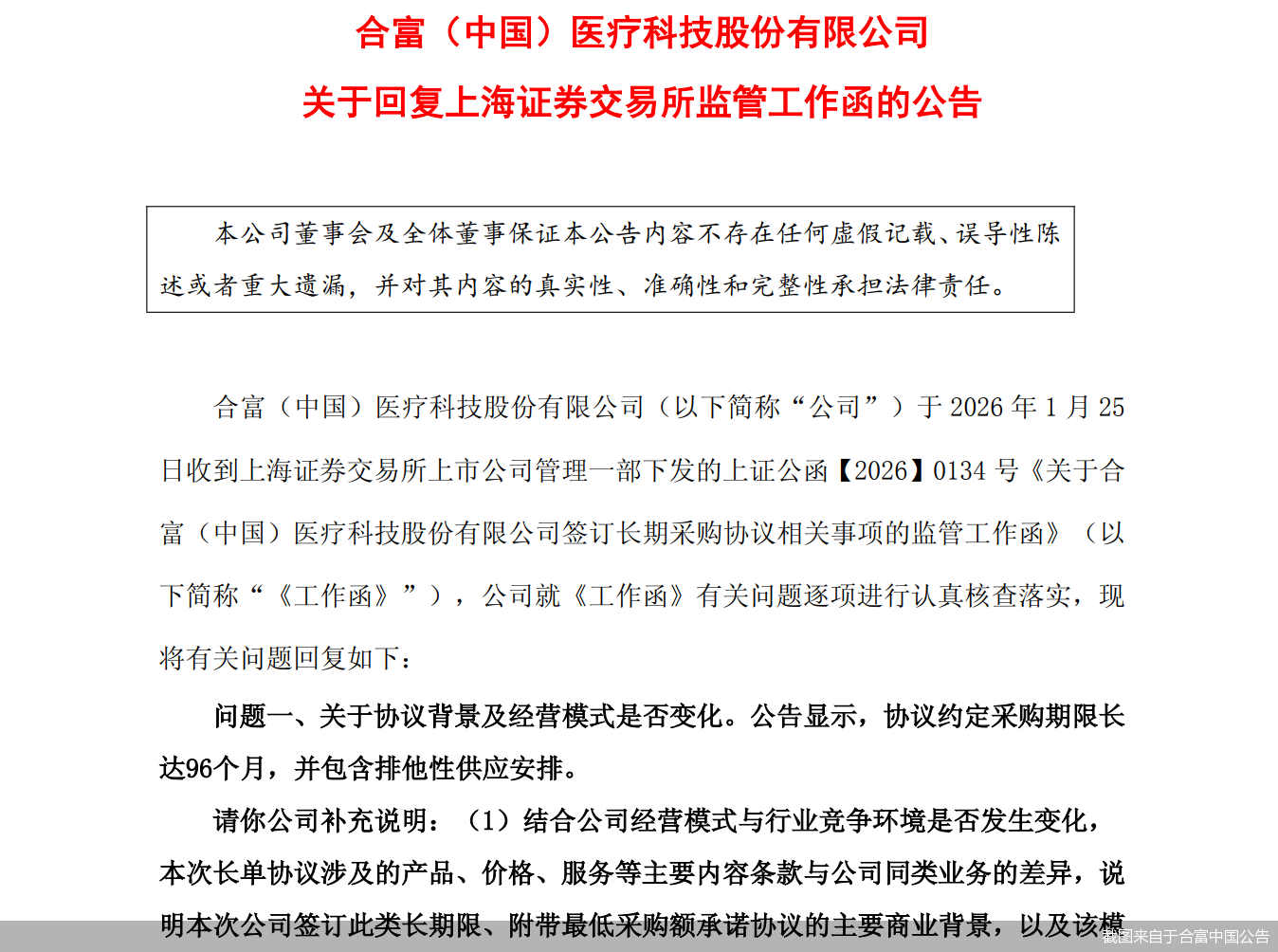
科华生物:预计2025年度净利润亏损5.8亿元~7.4亿元
Sou Hu Cai Jing· 2026-01-30 13:56
Group 1 - The company Kewah Bio expects a net loss attributable to shareholders of 580 million to 740 million yuan for 2025, with basic earnings per share loss estimated at 1.1276 to 1.4387 yuan [1] - In the same period last year, the company reported a net loss of approximately 641 million yuan, with a basic earnings per share loss of 1.2687 yuan [1] - The primary reason for the performance change is significant adverse impact from asset impairment provisions, which the company plans to assess and test comprehensively based on industry trends and actual operating conditions [1] Group 2 - The IVD industry is facing intensified competition due to policy changes and market pressures, leading to a decline in both revenue scale and product gross margins year-on-year [1] - Factors such as medical procurement policies, DRG payment reform, mutual recognition of test results, adjustments in testing service fees, and unbundling of testing packages are reshaping the competitive landscape of the industry [1] - The demand for certain routine testing projects is contracting, coupled with downward pressure on product prices, which directly affects the company's profitability [1]

北京市春立正达医疗器械股份有限公司2025年年度业绩预增公告
Shang Hai Zheng Quan Bao· 2026-01-29 20:26
Group 1 - The company expects a significant increase in net profit for the year 2025, projecting a range of CNY 244.99 million to CNY 287.99 million, which represents an increase of CNY 120 million to CNY 163 million compared to the previous year, translating to a year-on-year growth of 96.01% to 130.41% [3] - The net profit attributable to the parent company, excluding non-recurring gains and losses, is estimated to be between CNY 229.54 million and CNY 269.54 million, indicating an increase of CNY 135 million to CNY 175 million from the previous year, with a year-on-year growth of 142.80% to 185.11% [3] - The previous year's net profit attributable to the parent company was CNY 124.99 million, with a net profit excluding non-recurring gains and losses of CNY 94.54 million [4] Group 2 - The substantial growth in net profit is attributed to the gradual release of growth potential from various product lines following their inclusion in centralized procurement, as well as the company's ongoing international development strategy and improved operational management [6] - The company has communicated with its auditing firm regarding the performance forecast, and there are no significant discrepancies between the company and the auditors concerning the forecast [3]

上市满月即签6亿合约:明基医院与合富中国的双向妥协与隐忧
Guan Cha Zhe Wang· 2026-01-27 06:41
Core Viewpoint - The recent long-term procurement contract worth 600 million yuan between Mingji Hospital and Hefei China reflects both companies' operational anxieties, with Mingji Hospital needing to implement its expansion plans and Hefei China facing significant performance declines due to industry pressures [1][5][8]. Group 1: Company Performance - Hefei China is experiencing a significant downturn, with a projected revenue decline of 26.67% to 689 million yuan for 2025 and a shift from a net profit of 27.57 million yuan to a loss between 25 million and 36 million yuan [5][7]. - The company's losses are attributed to the implementation of centralized procurement policies in the in vitro diagnostics industry, which have drastically reduced procurement prices and squeezed sales revenue and gross margins [7][11]. - Despite cost control measures, Hefei China is unable to reduce fixed expenses proportionally to its declining revenue, leading to continued financial strain [7][11]. Group 2: Strategic Implications - The partnership between Mingji Hospital and Hefei China is driven by Mingji's urgent need for a stable supply chain to support its expansion plans following its recent IPO, where it raised approximately 555 million HKD [8][11]. - Mingji Hospital's operational model is limited by its higher pricing compared to public hospitals and a narrow customer base, which constrains its growth potential [11][15]. - The exclusive supply agreement with Hefei China may limit Mingji Hospital's ability to negotiate prices and manage costs effectively, especially in a context of increasing centralized procurement [11][12]. Group 3: Contractual Risks - The eight-year procurement agreement includes clauses for price adjustments based on market fluctuations, which could significantly impact Hefei China's profit margins and overall financial health [12][15]. - Payment terms require Hefei China to front nearly four months of payment for supplies, increasing its cash flow pressure amid ongoing losses [13][15]. - The lack of clear fallback provisions in the contract raises concerns about potential disputes and the overall stability of the partnership [12][14].
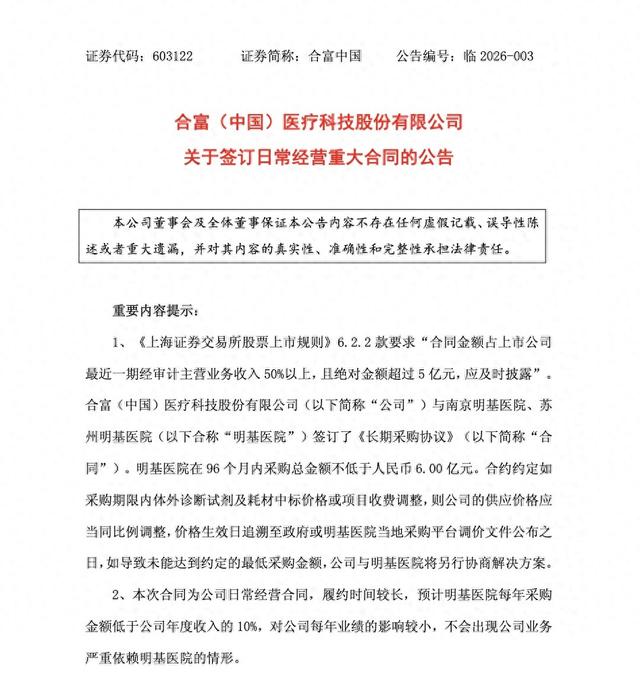
合富(中国)医疗科技股份有限公司关于签订日常经营重大合同的公告
Shang Hai Zheng Quan Bao· 2026-01-25 19:19
Core Viewpoint - The company has signed a long-term procurement agreement with Nanjing Mingji Hospital and Suzhou Mingji Hospital, committing to a minimum procurement amount of RMB 600 million over 96 months, which is expected to have a limited impact on the company's annual revenue [2][3][17]. Group 1: Contract Details - The contract stipulates that the total procurement amount from Mingji Hospitals will not be less than RMB 600 million over 96 months, with annual procurement expected to be less than 10% of the company's annual revenue [2][3]. - The contract includes provisions for price adjustments based on changes in procurement prices or project fees, with adjustments effective from the date of the announcement by the government or local procurement platform [2][12]. - The contract has been approved internally and does not constitute a related party transaction or a major asset restructuring [3][10]. Group 2: Parties Involved - Nanjing Mingji Hospital is a foreign-owned limited liability company with a registered capital of approximately USD 19.2 million, established in 2003, and is fully owned by Malaysian Mingji Bimoo Holdings [6][7]. - Suzhou Mingji Hospital is a non-wholly foreign-owned limited liability company with a registered capital of approximately RMB 601.98 million, established in 2004, with major shareholders being Mingji Bimoo Holdings and Suzhou Mingji Investment [8][9]. Group 3: Financial Impact - The contract is expected to positively impact the company's performance in 2026 and subsequent years, enhancing its profitability and competitive strength [17]. - The company emphasizes that the contract's execution will not lead to dependency on the hospitals for its business operations [18]. Group 4: Performance Forecast - The company anticipates a net loss of between RMB 36 million and RMB 25 million for the year 2025, a significant decline compared to the previous year's profit of approximately RMB 27.57 million [22][25]. - The expected loss is attributed to changes in the macro environment, competitive pricing pressures, and increased operational costs due to strategic investments in talent and technology [26].
股市必读:蓝帆医疗(002382)1月14日主力资金净流入775.72万元
Sou Hu Cai Jing· 2026-01-14 19:01
Group 1 - The stock price of Bluestar Medical (002382) closed at 5.99 yuan on January 14, 2026, with an increase of 0.67% and a trading volume of 184,100 shares, resulting in a transaction amount of 111 million yuan [1] - On January 14, the net inflow of main funds was 7.76 million yuan, indicating increased short-term interest from major investors [2][3] - Bluestar Medical's subsidiary, Shandong Jiwei Medical Products Co., Ltd., is expected to be selected for the national centralized procurement of coronary drug-coated balloons, with a proposed price of 2,524 yuan, and the procurement period extending until December 31, 2028 [2][3]