
依法治市

Search documents
十二届市纪委六次全会召开 以更高标准更实举措推进全面从严治党 为在奋力谱写中原 大地推进中国式现代化新篇章中挑大梁走在前提供坚强保障
Zheng Zhou Ri Bao· 2026-01-26 02:15
Group 1 - The meeting of the 12th Discipline Inspection Committee of the Zhengzhou Municipal Committee emphasized the importance of implementing the spirit of the 20th National Congress and the recent Central Commission for Discipline Inspection meetings, aiming to strengthen the comprehensive and strict governance of the Party [1] - The meeting highlighted the need for a higher standard and more practical measures to ensure the successful implementation of the "14th Five-Year Plan" and to provide strong support for advancing modernization in the region [1] - The Secretary of the Municipal Committee, An Wei, called for a unified understanding of the importance of the anti-corruption struggle, recognizing its long-term and complex nature, and emphasized the need for unwavering commitment to strict governance [1] Group 2 - An Wei acknowledged the achievements made in strict governance over the past year and stressed the importance of implementing major decisions from the central government, particularly during the critical phase of the "14th Five-Year Plan" [2] - The focus will be on enhancing the institutional framework to ensure clear responsibilities and effective execution, while also maintaining a high-pressure stance against corruption [2] - The meeting called for continuous improvement in the construction of the disciplinary inspection and supervision team, emphasizing the need for loyalty, integrity, and the ability to combat corruption effectively [2]
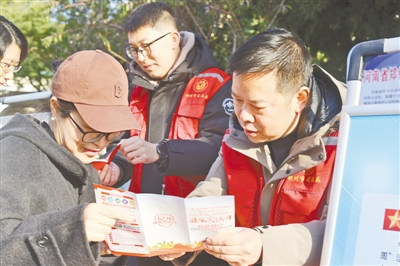
郑州举行宪法宣传周集中宣传活动
Zheng Zhou Ri Bao· 2025-12-05 00:48
Group 1 - The event on December 4th marks the 12th National Constitution Day, aimed at promoting constitutional spirit and advancing the rule of law in Zhengzhou's modernization efforts [1] - The event was organized by multiple local government departments, emphasizing the importance of the constitution as the fundamental law of the state [1] - Activities included a legal-themed cultural performance, constitutional knowledge quizzes, legal consultation services, and displays from 42 municipal units showcasing their "rule of law packages" [1] Group 2 - The City Federation of Trade Unions focused on protecting the rights of "new" workforce groups by distributing promotional materials to support new economic development [1] - The Human Resources and Social Security Bureau provided explanations on employment, social insurance, and labor dispute arbitration to guide employers in legal management and help workers protect their rights [1] - The Judicial Bureau showcased 40 years of legal publicity and education achievements, promoting the "Legal Publicity and Education Law" [1]

依法治市 证监会明确监管措施程序规定
Sou Hu Cai Jing· 2025-11-28 22:15
Core Viewpoint - The China Securities Regulatory Commission (CSRC) has publicly solicited opinions on the "Implementation Measures for Supervision and Administration of Securities and Futures Markets (Draft for Comments)", aiming to enhance the standardization and legal governance of regulatory measures in the market [1] Group 1 - The "Implementation Measures" outlines 14 common regulatory actions, including orders for correction, regulatory talks, warning letters, and orders for regular reporting, while also including a catch-all provision for other supervisory measures as per laws and regulations [1] - The implementation of regulatory measures must adhere to principles of legality, efficiency, and fairness, ensuring timely correction of illegal activities and prevention of risk spread [1] - Regulatory measures can be applied individually or in combination, based on the nature, circumstances, severity, and risk level of the behavior [1] Group 2 - The general procedural requirements for implementing regulatory measures include the need for documentation of evidence collection, decision-making, and delivery, with on-site enforcement requiring at least two qualified personnel [2] - If a violation is not discovered within two years, the implementing agency generally will not take regulatory measures unless otherwise specified by laws or if the risk from the violation has not been eliminated [2] - Special procedural requirements include prior notification to the parties involved, detailing the type of measures, facts, reasons, and rights to respond [2]
市委理论学习中心组召开学习会 锲而不舍落实中央八项规定精神 提升法治素养增强依法履职能力 马明龙主持并讲话
Zhen Jiang Ri Bao· 2025-09-22 23:40
Group 1 - The core viewpoint emphasizes the importance of strengthening the Party's work style and implementing the Central Eight Regulations to ensure effective governance and self-revolution within the Party [1][2] - The meeting highlighted the need for continuous education and guidance for Party members to adhere to practical and effective governance, fostering a culture of integrity and accountability [2] - The significance of Xi Jinping's rule of law thought was underscored, with a focus on integrating it into all aspects of governance to enhance the legal environment and promote high-quality development [3] Group 2 - The meeting called for a consistent and long-term approach to improving the Party's work style, ensuring that new positive practices are firmly established in the new journey ahead [2] - It was stressed that law-based governance is crucial for advancing modernization in Zhenjiang, enhancing public trust in legal systems, and creating a favorable business environment [3] - The Party's comprehensive leadership role in law-making, enforcement, and compliance was reiterated as essential for the successful implementation of legal frameworks [3]
以人民为中心 走好中国特色城市现代化新路
Xiao Fei Ri Bao Wang· 2025-07-30 03:15
Core Insights - The Central Urban Work Conference held in mid-July in Beijing emphasized the strategic deployment of urban development goals, paths, and tasks for the future, marking a significant top-level design and guidance at a critical juncture of urbanization in China [1][2] Group 1: Urban Development Goals - The conference identified "modernization of people-oriented cities" as a key goal, outlining six transformations in urban development, including a shift from incremental expansion to stock optimization and from extensive development to intensive efficiency [2][3] - The proposed six types of cities—innovative, livable, beautiful, resilient, civilized, and smart—cover essential areas such as urban space, function, ecology, culture, safety, and governance, reflecting a comprehensive and systematic approach [2][3] Group 2: Quality-Oriented Urban Governance - The meeting highlighted the importance of green low-carbon transformation, resilient city construction, and cultural continuity, indicating a clear shift from speed-oriented to quality-oriented urban development [3][4] - A three-pronged approach to smart city construction was proposed, focusing on party leadership, rule of law, and digital empowerment, aimed at addressing urban issues and enhancing governance capabilities [3][4] Group 3: Challenges and Future Directions - The future of urban work faces challenges such as aging population, uneven urban-rural development, outdated infrastructure, and increasing public service pressure, necessitating continuous innovation across various dimensions [3][4] - The emphasis on a people-centered approach in urban modernization reflects a broader trend towards more humanistic, greener, smarter, and more resilient urban environments, aligning with the essence of modern Chinese-style development [4][5]