侠义精神

Search documents
闽产电影《镖人:风起大漠》破10亿
Xin Lang Cai Jing· 2026-02-27 23:36
Core Insights - The film "Biao Ren: Wind Rises in the Desert," produced in Fujian, has surpassed 1 billion yuan in box office revenue during the Spring Festival period, setting a record for the highest box office for domestic martial arts films in Chinese cinema history [1] Group 1 - The film is adapted from a popular anime with complete intellectual property rights owned by a company in Xiamen, which has built a strong reputation in the domestic animation market [1] - The project was registered and supported by the Fujian Provincial Film Bureau, highlighting its significance as a key project for the province [1] - The film deeply interprets the chivalrous spirit of traditional Chinese culture, featuring distinct and unique character portrayals [1] Group 2 - Since its release during the Spring Festival, the film has received consistently positive reviews, leading to multiple record-breaking box office achievements for domestic martial arts films [1]
《镖人》、袁和平与渐远的江湖
3 6 Ke· 2026-02-20 02:57
Core Perspective - The film "Biao Ren" attempts to transform a comic story rooted in traditional chivalric spirit and Western film's desolate aesthetics into a visual presentation on the big screen, questioning how traditional martial arts aesthetics and chivalric essence can find new expression in modern times [1][2] Group 1: Film Production and Cast - Directed by 81-year-old Yuen Woo-ping, "Biao Ren" features a star-studded cast including Jet Li, Wu Jing, and Donnie Yen, representing nearly all active generations of Chinese action actors [1] - The film's essence is a blend of traditional martial arts ethics and modern storytelling, aiming to explore the continuity of martial arts spirit in contemporary society [1][2] Group 2: Industry Context and Challenges - The film reflects the current state of the martial arts film industry, where traditional elements are increasingly challenged by modern interpretations and technological advancements [2][12] - The decline of the traditional martial arts ecosystem is attributed to various factors, including market shrinkage and the loss of talent, leading to a disconnection from the foundational "jianghu" culture [8][11] Group 3: Artistic Direction and Aesthetic - Yuen Woo-ping's approach emphasizes physical authenticity and real action, contrasting with the trend of digital effects in modern filmmaking [12][15] - The film seeks to revive the "hard bridge, hard horse" aesthetic, showcasing genuine physicality and emotional depth in martial arts [14][15] Group 4: Cultural Significance and Future Prospects - "Biao Ren" serves as a reflection on the essence of chivalry in contemporary narratives, questioning how traditional values can be reinterpreted in today's context [17][18] - The film's release highlights the ongoing evolution of martial arts cinema, suggesting that while the traditional industry may be fading, the spirit of martial arts and its cultural significance can still resonate through new narratives and mediums [20][21][23]

对“金庸平行宇宙”的一次梳理
Xin Lang Cai Jing· 2026-01-08 22:05
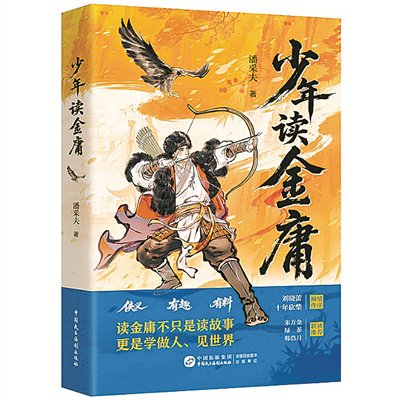
Core Viewpoint - The book "Youth Reading Jin Yong" by Pan Caifu addresses the question of whether young people still read Jin Yong, reflecting on the impact of Jin Yong's works on the 70s generation and their relevance to contemporary youth [2][5]. Group 1: Impact of Jin Yong's Works - Jin Yong's novels have significantly influenced the 70s generation, who grew up reading his works and watching adaptations, forming a deep connection with characters like Duan Yu and Guo Jing [2]. - The evolution of Jin Yong's writing reflects a shift from idealism and romanticism to realism, paralleling the ideological journey of the 70s generation [2][4]. Group 2: Content and Style of "Youth Reading Jin Yong" - Pan Caifu employs a light-hearted and humorous writing style to explore Jin Yong's entry into the martial arts world, his development, and the unique characteristics of his characters [3]. - The book intertwines the author's personal growth and experiences with the analysis of Jin Yong's works, creating a dialogue that transcends time [3]. Group 3: Cultural Significance - Jin Yong's works are deeply rooted in traditional culture, serving as both popular literature and intellectual writing, and continue to offer valuable insights for new generations [4]. - Despite the decline in physical book readership, Jin Yong's works remain popular among youth, with multiple titles appearing in library and university reading surveys [5].
平陆运河风物志 | 一骑绝尘苏三娘
Guang Xi Ri Bao· 2025-11-23 02:50
Core Viewpoint - The article highlights the legendary figure of Su San Niang, a female general from the Taiping Heavenly Kingdom, and her enduring legacy in Su Village, Ling Shan, where her story continues to inspire local culture and tourism development [1][4]. Group 1: Historical Background - Su San Niang, originally named Yu Niang, was born into a martial arts family and became a prominent leader during the Taiping Rebellion, known for her exceptional combat skills and leadership [1][2]. - She gained fame after successfully leading her troops in battles against Qing forces, including a notable victory at the Battle of Ling Shan, where her strategic acumen and bravery were on full display [2][3]. - Following the death of her husband, Su San Niang sought revenge and became a key figure in the local resistance, eventually joining the Taiping Army and participating in significant battles across China [2][3]. Group 2: Cultural Significance - Su San Niang's legacy is deeply embedded in the cultural fabric of Su Village, where her story is celebrated and has influenced local values, such as integrity and community spirit, exemplified by the village's unique self-service market [3][4]. - The village is also home to historical architecture, including the Liu family ancient buildings, which reflect the region's rich heritage and are a focal point for cultural tourism [3][4]. - Plans are underway to enhance Su San Niang's legacy through the construction of a statue and a themed park, aiming to attract tourists and promote cultural tourism along the Pinglu Canal [4].