侵华日军细菌战罪行

Search documents
731部队原队员揭露活体实验残忍细节
Ren Min Ri Bao Hai Wai Ban· 2025-12-12 00:55
Core Viewpoint - The video testimony released by the 731 Unit Crimes Exhibition Hall reveals the inhumane experiments conducted by the Japanese military during the invasion of China, highlighting the systematic nature of their biological warfare and human rights violations [1][2]. Group 1: Testimony Details - The video features a 38-minute testimony from Nishida Tsuruhiko, a former member of the 731 Unit, who describes the use of meteorological data for conducting bacterial spraying and frostbite experiments [1]. - Nishida confirms that the meteorological team was not merely an observational unit but played a crucial role in ensuring optimal conditions for field experiments, including the low-altitude spraying of bacteria from aircraft [1]. - The experiments involved binding individuals to wooden stakes and spraying them with bacterial culture liquid, with approximately 30 subjects per experiment, spaced about 5 meters apart [1]. Group 2: Historical Context and Evidence - The testimony corroborates findings from a 1949 medical doctoral thesis by former 731 Unit member Kaneko Shunichi, which examined the methods and effectiveness of bacterial warfare [2]. - Nishida also disclosed details about frostbite experiments, where subjects were forced to expose their bodies to extreme cold for observation, aligning with reports from the unit's frostbite section [2]. - The video, recorded by Japanese scholar Nishiri Fuyoko in 1997 and donated to the exhibition hall in 2019, serves as a critical oral history that reconstructs the criminal activities of the 731 Unit, affirming the undeniable historical truth of their biological warfare crimes [2].
七三一部队原队员揭露活体实验残忍细节
Ren Min Ri Bao· 2025-12-11 22:11
Core Viewpoint - The video testimony released by the Harbin-based 731 Unit Crimes Evidence Exhibition Hall reveals the systematic and inhumane nature of the biological warfare conducted by the Japanese military during the invasion of China, as recounted by former member Nishida Tsuruhiko [1][2]. Group 1: Testimony Details - Nishida Tsuruhiko, a former member of the 731 Unit, disclosed that the meteorological team was not merely an observational unit but played a crucial role in conducting human experiments by measuring wind direction and speed to optimize the effects of biological attacks [1]. - The testimony describes a specific experiment where bacteria were sprayed from aircraft flying as low as 50 meters above ground onto individuals tied to wooden stakes, with approximately 30 subjects per experiment [1]. - The high pathogenicity of the bacterial culture was underscored by an incident where a Japanese military doctor died after removing his mask during an experiment [1]. Group 2: Historical Context and Validation - The testimony corroborates findings from a 1949 doctoral thesis by former 731 Unit member Kaneko Shunichi, which examined the methods and effectiveness of bacterial warfare [2]. - Nishida's account also details frostbite experiments conducted under extreme cold conditions, where subjects were forced to expose their bodies to temperatures between -20 to -35 degrees Celsius for observation [2]. - The experiments were conducted under severe conditions, including starvation and sleep deprivation, aligning with reports from other members of the 731 Unit [2].
电影《731》在港上映
Xin Hua She· 2025-09-18 15:07
Core Viewpoint - The film "731," which reflects the war crimes of the Japanese Army's Unit 731, was officially released in Hong Kong on September 18, 2023, coinciding with its release in mainland China [1] Group 1: Film Overview - The film is co-distributed by Silver City Holdings Limited, Oriental Entertainment Limited, and Chiu Lick Films Distribution (Hong Kong) Limited [1] - Unit 731, based in Harbin, Heilongjiang Province, secretly developed biological weapons and conducted human experiments under the guise of "epidemic prevention" during World War II [1] Group 2: Content and Themes - The film portrays the protagonist Wang Yongzhang and others being forcibly taken to Unit 731's "special prison," where they endure inhumane torture while fighting for survival [1] - It reveals extreme atrocities committed by the Japanese Army, including bacterial experiments, frostbite experiments, gas experiments, and vivisection [1] Group 3: Audience Reaction - A Hong Kong citizen, Mr. Zhao, expressed that the current peaceful life is hard-won and that the painful history should not be forgotten, emphasizing the importance of learning from the past to cherish the present peace [1]
听他们讲述侵华日军细菌战历史真相
Huan Qiu Shi Bao· 2025-09-17 22:36
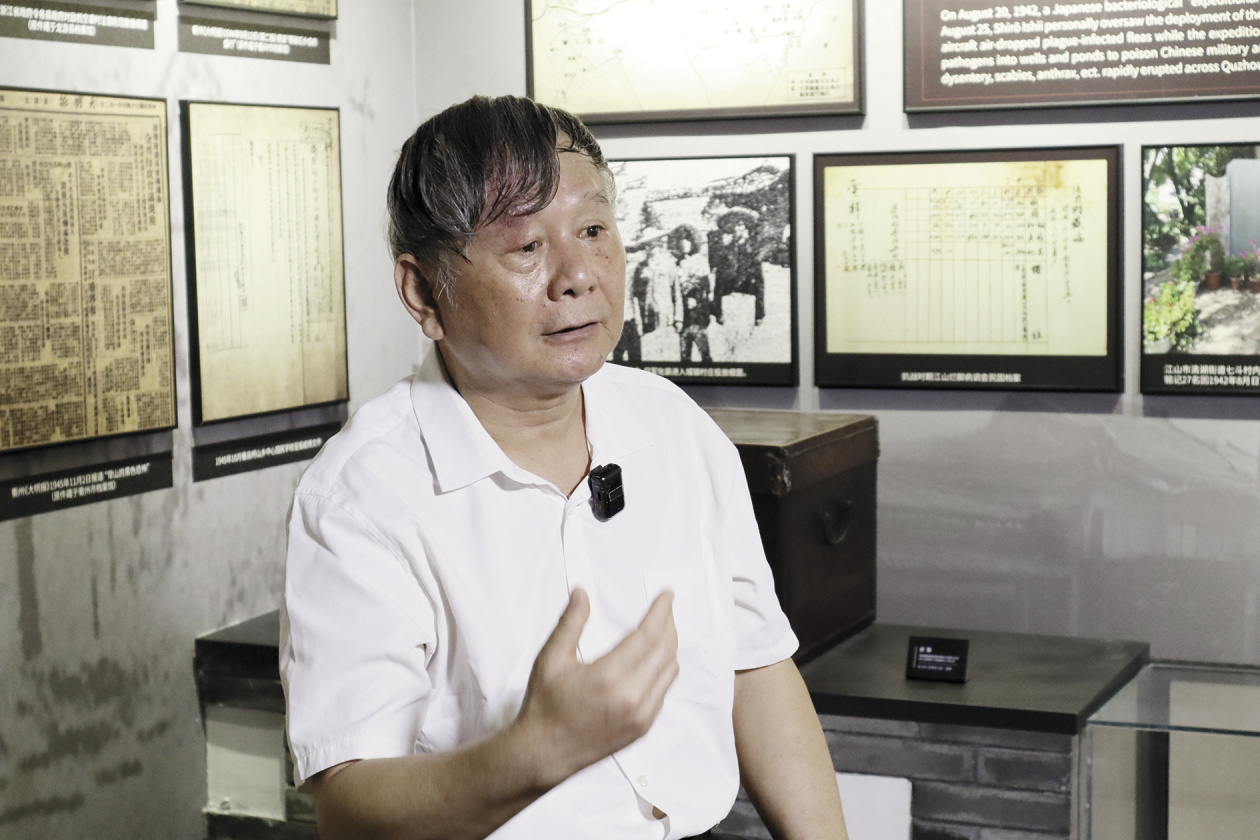
Core Viewpoint - The film "731," which focuses on the atrocities committed by the Japanese Army's Unit 731 during the Second Sino-Japanese War, was released globally on September 18, coinciding with the anniversary of the Mukden Incident, marking the beginning of the Chinese resistance against Japanese aggression and the global anti-fascist war [1]. Group 1: Historical Context - The Japanese Army conducted multiple large-scale biological warfare attacks in Quzhou, Zhejiang Province, in 1940, 1942, and 1944, with the first attack occurring on October 4, 1940, when a Japanese aircraft released plague-infested materials over densely populated areas [3][6]. - The 1942 biological warfare campaign involved the distribution of cholera-infected food to vulnerable populations, leading to significant casualties, with over 30,000 people infected and more than 51,000 documented deaths by the end of 1948 [6][10]. Group 2: Medical and Psychological Impact - A medical assistance group was established in 2009 to provide treatment for "decaying foot disease" (anthrax) among survivors, identifying 39 affected individuals and creating personalized treatment plans [10][11]. - The psychological trauma experienced by survivors is profound, with many unaware that their condition was caused by wartime actions, leading to feelings of shame and isolation [11]. Group 3: Cultural and Educational Efforts - Local organizations have been actively involved in educating younger generations about this dark chapter in history, emphasizing the importance of remembering the past to prevent future atrocities [7][11]. - The film "731" aims to raise global awareness of the crimes against humanity committed by Unit 731, highlighting the need for historical acknowledgment and justice [16][18]. Group 4: International Relations and Historical Narrative - The director of "731" criticized Japan's narrative of victimhood regarding atomic bombings while neglecting its wartime aggressions, calling for a more honest reckoning with history [18]. - The film serves as a counter-narrative to Japan's attempts to sanitize its wartime actions, aiming to foster a deeper understanding of the consequences of such historical events [18].