信贷质量恶化

Search documents
美国区域性银行信贷危机再起 会重蹈硅谷银行覆辙吗?
Hua Xia Shi Bao· 2025-10-21 01:08
Core Viewpoint - The recent significant stock price declines of Zions Bancorp and Western Alliance Bancorp highlight emerging concerns over credit quality and potential systemic risks in the U.S. regional banking sector due to fraudulent commercial mortgage loans [1][3][5]. Group 1: Bank Performance and Financial Impact - Zions Bancorp reported a full provision for approximately $60 million in unpaid debts related to two commercial and industrial loans, which will impact its Q3 2025 financial statements [2]. - The losses from these loans represent about 3.5% of Zions Bancorp's projected net revenue of $3.1 billion for 2024 [2]. - Both banks have initiated legal actions against borrowers for fraud, indicating a serious breach of trust and potential systemic issues in credit approval processes [3][2]. Group 2: Market Reactions and Comparisons - The stock prices of Zions Bancorp and Western Alliance Bancorp fell by 13% and 11% respectively, marking one of the worst trading days for regional banks since the Silicon Valley Bank collapse in March 2023 [1][5]. - Investors are drawing parallels between the current situation and the 2023 Silicon Valley Bank crisis, which was primarily driven by liquidity issues rather than credit quality [5][6]. Group 3: Risk Factors and Industry Concerns - The fraudulent activities reveal significant weaknesses in the risk management frameworks of regional banks, particularly in their due diligence processes for commercial loans [3][7]. - The current economic environment, characterized by high interest rates and a cooling commercial real estate market, has led to increased default rates on commercial mortgages, putting additional pressure on regional banks [7]. - Regional banks hold approximately 80% of the U.S. commercial mortgage loans, making them particularly vulnerable to credit quality deterioration [6][5].
Tricolor事件恐非孤例 摩根大通CEO警示信贷隐患 强劲营收亦难掩阴影
Xin Lang Cai Jing· 2025-10-14 17:56
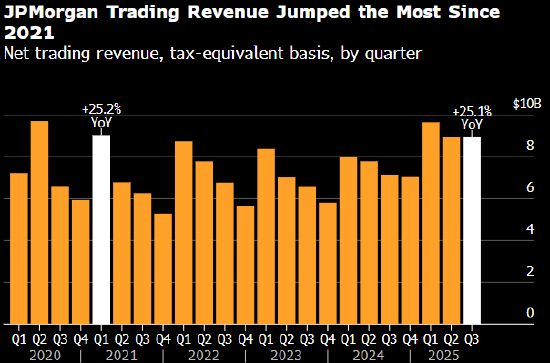
Core Viewpoint - JPMorgan Chase's CEO Jamie Dimon warns of potential deterioration in credit quality, overshadowing strong growth in trading and investment banking revenues [1] Group 1: Economic Outlook - Despite signs of slowdown, particularly in employment growth, the overall U.S. economy remains resilient according to Dimon [1] - Geopolitical complexities, tariff and trade uncertainties, high asset prices, and persistent inflation risks contribute to economic uncertainty [1] Group 2: Credit Quality and Provisions - JPMorgan increased its provisions for potential bad debts by $810 million, exceeding analyst expectations, reflecting a more cautious outlook [1] - Most of the provisions are related to credit card business, attributed to loan growth and updates on certain macroeconomic variables [1] - The focus on loan quality has intensified following two bankruptcy events in the automotive sector, with JPMorgan being one of the banks affected by losses related to Tricolor Holdings [1] Group 3: Financial Performance - JPMorgan's trading and investment banking fees surged in Q3, driven by a rebound in trading and underwriting activities, surpassing analyst expectations [3] - The bank reported a 16% increase in investment banking fees and a 25% rise in market revenue, with the busiest IPO quarter since 2021 contributing to this growth [3][5] - Market revenue reached $8.94 billion, while investment banking fees rose to $2.63 billion, with equity underwriting business seeing a 53% increase [5] Group 4: Revenue and Earnings - Q3 stock trading revenue jumped 33% to $3.33 billion, while fixed income business grew by 21% [6] - Debt underwriting and merger advisory revenues both increased by 9% [6] - Net interest income was reported at $24 billion, slightly below the expected $24.1 billion, with the full-year net interest income forecast raised from approximately $95.5 billion to about $95.8 billion [6]