
信贷危机

Search documents
美银调查:35%投资者担忧企业过度投资创20年新高 四分之一受访者将AI泡沫视为首要尾部风险
Jin Rong Jie· 2026-02-17 14:23
Group 1 - The latest Bank of America fund manager survey indicates that investor concerns about overheating corporate capital expenditures have reached the highest level in 20 years, with 35% of respondents warning about excessive investment, a record high since the survey began [1] - Despite concerns over capital expenditures, investor optimism regarding global corporate earnings has risen to its highest level since August 2021, reflecting a complex sentiment in the market [1] - Investors are actively reducing their exposure to technology stocks, with the net overweight in tech stocks dropping to 5%, a significant decline from 19% a month ago, marking the largest decrease since March 2025 [1] Group 2 - One-quarter of respondents view the artificial intelligence bubble as the primary tail risk, with 30% believing that massive capital expenditures by tech giants in AI could trigger a credit crisis [2] - The most crowded trade for the second consecutive month is long positions in gold, accounting for 50%, while long positions in non-tech U.S. stocks rank second at 20% [2]
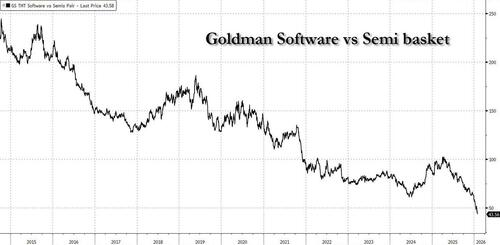
软件股暴跌或成下一轮信贷危机导火索?
Hua Er Jie Jian Wen· 2026-02-04 14:18
Core Insights - Wall Street analysts warn that the substantial software debt held by Business Development Companies (BDCs) could trigger the next credit crisis, with market concerns already surfacing [1] - BDCs, which primarily fund small to mid-sized private enterprises, have approximately 16% of their portfolios invested in software companies, facing significant asset impairment risks amid an unprecedented sell-off in the software sector [1][3] - The software sector has seen a decline in stock prices, with 9 out of the last 12 trading days experiencing drops, leading to a severe deterioration in market sentiment [1][3] Group 1: Market Conditions and Risks - The collapse in the software sector is largely attributed to the disruptive threat posed by artificial intelligence (AI), causing panic among investors who fear AI could be the end of software companies [3] - BDCs, viewed as major lenders in the Software as a Service (SaaS) space, are experiencing significant market pressure, with any minor fluctuations causing substantial impacts [3] - Morgan Stanley's analysis indicates that the BDC industry may need to undergo a stress test similar to that faced by airline leasing companies during the pandemic, highlighting the need for BDCs to demonstrate their risk resilience [3] Group 2: Financial Exposure and Impact - As of Q3 2025, the total investment portfolio of 30 tracked BDCs is approximately $359 billion, with software exposure amounting to about $70 billion, representing 16% of their portfolios [4] - The broader technology exposure among these BDCs totals around $80 billion, indicating a significant reliance on the tech sector [4] - There is a wide variance in risk exposure among different institutions, with some, like Blue Owl Technology Fund, having software exposure as high as 40% [6] Group 3: Stress Testing and Potential Losses - Morgan Stanley conducted stress tests on BDCs' software portfolios, revealing that under a simplified "33% rule" scenario, these BDCs could face approximately $22 billion in losses, reducing net assets by 11% and increasing leverage from 0.86 to about 1.0 [8] - In a more severe "extreme scenario" where 75% of software companies default and recovery rates are only 10%, the industry could incur cumulative net losses nearing $50 billion, diluting book values by 24% [8] Group 4: Specific Loan Concerns - The report highlights specific software loans under pressure, with several loans trading at significant discounts in the secondary market compared to their book values [10] - Cornerstone OnDemand, a widely held risk asset among six BDCs, has seen its loan price drop by about 10 points since November 2025, currently trading at 83, while the average mark price for BDCs remains at 97 [10] - Other notable loans include Finastra, Medallia, and Auctane, which are also experiencing significant price declines, indicating that the pressure on BDC assets may just be beginning [10]

美银全球基金经理抽样大调查:现金持有量低至3.3%,AI与黄金交易最拥挤
Zhi Tong Cai Jing· 2025-12-16 13:20
Core Viewpoint - The recent survey by Bank of America indicates a significant rise in optimism among fund managers, with macroeconomic confidence reaching its highest level since August 2021, while cash holdings have dropped to a record low of 3.3%, highlighting potential risks from AI bubbles and private credit [1] Group 1: Macroeconomic Outlook - 57% of fund managers anticipate a "soft landing" for the global economy, characterized by moderate growth and controlled inflation, while 37% expect continued strong growth, and only 3% are concerned about a "hard landing" [2] - Global growth expectations have risen to a four-year high, with corporate earnings expectations also reaching their peak since August 2021, as 41% of respondents believe that corporate earnings in the Asia-Pacific region will strengthen [2] Group 2: Liquidity Environment - The liquidity environment is assessed as the best since September 2021, with 69% of investors betting on Kevin Hassett to become the next Federal Reserve Chair [3] Group 3: Risks and Crowded Trades - Despite the optimism, 37% of respondents identify potential risks from an "AI bubble" [4] - 40% of respondents see a risk of a credit crisis, with private credit being the largest source of systemic credit events [5] - The most crowded trades include 54% of investors going long on the "Wall Street Seven" and 29% on gold, indicating the most popular investment directions [6] Group 4: Asset Allocation - Fund managers are undergoing aggressive asset reallocation, with cash holdings plummeting to a historical low of 3.3%, approaching a "sell signal" as per Bank of America's cash rule [6] - Net overweights include stocks at 42%, the highest since December 2024, and commodities at 18%, the highest since September 2022 [7] - Net underweights include bonds at 29%, the lowest since October 2022, and significant underweights in cash, consumer staples, and energy stocks [8] Group 5: Sector Preferences - Top three sectors with net overweights are healthcare at 35%, banks at 32%, and technology at 21%, with technology stock allocations reaching their highest since July 2024 [8] - The bottom three sectors with net underweights are energy at 26%, consumer staples at 20%, and consumer discretionary at 16% [8] - Japan remains the most favored market with a net overweight of 41%, while India has a moderate overweight of 10% [8] - Expectations for the semiconductor cycle have rebounded to the highest level since July 2024, with 55% of respondents believing the semiconductor industry will strengthen in the next 12 months [8]


贵金属日评:美元指数走强使贵金属价格承压-20251023
Hong Yuan Qi Huo· 2025-10-23 02:37
Report Industry Investment Rating - No investment rating information provided in the report Core Viewpoints - The strengthening of the US dollar index may put pressure on precious metal prices, but concerns about a weakening US job market, potential future interest rate cuts by the Fed, uncertainty in China-US trade negotiations, geopolitical conflicts in Russia-Ukraine and the Middle East, and the expansion of fiscal deficits in many countries globally, along with continuous gold purchases by central banks, support precious metal prices in the medium to long term [1] Summary by Relevant Catalogs Precious Metal Market Data - **Shanghai Gold**: The closing price was 948.84 yuan/g, down 38.05 yuan from the previous day and 18.45 yuan from the previous week; trading volume was 87,610, with a position of 254,754, down 186 from the previous day and up 5,052 from the previous week [1] - **Shanghai Silver**: The closing price was 11,381 yuan/10g, down 378 yuan from the previous day and 600 yuan from the previous week; trading volume was 2,347,356, with a position of -182,550 [1] - **COMEX Gold Futures**: The closing price was 4,116.60 US dollars/ounce, down 21.90 US dollars from the previous day and 43.00 US dollars from the previous week; trading volume was 396,022, with a position of 357,370, down 4,708 from the previous day and 16,561 from the previous week [1] - **COMEX Silver Futures**: The closing price was 48.16 US dollars/ounce, down 2.17 US dollars from the previous day; trading volume was -66,532, with a position of 122,583, down 3,620 from the previous day and 7,608 from the previous week [1] Important Information - The secondary lending market is in turmoil, and PrimaLend has filed for bankruptcy. The Fed is considering reducing bank capital requirements from 19% to a minimum of 3% [1] - The US government shutdown has entered its 22nd day, the second-longest on record. Unemployment may rise temporarily. Trump has cancelled his meeting with Putin in Budapest [1] - The US has lifted key restrictions on Ukraine's use of long-range missiles and imposed sanctions on two major Russian oil companies [1] Trading Strategy - Temporarily wait and see. For London gold, focus on support levels around 3,900 - 4,100 and resistance levels around 4,383 - 4,778; for Shanghai gold, support levels around 890 - 930 and resistance levels around 1,000 - 1,100; for London silver, support levels around 42 - 48 and resistance levels around 57 - 68; for Shanghai silver, support levels around 9,800 - 10,800 and resistance levels around 13,000 - 14,800 [1]
贵金属周报:美国信贷危机缓解和政府关门结束预期或使贵金属价格承压-20251021
Hong Yuan Qi Huo· 2025-10-21 08:24
1. Report Industry Investment Rating - Not provided in the given content 2. Core Viewpoints of the Report - The relief of the US credit crisis and the expectation of the end of the government shutdown may put pressure on precious metal prices. However, factors such as the weakening employment performance in the US leading to an increased expectation of the Fed's interest rate cuts, tight inter - bank liquidity potentially causing the Fed to end balance - sheet reduction by the end of 2025, the proactive fiscal expansion expectations of many global countries, continuous gold purchases by central banks of many countries, and intractable geopolitical risks provide long - term support for precious metal prices [3]. - It is expected that precious metal prices may be adjusted. Investors are advised to wait for price pull - backs before establishing long positions. Specific support and resistance levels are provided for London gold, Shanghai gold, London silver, and Shanghai silver [3]. 3. Summary According to Relevant Catalogs First Part: US Fiscal and Monetary Policy - The US outstanding public debt scale reached $3.80 trillion, an increase of $102.7 billion from the previous week. The net issuance of US federal government treasury bonds in Q3 2025 was $964.5 billion, and the net issuance in Q4 may decline quarter - on - quarter. The CBO's 2025 forecast shows that making the expanded additional tax credits permanent may increase the fiscal deficit by $23.4 - $43.9 billion from 2026 - 2035, and repealing health insurance - related provisions may increase the fiscal deficit by $1.4 - $37.5 billion from 2026 - 2035 [10]. - The Fed's daily overnight reverse repurchase scale was $4.1 billion. The Fed's bank reserve balance decreased from the previous week to $2.99 trillion, the overnight reverse repurchase agreement scale decreased to $347.9 billion, and the US Treasury cash account increased to $852 billion. The US Congress has not passed a new temporary appropriation bill, and the federal government shutdown has entered the fourth week, with 4,108 federal employees laid off [11][13]. - The Fed's rediscount loan to commercial banks decreased to $6.018 billion from the previous week, the seasonal loan increased to $0.49 billion, and the Bank Term Funding Program (BTFP) expired on March 11 and dropped to $0 [14]. - Due to the relief of the US credit crisis, the Fed's Standing Repurchase Facility (SRF) suspended operations on October 17, after having a scale of $15.1 billion on October 15 and 16 [15]. - The medium - and long - term inflation expectations implied by US Treasury bonds decreased, but the one - year and five - year inflation expectations of consumers in September were 4.8% and 3.9% respectively, remaining flat or higher than the previous values. The US Bureau of Labor Statistics will release the September consumer - end inflation CPI data on October 24 [16][17]. - Concerns about the weakening of the US employment market and the Fed's expected interest rate cuts and end of balance - sheet reduction led to a decline in the yields of short -, medium -, and long - term US Treasury bonds [19]. - The difference between long - and medium - term US Treasury bond yields was positive, but the difference between long - and short - to medium - term Treasury bond yields narrowed due to expectations of Fed interest rate cuts [22][23]. - The US Office of Financial Research (OFR) Financial Stress Index increased from the previous week to - 1.8610, mainly due to the Fed's continuous balance - sheet reduction and the US Treasury's reconstruction of the cash account, which tightened inter - bank market liquidity [24]. Second Part: US Economic and Employment Performance - The weekly rate of loans and leases of US commercial banks decreased quarter - on - quarter. The weekly rate of all commercial bank loans and leases was 0.01%, with different changes in various types of loans such as business and industrial loans, residential real estate loans, etc. [29][31]. - The weekly annual rate of US Redbook commercial retail sales increased to 5.9% from the previous week, indicating stable consumer spending [34]. - The US MBA Mortgage Application Activity Index decreased to 317.2 from the previous week. The 15 - year and 30 - year fixed mortgage rates decreased to 5.52% and 6.27% respectively. The total sales volume of new and existing homes in August increased to 4.8 million units [37]. - As of September 25, the number of initial jobless claims in the US was 218,000, lower than expected and the previous value, while the number of continued jobless claims was 1.926 million, lower than expected but higher than the previous value. The ADP non - farm private employment in September was - 32,000, lower than expected and the previous value, indicating concerns about the weakening of the US employment market [40]. - The differences in medium - and long - term Treasury bond yields between the US and Germany and Japan decreased due to factors such as the weakening of the US employment market and different monetary policy expectations of central banks in different countries [41][43]. - The euro - to - dollar exchange rate began to rise, and the dollar - to - RMB exchange rate began to weaken due to factors such as the weakening of the US employment market and different economic and political situations in different countries [44]. - The volatility of the US S&P 500 index decreased, while the volatility of the gold ETF increased [46]. Third Part: Gold - Silver Spread and Inventory Situation - As of September 23, the ratio of non - commercial long - to - short positions in COMEX gold futures decreased quarter - on - quarter, and the SPDR Gold ETF holdings increased from the previous week [55]. - The total inventory of gold in COMEX and the Shanghai Futures Exchange decreased from the previous week, with the COMEX gold futures inventory decreasing and the Shanghai Futures Exchange gold futures inventory increasing [59][60]. - The differences between domestic and foreign gold futures and spot prices were at relatively low levels. Investors are advised to pay attention to short - term, light - position, and low - entry arbitrage opportunities for the differences between domestic and foreign gold futures or spot prices [64]. - The London - COMEX gold basis was negative and at a relatively low level, while the basis between the Shanghai Gold Exchange and the Shanghai Futures Exchange was positive and at a relatively high level. Investors are advised to pay attention to short - term, light - position, and high - exit arbitrage opportunities for the Shanghai gold basis [66]. - The differences between near - and far - month contracts of COMEX and Shanghai gold futures were negative and basically within a reasonable range. Investors are advised to take profit on last week's long positions in the Shanghai gold monthly spread at high prices [69]. - The 1 - month London silver lease rate began to decline, and the supply shortage in the London silver market may be alleviated [71][73]. - As of September 23, the ratio of non - commercial long - to - short positions in COMEX silver futures increased quarter - on - quarter, and the iShare Silver ETF holdings increased from the previous week [75]. - The total inventory of silver in COMEX, the Shanghai Futures Exchange, and the Shanghai Gold Exchange decreased from the previous week [77][79]. - The differences between domestic and foreign silver futures and spot prices were at relatively low levels. Investors are advised to pay attention to short - term, light - position, and low - entry arbitrage opportunities for the differences between domestic and foreign silver futures or spot prices [82]. - The overseas and Shanghai silver bases were positive and at relatively high levels. Investors are advised to pay attention to short - term, light - position, and high - exit arbitrage opportunities for the Shanghai silver basis [83]. - The differences between near - and far - month contracts of COMEX and Shanghai silver futures were negative and basically within a reasonable range. Investors are advised to temporarily wait and see for arbitrage opportunities in the Shanghai silver near - and far - month contract spread [85]. - The "gold - silver ratio" in London, the US, and Shanghai was higher than the 25% and 50% quantiles of the past five years respectively. Investors are advised to hold last week's long positions in the "gold - silver ratio" cautiously [87]. - The "gold - oil ratio" in London, the US, and Shanghai was much higher than the 90% quantile of the past five years. Due to the expected increase in oil production by OPEC +, investors are advised to hold last week's long positions in the "gold - oil ratio" cautiously. The "gold - copper ratio" in London, the US, and Shanghai was also much higher than the 90% quantile of the past five years. Due to the uncertainty of Sino - US tariffs, investors are advised to hold last week's long positions in the "gold - copper ratio" cautiously [89].
贵金属日评:中美贸易谈判的不确定性支撑贵金属价格-20251021
Hong Yuan Qi Huo· 2025-10-21 01:52
Group 1: Report Industry Investment Rating - No information provided about the report industry investment rating [1] Group 2: Core Viewpoint of the Report - Uncertainties in China-US trade negotiations support precious metal prices. Concerns about the weakening US job market increase the expectation of future interest rate cuts by the Fed and a possible halt to balance - sheet reduction. Geopolitical conflicts in regions like Russia - Ukraine and the Middle East, expansion expectations of fiscal deficits in many countries, and continuous gold purchases by central banks globally support precious metal prices in the medium - to - long - term, but potential negative factors such as the alleviation of the US credit crisis and the end of the federal government shutdown should be watched [1] Group 3: Summary by Relevant Catalogs Precious Metal Market Data - **Gold**: In the Shanghai market, the closing price of Shanghai Gold was 973.70 yuan/gram, with a change of - 22.20 compared to the previous day. The trading volume of spot沪金T+D was 71850.00, and the position was 258232.00. In the international market, the closing price of COMEX gold futures active contract was 4267.90 dollars/ounce, and the inventory was 39107098.30 troy ounces. The holding amount of SPDR gold ETF was 41.50 tons [1] - **Silver**: In the Shanghai market, the closing price of Shanghai Silver was 11779.00 yuan/ten grams, and the trading volume of spot沪银T+D was 1249250.00. In the international market, the closing price of COMEX silver futures active contract was 47.52 dollars/ounce, and the inventory was 506467618.32 troy ounces. The holding amount of iShare silver ETF was 487.19 tons [1] Important Information - The US listed rare earths, fentanyl, and soybeans as the three major issues in China - US economic and trade consultations. The White House economic advisor said the US government shutdown might end this week. Japan's Liberal Democratic Party and the Japan Innovation Party signed a coalition - governing document, and Takamachi Sanae is likely to become the Japanese prime minister. Vietnam's real estate market has a "trillions - level" problem [1] Trading Strategy - It is advisable to lay out long positions after price corrections. For London gold, pay attention to the support level around 3900 - 4100 and the resistance level around 4383 - 4778. For Shanghai gold, focus on the support level around 890 - 930 and the resistance level around 1000 - 1100. For London silver, watch the support level around 42 - 48 and the resistance level around 57 - 68. For Shanghai silver, pay attention to the support level around 9800 - 10800 and the resistance level around 13000 - 14800 [1]
美国区域性银行信贷危机再起 会重蹈硅谷银行覆辙吗?
Hua Xia Shi Bao· 2025-10-21 01:08
Core Viewpoint - The recent significant stock price declines of Zions Bancorp and Western Alliance Bancorp highlight emerging concerns over credit quality and potential systemic risks in the U.S. regional banking sector due to fraudulent commercial mortgage loans [1][3][5]. Group 1: Bank Performance and Financial Impact - Zions Bancorp reported a full provision for approximately $60 million in unpaid debts related to two commercial and industrial loans, which will impact its Q3 2025 financial statements [2]. - The losses from these loans represent about 3.5% of Zions Bancorp's projected net revenue of $3.1 billion for 2024 [2]. - Both banks have initiated legal actions against borrowers for fraud, indicating a serious breach of trust and potential systemic issues in credit approval processes [3][2]. Group 2: Market Reactions and Comparisons - The stock prices of Zions Bancorp and Western Alliance Bancorp fell by 13% and 11% respectively, marking one of the worst trading days for regional banks since the Silicon Valley Bank collapse in March 2023 [1][5]. - Investors are drawing parallels between the current situation and the 2023 Silicon Valley Bank crisis, which was primarily driven by liquidity issues rather than credit quality [5][6]. Group 3: Risk Factors and Industry Concerns - The fraudulent activities reveal significant weaknesses in the risk management frameworks of regional banks, particularly in their due diligence processes for commercial loans [3][7]. - The current economic environment, characterized by high interest rates and a cooling commercial real estate market, has led to increased default rates on commercial mortgages, putting additional pressure on regional banks [7]. - Regional banks hold approximately 80% of the U.S. commercial mortgage loans, making them particularly vulnerable to credit quality deterioration [6][5].
天风·固收 | 美国信贷市场的“裂痕”
Sou Hu Cai Jing· 2025-10-20 23:57
Group 1 - The risk of a systemic crisis is still controllable, and the probability of a repeat of the "subprime mortgage crisis" is low. Large banks and the core financial system remain stable [1][3] - Recent financial "blow-up" events in the U.S. include the bankruptcy of Tricolor on September 10, FirstBrands on September 28, and significant credit fraud and bad debt issues at Zions Bancorp and Western Alliance Bancorp on October 16 [1][2] - The S&P regional bank index fell by 6.3% on October 16, indicating that risks are concentrated in regional banks, while large banks and other sectors were less affected [1] Group 2 - The current private credit risks in the U.S. differ fundamentally from those during the Silicon Valley Bank crisis, with the latter being driven by interest rate hikes leading to asset-liability mismatches and liquidity crises [2] - The current financial risk events are characterized by economic slowdown leading to deteriorating credit quality, which exposes issues such as financial fraud and high-leverage financing [2][3] - There is a concern that the "credit blow-up chain" may not be over, with potential for further risk escalation due to the underlying weaknesses in the financial market [3] Group 3 - If risks escalate, asset prices may be impacted, particularly in the banking and financial sectors, with expectations of initial declines followed by potential recoveries in the stock market [5] - U.S. Treasury yields and the dollar are expected to trend downward, especially if the Federal Reserve accelerates rate cuts in response to rising risks [5] - Gold prices are likely to rise due to increased demand for safe-haven assets amid heightened risk sentiment [5]


全球股市暴跌,中美日欧齐跌潮,信贷危机风险骤升
Sou Hu Cai Jing· 2025-10-19 20:45
Market Overview - Global stock markets experienced a significant decline, with major indices in the US, China, Japan, and Europe all falling, indicating a widespread market downturn [1][6] - The Shanghai Composite Index dropped by 1.96%, while the Shenzhen Component and ChiNext Index fell by over 3% [6] Banking Sector Concerns - There are growing concerns about a potential credit crisis following the collapse of regional banks in the US, which has heightened fears among investors [1][5] - Reports suggest that internal bank employees have criticized lax loan approval processes, leading to increased risks of fraud and financial instability [5] Regulatory Environment - The market is facing regulatory scrutiny, with discussions around the "Price Law Amendment Draft" aimed at standardizing market practices, yet the ongoing market chaos raises questions about the effectiveness of these regulations [3][8] - The contradiction between regulatory intentions and market realities is evident, as regulatory bodies attempt to impose order while market manipulation continues [3] Consumer Impact - The potential credit crisis could adversely affect ordinary consumers, leading to difficulties in obtaining loans and higher interest rates, which may dampen consumer confidence and economic activity [6][8] - Public sentiment reflects anxiety about financial stability, with individuals considering the need to save more cash in light of economic uncertainties [6] Investment Strategies - In light of the current market volatility, a cautious approach is advised, emphasizing the importance of maintaining liquidity and avoiding impulsive trading decisions [8] - Investors are encouraged to stay informed about policy changes and the banking sector's risks, as these factors are closely tied to personal financial security [8]

和讯投顾徐梦婧:市场多重积极信号支撑
Sou Hu Cai Jing· 2025-10-19 09:19
Group 1 - Multiple positive signals support the market rebound, with external environment improvements and upcoming domestic policy events providing favorable conditions for recovery [1][2] - The easing of trade tensions, indicated by comments on tariffs, alleviates concerns over US-China trade friction, which had previously suppressed market sentiment [1] - The upcoming important meeting and the drafting of the 15th Five-Year Plan are expected to clarify future industry development directions, potentially stabilizing market expectations for economic growth [1] Group 2 - Technical indicators show a significant low divergence across multiple time frames, suggesting a potential market bottom and increasing the likelihood of a rebound [1] - The market's downward momentum has slowed, with signs of stabilizing investor sentiment and attempts to "bottom fish," particularly in the technology sector [1] - The recommendation for investors is to focus on previously oversold mainstream sectors like technology and new energy, rather than chasing all stocks indiscriminately [2] Group 3 - A combined strategy of index investing and short-term trading for individual stocks is advised, with index ETFs suitable for dollar-cost averaging due to their long-term policy support [2] - Investors should remain cautious of potential "black swan" risks and set stop-loss levels to manage downside exposure effectively [2] - The overall assessment indicates a significant probability of market rebound, particularly in previously oversold sectors, while emphasizing the distinction between a rebound and a trend reversal [2]