债券市场税收制度调整

Search documents
南财快评|债券税收安排调整,促进债市长期健康发展
2 1 Shi Ji Jing Ji Bao Dao· 2025-08-08 15:12
Group 1 - The restoration of VAT on newly issued government bonds, local government bonds, and financial bonds starting from August 8 aims to enhance fiscal sustainability and prevent financial risks while promoting market efficiency and the development of the bond market [1][2]. - This policy adjustment is expected to improve the transparency and compliance of bond issuance and trading, reducing speculative arbitrage and enhancing the risk-return matching in the market [1][2]. - The tax treatment of different bond types will become more consistent, leading to improved pricing efficiency and resource allocation in the bond market, ultimately directing funds towards high-quality development sectors such as technology innovation and green economy [2][3]. Group 2 - The implementation of the VAT policy will adopt a "new and old distinction," allowing existing bonds to continue enjoying the previous tax exemption until maturity, which aims to avoid drastic impacts on the current bond market while gradually moving towards a more transparent and efficient development phase [3]. - The adjustment aligns China's bond market tax arrangements more closely with international practices, enhancing market comparability and institutional transparency, which is crucial for high-level financial opening [2][3]. - Future reforms may include improvements in tax administration details, market expectation guidance, and the development of supporting systems such as credit rating and investor protection, contributing to the sustainable and high-quality development of China's bond market [3].
新发国债等利息恢复征收增值税 国债利率定价基准作用进一步提高
2 1 Shi Ji Jing Ji Bao Dao· 2025-08-04 13:02
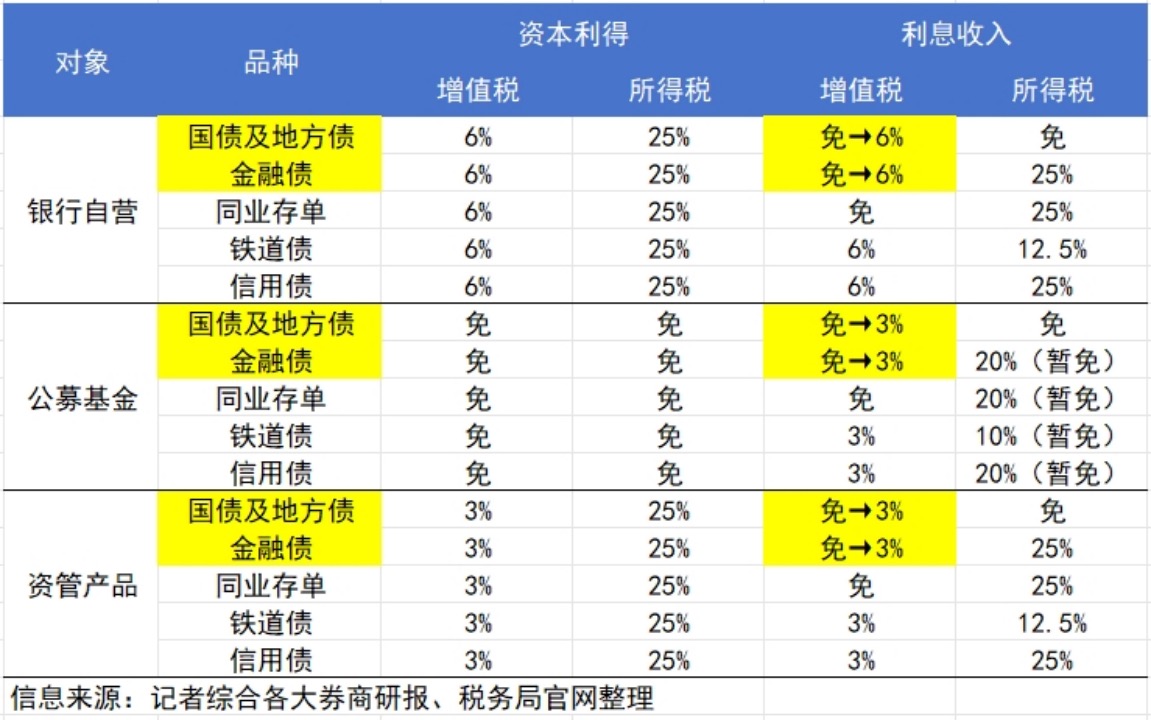
Core Viewpoint - The Ministry of Finance and the State Taxation Administration announced that starting from August 8, 2025, interest income from newly issued government bonds, local government bonds, and financial bonds will be subject to value-added tax (VAT) [1] Group 1: Policy Changes - The policy adjustment will adopt a "new and old distinction" approach, where interest income from bonds issued before August 8, 2025, will continue to be exempt from VAT until maturity [1] - The adjustment is aimed at optimizing the tax system in response to the growth of the bond market, which has become the second largest in the world [5][6] Group 2: Impact on Financial Institutions - For newly issued bonds after August 8, 2025, banks' self-operated investments will be subject to a 6% VAT rate, while asset management products will be subject to a 3% VAT rate [1][2] - The new VAT policy may lead banks to increase their outsourcing investments through public funds, as these products will have a lower VAT rate compared to self-operated investments [3][10] Group 3: Market Reactions - The overall impact on the bond market is expected to be limited, as the proportion of new bond issuance relative to the total stock is less than 30% [3][9] - Following the announcement, bond market fluctuations remained within a controllable range, with slight movements in bond futures and yields [4] Group 4: Long-term Implications - The adjustment is seen as a way to prevent excessive accumulation of risks in the bond market and enhance the pricing benchmark role of government bond yields [6][8] - Analysts suggest that the policy may lead to a widening yield spread between new and old bonds, as older bonds retain tax advantages [9]