储能电池市场竞争

Search documents
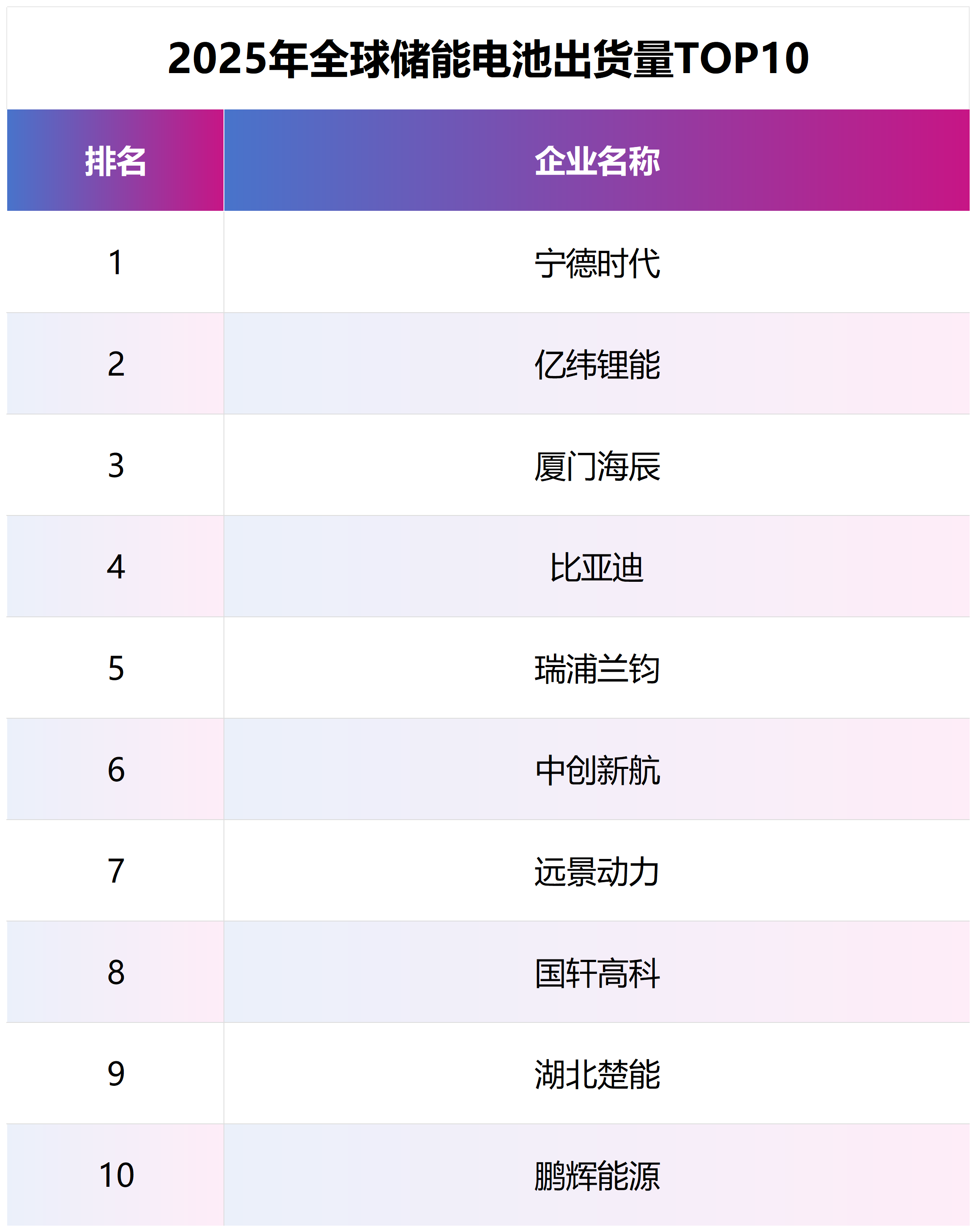
湖北储能新晋、鹏辉能源重返 2025年全球储能电池出货量TOP10出炉
Jing Ji Guan Cha Wang· 2026-02-12 07:55
Core Insights - The global energy storage battery market is experiencing explosive growth, with Chinese companies maintaining a dominant position and significant reshuffling occurring within the industry [1][8] - In 2025, global energy storage battery shipments are projected to reach 651.5 GWh, representing a year-on-year increase of 76.2%, with Chinese companies accounting for 614.7 GWh, or 94.4% of the total [1][9] Market Dynamics - The 2025 top 10 global energy storage battery companies include CATL, EVE Energy, Xiamen Hicharge, BYD, Ruipu Lanjun, Zhongxin Innovation, Envision AESC, Guoxuan High-Tech, Hubei Chuangneng, and Penghui Energy [7][9] - The top four companies (CATL, EVE Energy, Xiamen Hicharge, BYD) have maintained their positions, while there is increased competition among mid-tier companies, leading to notable ranking changes [7][9] New Entrants and Exits - Hubei Chuangneng has entered the top 10 rankings, marking a significant rise in its market presence, while established players Samsung SDI and LGES have exited the top 10 [8][9] - This shift indicates a transition in the competitive landscape from "China vs. foreign" to "internal competition" among Chinese firms [9] Industry Trends - The overall trend for 2025 shows a stable top tier and a more dynamic mid-tier, with the market share of the top ten Chinese energy storage battery companies slightly decreasing from 95% in 2024 to 90% in 2025, reflecting increased competition [9][10] - Technological advancements are accelerating the industrialization of large-capacity storage batteries, contributing to reduced costs and laying the groundwork for scalable development [10] Future Outlook - The global energy storage battery market is expected to enter a phase of high-quality development in 2026, with a shift in competitive logic towards technological innovation, capacity layout, and market expansion capabilities [10] - The reshuffling of the 2025 top 10 list is seen as a natural outcome of the industry's evolution and a reflection of the enhanced competitiveness of Chinese energy storage battery companies [10]





150亿元!30GWh储能电池大单将落地
起点锂电· 2025-11-04 10:26
Core Viewpoint - Korean battery companies are accelerating their entry into the global energy storage battery market through the development of lithium iron phosphate (LFP) battery technology, with Samsung SDI in discussions with Tesla for battery supply agreements [3][4]. Group 1: Market Developments - Samsung SDI is reportedly set to supply approximately 10 GWh of energy storage system batteries annually to Tesla for at least the next three years, totaling around 30 GWh and potentially exceeding 3 trillion KRW (approximately 150 million RMB) in procurement value [4]. - The global energy storage lithium battery shipment reached 315.8 GWh in the first half of the year, marking a 98% year-on-year increase, with leading companies including CATL, EVE Energy, and BYD [4][6]. Group 2: Competitive Landscape - The top ten companies in energy storage battery shipments do not include the three major Korean battery firms: LG Energy Solution, Samsung SDI, and SK On [5]. - The shift towards lithium iron phosphate batteries is driven by safety concerns and higher costs associated with ternary lithium batteries, positioning Korean companies as significant competitors to Chinese firms in the energy storage sector [7]. Group 3: Strategic Initiatives - Korean battery companies are making progress in LFP battery production, with Samsung SDI planning to achieve mass production by 2026 and establishing production capacity in Indiana, USA [8]. - LG Energy Solution has signed a $4.3 billion (approximately 303 million RMB) supply agreement with Tesla for LFP batteries, with production set to begin in Michigan [8]. - SK On is converting part of its Georgia factory's EV battery production lines to LFP energy storage systems, aiming for mass production by the second half of 2026 [9]. Group 4: Market Trends - The demand for electric vehicles in Europe and the US is currently weak, prompting the three major Korean battery companies to focus on energy storage as a primary strategy for business restructuring and improving operational capabilities [10].