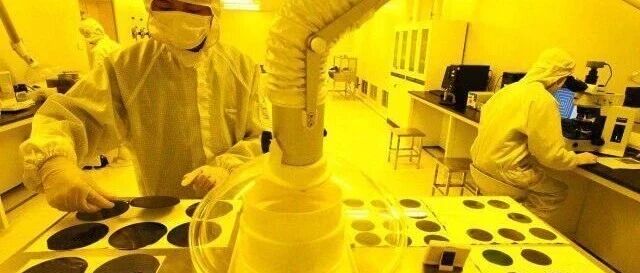
光刻胶研发

Search documents
诚志股份:向光刻胶材料仍处于实验研发阶段
Mei Ri Jing Ji Xin Wen· 2026-01-07 03:51
Core Viewpoint - The company is currently in the experimental research and development stage for its expansion into the photoresist materials sector and is actively following up on customer validation progress [1] Group 1 - The company has received inquiries from investors regarding its future development strategy, specifically about its expansion into the photoresist materials field [1] - As of January 7, the company confirmed its ongoing efforts in the experimental R&D phase [1] - The company is committed to continuously monitoring the progress of customer validation [1]

国风新材(000859.SZ):光敏聚酰亚胺光刻胶产品目前处于研发阶段,未进行生产
Ge Long Hui· 2025-12-11 13:02
Core Viewpoint - Guofeng New Materials (000859.SZ) is currently in the research and development phase for its photosensitive polyimide (PSPI) photoresist products, with production not yet initiated. The timeline for industrialization will depend on R&D progress and market conditions, which remains uncertain [1] Group 1 - The PSPI photoresist products are still under development and have not entered production [1] - The company emphasizes that the advancement towards industrialization will be influenced by various factors, including R&D progress and market conditions [1] - Investors are advised to be aware of the investment risks associated with the uncertainty in the product development timeline [1]

光刻技术与光刻胶材料的进展与未来趋势(附72页报告)
材料汇· 2025-09-25 13:47
Core Viewpoint - The article provides a comprehensive overview of the evolution of lithography technology from the 1950s to the 21st century, focusing on the advancements in extreme ultraviolet lithography (EUVL) and its significance in semiconductor manufacturing [2][6]. Group 1: Introduction to Lithography Technology - Lithography technology is the cornerstone of modern microelectronics, enabling the precise transfer of complex patterns onto substrates, which directly impacts the integration density, computational performance, and manufacturing costs of integrated circuits [7]. - The application scenarios of lithography technology have expanded from traditional fields such as consumer electronics and medical devices to emerging areas like artificial intelligence and quantum computing, which require high-performance chips [8][9]. Group 2: Overview of Lithography Technology - The basic process of lithography includes substrate preparation, photoresist coating, pre-baking, exposure, development, post-baking, etching, and stripping [10][11]. - Key lithography technologies include deep ultraviolet lithography (DUVL), electron beam lithography (EBL), and nanoimprint lithography (NIL), each with unique characteristics and applications [10][11]. Group 3: Photoresist Materials - Photoresists are sensitive materials used in lithography, classified into positive and negative types based on their behavior after development [12][13]. - The core components of photoresists include film-forming resins and photoinitiators, which play crucial roles in the lithography process [12][13]. Group 4: Development Trends and Challenges - The future of photoresist development focuses on high-resolution materials compatible with EUVL, environmentally friendly options, and multifunctional photoresists that integrate various properties [15][16]. - Key challenges in lithography technology include resolution limits, high costs, and environmental impacts, with ongoing research aimed at addressing these issues through innovative solutions [22][23][24]. Group 5: Summary and Outlook - The evolution of lithography technology has progressed from DUVL to EUVL, achieving mass production capabilities for 5nm and below process nodes, while new types of photoresists are being developed to meet advanced manufacturing needs [16][33]. - Future directions include interdisciplinary collaboration, intelligent lithography systems, and the integration of multifunctional materials to adapt to emerging technologies [16][33].