光子神经网络

Search documents
光芯片,一些看法
3 6 Ke· 2026-01-07 03:36
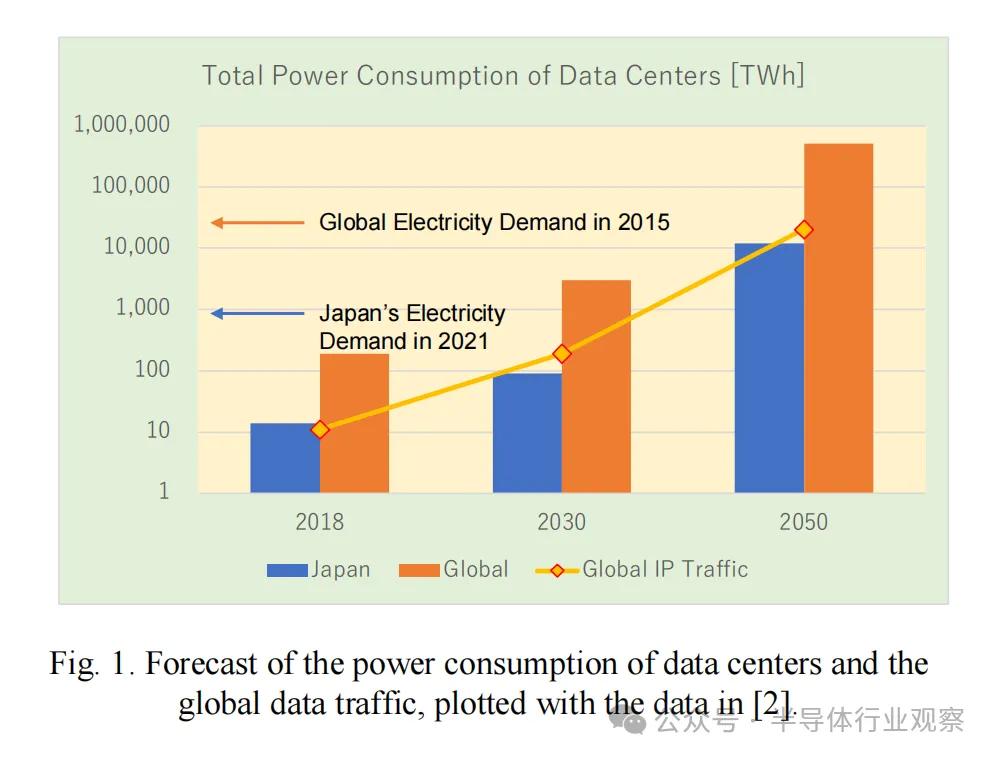
Group 1 - The rapid development of generative artificial intelligence has accelerated the deployment of large-scale AI clusters globally, leading to a significant energy crisis due to increased energy consumption associated with data processing and transmission [1] - The only effective way to address the energy issue is to develop technologies that decouple energy growth from data growth [1] Group 2 - Photonics has immense potential as it allows for scalable functionalities without increasing energy consumption, with silicon photonics having developed into a nearly ideal platform over the past two decades [3] - Silicon photonics can provide efficient high-density interconnects, low-energy optical switching, and optical neural networks that can accelerate AI computations [3] Group 3 - The energy efficiency of optical transceivers has kept pace with Moore's Law, achieving over 5 pJ/bit, while the scalability of switch ASICs has lagged behind [4] - ASIC switch power consumption increases with throughput, exceeding 1000W at 100Tbps, whereas optical switches maintain low and stable power consumption [6] Group 4 - Optical switches cannot directly replace ASIC switches due to their inability to process data packets, requiring a complete system redesign and optimization [8] - Google is currently the only company capable of implementing optical circuit switches (OCS) at scale in its data centers and AI infrastructure [8] Group 5 - The AIST has developed a large-scale silicon photonic switch that offers 32 x 32 non-blocking connections and can be expanded to 131,072 x 131,072 connections, demonstrating a 75% reduction in network power consumption [9] Group 6 - Silicon photonic devices, based on standard CMOS technology, are crucial for photonic neural networks (PNN), which can perform matrix-vector multiplications at high speed without energy consumption [12] - PNNs can alleviate the computational load on high-energy digital processors like GPUs, although they currently lack effective nonlinear activation functions [12] Group 7 - Several AI models based on electro-optic nonlinearity have been proposed, demonstrating effective classification capabilities using silicon photonic chips [13] - The proposed models ensure low power and low latency computation by utilizing passive photonic circuits for signal propagation [13] Group 8 - The architecture of the proposed models allows for associative memory effects, enabling the recall of stored patterns even with partially damaged input [18] - The concept of a streaming PNN is introduced, which optimally operates with both electrical and optical I/O [20] Group 9 - Significant advancements in silicon photonic technology have the potential to enhance the sustainability of AI infrastructure through high-density I/O, bandwidth-independent circuit switching, and optical speed AI accelerators [21] - Integrating photonic functional devices into traditional digital infrastructure presents challenges that require further research into overall system design and implementation [21]