
全球文明对话

Search documents
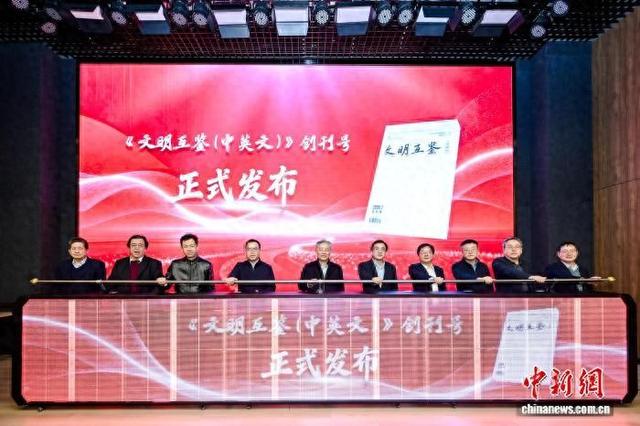
学术期刊《文明互鉴(中英文)》创刊号发布
Xin Lang Cai Jing· 2026-01-05 12:33
Core Viewpoint - The academic journal "Civilization Mutual Learning (Chinese and English)" was officially launched by Southwest University, aiming to explore the historical context and future trends of human civilization exchanges and mutual learning from a cross-cultural and multidisciplinary perspective [1][3]. Group 1: Journal Overview - The journal received approval from the National Press and Publication Administration in July 2025 and is positioned as a comprehensive social science journal [1]. - It aims to build a high-level, iconic, and international platform for humanistic exchanges, focusing on both theoretical and practical dimensions [1][3]. Group 2: Academic Quality and Collaboration - Southwest University emphasizes maintaining academic integrity and ensuring high-quality submissions to create scholarly works with depth and international perspective [3]. - The journal will serve as an important platform for scholars from China and abroad to exchange ideas and reach consensus, promoting the transformation of research outcomes [3]. Group 3: Mission and Content Focus - The journal is designed to be a new platform for global civilization dialogue, showcasing academic achievements and facilitating mutual understanding [3]. - It will include high-quality papers from authoritative experts, covering in-depth interpretations of classical thoughts and exploring practical paths for civilization mutual learning [3][4]. Group 4: Multidisciplinary Approach - The editorial board aims to act as a "bridge" to promote the integration of linguistics, history, philosophy, and art studies, fostering a research paradigm with Chinese characteristics in classical studies [4]. - The goal is to establish an academic high ground that is cross-cultural, multidisciplinary, and international [4].

蒙曼:全球文明对话不强调一家独大 “万紫千红总是春”
Zhong Guo Xin Wen Wang· 2025-10-18 12:08
Core Viewpoint - The conference emphasizes the importance of dialogue among global civilizations, advocating for a diverse and inclusive approach rather than a singular dominant civilization [1] Group 1: Conference Overview - The "Zhuzi Culture and Global Civilization Dialogue Conference" was held on October 18 in Nanping, Fujian Province, co-hosted by the Chinese Academy of Social Sciences, the International Confucian Federation, and the Fujian Provincial Government [1] - Nearly 200 experts and scholars from 51 countries and regions attended the conference [1] Group 2: Key Statements - Professor Meng Man highlighted the idea of "a hundred flowers blooming" in global civilization dialogue, rejecting the notion of a single dominant civilization [1] - The concept of building a community with a shared future for mankind is presented as a strong and justified proposition by China [1]
以讲好中国故事参与全球文明对话
Ren Min Ri Bao· 2025-07-14 22:03
Group 1 - The core viewpoint emphasizes the importance of global dialogue among civilizations, highlighting that the prosperity of civilizations and human progress rely on mutual exchange and learning [1] - The global civilization initiative proposed by Xi Jinping advocates for respect for the diversity of world civilizations and the promotion of shared human values, which has received positive responses from the international community [1][2] - The narrative approach of storytelling is identified as a powerful method for international communication, bridging cultural gaps and enhancing the understanding of Chinese civilization [2][3] Group 2 - The article stresses the need to optimize content production by following narrative principles, focusing on creating vivid and relatable stories that connect China's historical and modern elements [3][4] - It highlights the importance of equality and respect in promoting the exchange and integration of different civilizations, moving from a unilateral narrative to a more inclusive dialogue [4][5] - The narrative of shared historical figures and cultural symbols is presented as a means to foster emotional connections and consensus among nations, particularly in the context of China's relations with Central Asian countries [4][5]