全球生产网络

Search documents
中国价值链系列研究之三:全球生产网络与绕不开的中国
工银国际· 2026-02-02 12:42
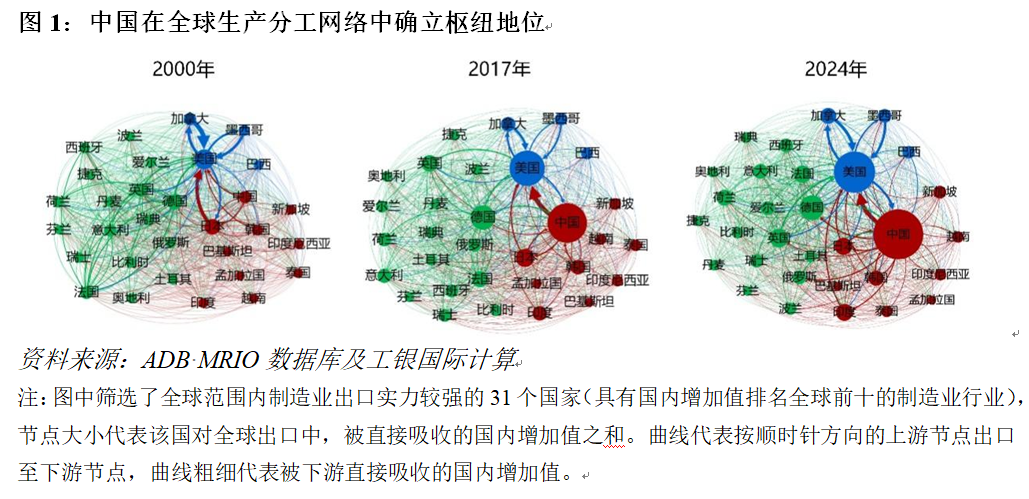
Group 1: China's Role in Global Value Chains - China is transitioning from a trade node in existing divisions to a central force in global production networks, driven by structural dynamics[1] - China's long-term supply capacity has increased its share in global output, while industrial upgrades have reduced reliance on low-end segments[1] - China and the US form a dual core driving global value circulation, with China acting as a critical production input provider[1] Group 2: Trade Centrality and Dependency - China ranks first in global export centrality, indicating its dense network connections in value-added trade[2] - The US maintains the highest import centrality, acting as the "final settler" of value, highlighting the "China produces, US consumes" model[2] - China's import centrality is rising, making it a significant value receiver alongside its role as a major exporter[2] Group 3: Structural Dependence and Industry Insights - China's structural dependence is highest globally, indicating its essential role in trade flows and making it a "super router" in global production networks[8] - In manufacturing, China's export centrality mirrors the US's import centrality, showcasing a near-mirror structural feature across various industries[4] - China leads in structural dependence across most manufacturing sectors, including textiles and electronics, emphasizing its control over midstream supply chains[13] Group 4: Strategic Recommendations - To mitigate systemic risks while consolidating its central position, China should diversify overseas production nodes and enhance cooperation with emerging markets[1] - Strengthening ties with high-value economies through trade agreements can solidify China's structural advantages and reduce vulnerability to external shocks[17]

程实:全球生产网络与绕不开的中国︱实话世经
Di Yi Cai Jing· 2026-02-01 12:19
Core Insights - China has transformed into a central hub for value output, working alongside the US to drive global value circulation [1][2] - This transformation is driven by three structural forces: enhanced supply capacity, industrial upgrading, and deeper cross-border industrial connections [1] - The analysis emphasizes a shift from traditional vertical division of labor to a more collaborative and horizontally restructured value flow [1] Group 1: China's Role in Global Value Chains - China has become the most densely connected export node globally, maintaining the highest export centrality, indicating its significant role in global production networks [3] - The US holds the top position in import centrality, acting as the "final settler" of value, which reflects the "China produces, US consumes" model [3][6] - China's import centrality is also rising, making it an important recipient of global value, second only to the US [3] Group 2: Structural Dependence and Industry Insights - China's structural dependence in the global supply chain is highest across most manufacturing sectors, particularly in textiles, leather, and electrical optical equipment [11][12] - The US relies on external supply in several industries, while China shows a more decentralized and globalized import structure [6] - The distribution of structural dependence indicates that US output often requires passing through China to reach global endpoints [12] Group 3: Centrality Metrics and Economic Relationships - China ranks first in betweenness centrality, indicating its critical role as a "super router" in global trade, making it difficult for other economies to bypass [8] - The combination of structural dependence and core association metrics reveals that both China and the US are versatile central nodes in the global production network [14] - China's deep connections with core economies ensure its stability in technology standards and value distribution, even amidst global supply chain shifts [13] Group 4: Strategic Recommendations - To mitigate systemic risks while maintaining its central position, China should diversify its overseas production nodes and enhance cooperation with emerging economies [15] - Strengthening ties with high-value economies in Europe through advanced trade arrangements can solidify China's structural advantages [15]