全球系统重要性银行(G - SIBs)

Search documents
九卦 | 一步之遥:股份制银行集体逼近全球系统重要性银行门槛
Sou Hu Cai Jing· 2025-12-08 13:40
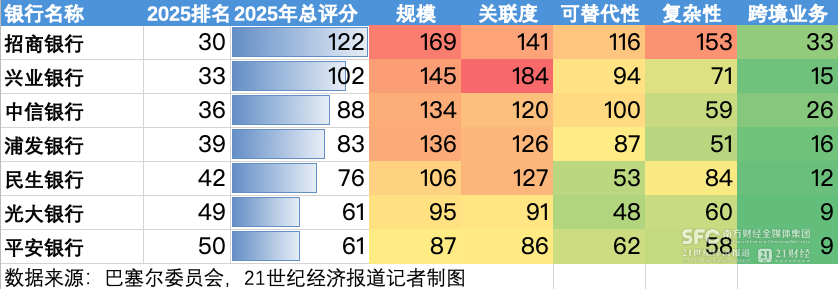
Core Viewpoint - The Financial Stability Board (FSB) has released the 2025 list of Global Systemically Important Banks (G-SIBs), which includes 29 banks globally, with China's five major state-owned banks maintaining their positions. Notably, Industrial and Commercial Bank of China (ICBC) has moved from Group 2 to Group 3 for the first time [1][5][10]. Group 1: G-SIBs List and Rankings - The 2025 G-SIBs list remains consistent with 2024, but there are changes in group classifications. The third group has increased from 2 to 4 banks, including ICBC and others [5][10]. - In the "Bucket 0" category, which does not incur additional capital requirements, China Merchants Bank has improved its ranking from 34th to 30th, closely approaching the G-SIBs threshold [5][6][10]. - Other Chinese banks, such as Industrial Bank and CITIC Bank, are also nearing the G-SIBs threshold, indicating a shift in the global financial stability focus [3][5][9]. Group 2: Factors Influencing Rankings - The rise in rankings for Chinese banks is attributed to improvements in interconnectedness and complexity metrics rather than size, which has traditionally been the focus [3][8]. - For instance, China Merchants Bank's total score increased significantly from 103 to 122, with interconnectedness and complexity contributing 31 and 60 points, respectively [7][8]. Group 3: Implications of G-SIBs Inclusion - Being classified as a G-SIB entails stricter capital regulatory requirements, which could compress the Return on Equity (ROE) for these banks [3][10]. - The additional capital requirements for G-SIBs range from 1% to 3.5% depending on the group, which could impact the capital strategies of banks approaching the threshold [10][11]. Group 4: Future Considerations for Chinese Banks - Chinese banks need to enhance their capital buffers and risk management frameworks to prepare for potential G-SIBs inclusion, as this could lead to increased systemic risk distribution [12][13]. - The banks are encouraged to diversify their capital tools and optimize asset structures to improve capital efficiency [12][13]. Group 5: Cross-Border Business Development - There is a need for Chinese banks to accelerate their cross-border business development to adapt to low-interest-rate environments and reduce reliance on single markets [15][14]. - Despite some progress, the density of overseas branches and subsidiaries remains low, indicating a need for strategic growth in international operations [15][14].






一步之遥:股份制银行集体逼近全球系统重要性银行门槛
2 1 Shi Ji Jing Ji Bao Dao· 2025-12-05 01:08
Core Viewpoint - The Financial Stability Board (FSB) has released the 2025 Global Systemically Important Banks (G-SIBs) list, which includes 29 banks, with five Chinese state-owned banks maintaining their status. Notably, Industrial and Commercial Bank of China (ICBC) has moved from Group 2 to Group 3 for the first time [1][5]. Group 1: G-SIBs List and Rankings - The 2025 G-SIBs list remains consistent with 2024, but there are changes in group classifications. The third group has increased from 2 to 4 banks, including ICBC, Bank of America, HSBC, and Citigroup [5][11]. - In the "Bucket 0" category, which does not require additional capital, China Merchants Bank has improved its ranking from 34th to 30th, closely approaching the G-SIBs threshold [1][6]. - Other Chinese banks, such as Industrial Bank and CITIC Bank, are also nearing the G-SIBs threshold, indicating a shift in global financial stability focus [1][9]. Group 2: Factors Influencing Rankings - The rise in rankings for Chinese banks is attributed to improvements in interconnectedness and complexity metrics rather than size, with China Merchants Bank's score increasing significantly due to these factors [3][8]. - For instance, China Merchants Bank's interconnectedness score rose by 31 points, and complexity increased by 60 points, while size only increased by 10 points [7][8]. Group 3: Implications of G-SIBs Inclusion - Inclusion in the G-SIBs list signifies greater regulatory scrutiny and higher capital requirements, which could compress the return on equity (ROE) for these banks [3][11]. - The additional capital requirements for G-SIBs range from 1% to 3.5% depending on the group, which could impact the capital strategies of the banks [11][12]. Group 4: Future Outlook and Strategic Considerations - There is a potential for China Merchants Bank to be included in the G-SIBs list within the next three years if current trends continue [2][14]. - Banks are advised to enhance their capital buffers and risk management frameworks to prepare for the implications of G-SIBs status, focusing on diversified capital tools and optimizing asset structures [14][15]. - The Basel Committee's adjustments to the G-SIBs recognition framework may introduce further uncertainties for banks nearing the threshold [15][16].
最新全球系统重要性银行名单出炉,中资机构首次进入第三组
第一财经· 2025-11-30 13:06
Core Viewpoint - The 2025 Global Systemically Important Banks (G-SIBs) list has been released, with five Chinese banks maintaining their status. The Industrial and Commercial Bank of China (ICBC) has moved up to the third group, marking a significant achievement for Chinese financial institutions [3][5]. Group 1: G-SIBs List and Rankings - The latest G-SIBs list includes 29 institutions, consistent with 2024, but with changes in scores and groupings for some banks [5]. - ICBC has advanced from the second group to the third group, becoming the first Chinese bank in this category. Other Chinese banks, including Bank of China, Agricultural Bank of China, and China Construction Bank, remain in the second group, while Bank of Communications stays in the first group [5][6]. - The G-SIBs list is divided into five groups, with the highest group (fifth) having no institutions, and the fourth group containing only JPMorgan Chase [5]. Group 2: Scoring Changes and Influencing Factors - This year, the scoring changes for Chinese G-SIBs show two main characteristics: scale is no longer the primary driver for score increases, and exchange rate fluctuations have had a positive impact [6][7]. - For instance, ICBC and Bank of China saw significant score increases of 33 and 32 points, respectively, due to various contributing factors [6]. - Despite these changes, Chinese G-SIBs still outperform global peers in terms of scale and interconnectedness [6]. Group 3: TLAC Compliance and Issuance - Following the successful achievement of the first phase of Total Loss-Absorbing Capacity (TLAC) requirements, the pressure for compliance in the next phase remains a concern [10][11]. - The five major banks have issued over 300 billion yuan in TLAC non-capital bonds this year, with a cumulative issuance of 540 billion yuan [11][12]. - The TLAC non-capital bonds are crucial for meeting international G-SIBs requirements, and the regulatory capital remains the primary component of total loss-absorbing capacity [12]. Group 4: Future Compliance Outlook - Some banks are currently able to meet the next phase of TLAC requirements, while others may need government support to achieve compliance [13]. - The assessment indicates that if risk-weighted asset growth remains stable, all five major banks are expected to meet the upcoming TLAC requirements on schedule [13].