全身控制

Search documents
Figure抛弃10万行C++代码!用1000小时人类数据训练神经网络,实现全身控制基础模型
量子位· 2026-01-28 13:33
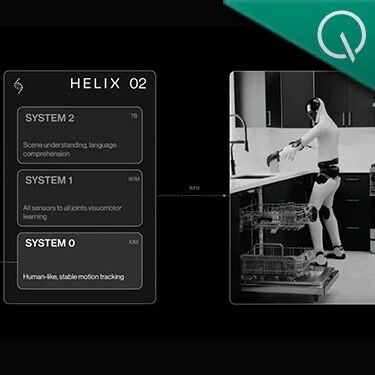
Core Viewpoint - Figure has introduced the Helix 02, a humanoid robot capable of performing complex household tasks autonomously, marking a significant advancement in robotic control systems [1][6]. Group 1: Technological Advancements - The Helix 02 features a unified control system that integrates visual and tactile inputs, allowing for end-to-end motion control without separate upper and lower body management [6][20]. - A new System 0 has been introduced, which is trained on over 1000 hours of human movement data, replacing more than 109,000 lines of manually written code [7][20]. - The robot successfully completed a 4-minute task of unloading a dishwasher, demonstrating the longest and most complex autonomous operation by a humanoid robot to date [5][6]. Group 2: Control Systems - The Helix 02 employs a three-tiered control architecture: - System 2 for high-level semantic reasoning and task decomposition [19][34]. - System 1 for rapid processing of sensory data into actionable movements [25][27]. - System 0 for maintaining balance and coordination at a high execution frequency [19][20]. - This architecture allows for a seamless integration of perception, decision-making, and action, addressing the limitations of traditional robotic control methods [66][67]. Group 3: Sensory Integration - The introduction of palm cameras and tactile sensors enables the robot to perform delicate tasks that require fine motor skills, such as opening a bottle cap or accurately dispensing liquid [30][41][49]. - The tactile sensors can detect forces as small as 3 grams, enhancing the robot's ability to manipulate objects with precision [30][31]. Group 4: Market Implications - The advancements in the Helix 02 position Figure as a leader in the field of humanoid robotics, particularly in the area of loco-manipulation, which combines movement and manipulation in real-time [54][77]. - The shift towards full-body control and continuous interaction with the environment suggests a growing trend in robotics, moving from static tasks to dynamic, real-world applications [77].