全链条问责

Search documents
麒麟信安骗取上交所成功上市:公司、保荐人、律所、会所全部闭眼 中泰证券等赚取7600多万 股市是他们的财神
Xin Lang Cai Jing· 2026-02-22 02:41
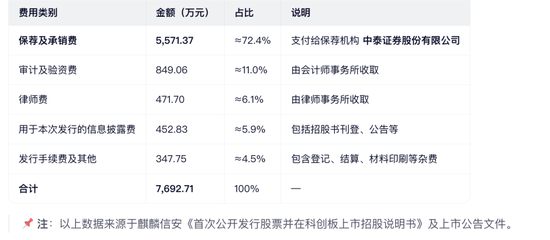
Core Viewpoint - Kirin Xin'an has successfully deceived the Shanghai Stock Exchange (SSE) to go public, with all involved parties, including the company, sponsors, law firms, and accounting firms, turning a blind eye to the misconduct. The intermediary firms, such as Zhongtai Securities, earned over 76 million in fees, while the only penalty imposed was a "regulatory warning" [1][19]. Group 1: Financial Misconduct - Kirin Xin'an's largest client, referred to as A1, accounted for significant sales revenue of 62.50 million, 102.95 million, and 144.17 million, representing 44.23%, 44.52%, and 42.65% of total revenue in respective periods [20][27]. - In May 2022, A1 issued a rectification notice claiming that Kirin Xin'an had inflated the total contract price by 23.70 million, demanding a refund of the excess amount [20][27]. - After receiving the notice, Kirin Xin'an failed to report the issue to the SSE and did not update its IPO application documents [21][27]. Group 2: Intermediary Involvement - The SSE issued an inquiry in August 2022, requiring intermediary institutions to verify the claims made in the rectification notice. Kirin Xin'an did not provide accurate information during this process, and the intermediaries, including Zhongtai Securities and various lawyers and accountants, chose to ignore the discrepancies [21][27]. - The total funds raised by Kirin Xin'an during the IPO amounted to 910.12 million, with a net amount of 833.19 million after deducting issuance costs. The actual fundraising exceeded the planned amount by 173.67 million [22][27]. Group 3: Regulatory Response - The SSE's current penalty for the involved intermediaries is merely a "regulatory warning." The China Securities Regulatory Commission has strengthened accountability mechanisms for IPO processes, establishing a principle of "penetrating supervision and full-chain accountability" [23][27]. - Despite the regulatory framework, the penalties imposed do not seem to deter intermediaries from engaging in similar misconduct, as they continue to profit significantly from IPOs [23][27].


抄私募作业,又曝券商负责人老鼠仓
财联社· 2025-12-05 16:06
Core Viewpoint - The recent regulatory fines highlight significant compliance and internal control issues within the securities industry, particularly in brokerage and investment banking sectors, indicating a trend towards stricter accountability and oversight [1][9]. Brokerage Business Violations - Four fines were issued in the brokerage sector, with notable cases including Liu Li from Southwest Securities for failing to report his actual mobile number and receiving excessive performance bonuses, and another individual penalized a total of 10.03 million yuan for insider trading [2][3]. - The fines reflect a dual accountability approach, targeting both individual misconduct and broader management failures within brokerage firms [2]. Insider Trading Cases - A significant case involved a securities employee, Yu, who utilized undisclosed information to conduct trades, resulting in a total penalty of 10.03 million yuan, including confiscation of illegal gains [3][4]. - The regulatory response to insider trading emphasizes a zero-tolerance policy, particularly against those in managerial positions who exploit their access to confidential information [4]. Investment Banking Violations - The investment banking sector faced scrutiny as two firms, Huatai United and Guoyuan Securities, along with four project leaders, were collectively warned for violations related to the 2025 acquisition project of Fuhuang Steel Structure [6][9]. - This incident illustrates a trend of "multi-party accountability," where not only the firms but also associated legal entities are held responsible for compliance failures [6][7]. Regulatory Signals - The recent fines convey several regulatory signals, including a focus on individual accountability alongside institutional responsibility, a crackdown on conflicts of interest and information misuse, and an emphasis on the due diligence responsibilities of intermediary institutions [9]. - Enhanced regulatory measures, including data monitoring and penetrative oversight, are increasingly effective in uncovering hidden violations within the industry [9].