老鼠仓

Search documents
X @去码头整点薯条
去码头整点薯条· 2026-03-23 07:32
老师们 这个叫XAU的是什么币啊,怎么一直跌啊是不是DEV SELL了,看看筹码结构,抓一下前榜是不是老鼠仓,监控一下持仓大户,谁在出啊🥲🥲🥲 https://t.co/YL3KKMktru ...
对基金经理个人炒股的做法应予以叫停
Sou Hu Cai Jing· 2026-02-12 07:22
Group 1 - The core issue revolves around the conflict of interest arising from fund managers engaging in personal stock trading, which can undermine the interests of fund investors [3][7] - Fund managers are required to declare their personal stock trading activities to their fund management companies, but this does not prohibit them from trading, leading to potential ethical concerns [1][2] - There are regulations in place at some fund companies that prevent fund managers from trading stocks that overlap with their managed funds, aimed at avoiding insider trading and self-dealing [2][5] Group 2 - The practice of personal trading by fund managers should be halted to ensure that their focus remains solely on fund investments, which is their primary responsibility [3][5] - Encouraging fund managers to invest in the funds they manage can align their personal interests with those of the fund investors, promoting a more responsible investment approach [6] - Legislative changes to the Fund Law are suggested to prohibit personal trading by fund managers, reinforcing the need for both self-regulation and legal frameworks to protect investor interests [5][7]


巴菲特说A股尾盘异动,手中持有的股票在尾盘最后30分钟拉升
Sou Hu Cai Jing· 2026-02-02 18:37
Core Viewpoint - The sudden price movements in the last thirty minutes of trading in the A-share market are often not due to spontaneous market emotions but rather deliberate actions by funds, which may include supporting prices, unloading shares, or setting the stage for the next day's trading [1] Group 1: Purpose of Last-Minute Price Movements - One reason for last-minute price increases is to set a higher opening price for the next day, attracting follow-up funds or facilitating unloading [3] - Price stabilization often occurs after repeated declines, where large orders support the price to maintain market confidence, but this is a temporary measure that does not change the underlying fundamentals [3] - Last-minute price drops are frequently orchestrated as a means of unloading or accumulating shares, concentrating transactions in a short time frame to lower prices for insiders [5] Group 2: Techniques and Strategies - The term "mouse warehouse" refers to internal personnel placing orders before the market closes, allowing them to benefit from price manipulations that are not compliant with regulations [7] - Techniques such as "testing the market" involve probing market support and enthusiasm through various methods, including price increases and decreases to gauge investor reactions [9] - Indicators like breakout points and trading volume are useful but should not be overemphasized; understanding the underlying market dynamics is crucial [11][13] Group 3: Investor Behavior and Market Structure - Retail investors often suffer losses due to a lack of discipline and systematic stock selection methods, making them vulnerable to last-minute market maneuvers [13][14] - The market is characterized by structural biases, including information asymmetry and concentrated holdings, which contribute to retail investor losses [14] - Investors should avoid blindly following last-minute price movements and instead focus on volume and market changes the next day [15] Group 4: Recommendations for Investors - Investors are advised to set clear rules for buying and selling, avoiding emotional decisions based on last-minute price changes [15] - Monitoring trading volume and price movements the following day is essential to assess the validity of last-minute price actions [15] - Understanding the structure of shareholdings and capital flows is more reliable than relying on mysterious indicators [15]
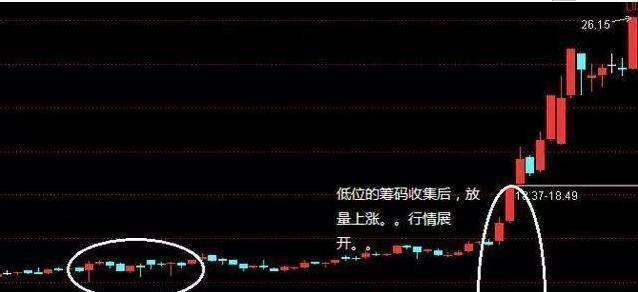
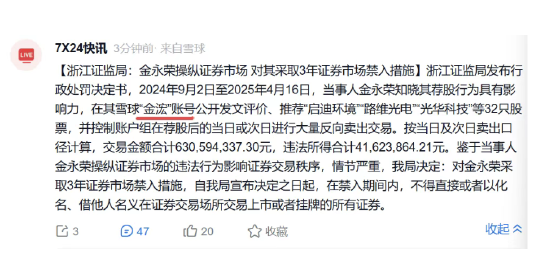
雪球某大V搞老鼠仓让粉丝接盘股票,被重罚
Xin Lang Cai Jing· 2026-01-19 10:04
Group 1 - The article discusses the risks associated with following short-term stock traders who may manipulate their followers into buying stocks after they have already established their positions [3][6] - A specific case is highlighted where a short-term trader executed transactions worth 600 million and made over 40 million in profit, but faced penalties including the confiscation of illegal gains and a three-year market ban [3][6] - The article warns that individuals who frequently post about their successful trades may not have altruistic intentions and could be leading others to take on losses [3][6][7] Group 2 - The article emphasizes that while it is acceptable to have a positive outlook on stocks, promoting them and selling on the same day can be considered unethical and detrimental to other investors [7]
抄私募作业,又曝券商负责人老鼠仓
财联社· 2025-12-05 16:06
Core Viewpoint - The recent regulatory fines highlight significant compliance and internal control issues within the securities industry, particularly in brokerage and investment banking sectors, indicating a trend towards stricter accountability and oversight [1][9]. Brokerage Business Violations - Four fines were issued in the brokerage sector, with notable cases including Liu Li from Southwest Securities for failing to report his actual mobile number and receiving excessive performance bonuses, and another individual penalized a total of 10.03 million yuan for insider trading [2][3]. - The fines reflect a dual accountability approach, targeting both individual misconduct and broader management failures within brokerage firms [2]. Insider Trading Cases - A significant case involved a securities employee, Yu, who utilized undisclosed information to conduct trades, resulting in a total penalty of 10.03 million yuan, including confiscation of illegal gains [3][4]. - The regulatory response to insider trading emphasizes a zero-tolerance policy, particularly against those in managerial positions who exploit their access to confidential information [4]. Investment Banking Violations - The investment banking sector faced scrutiny as two firms, Huatai United and Guoyuan Securities, along with four project leaders, were collectively warned for violations related to the 2025 acquisition project of Fuhuang Steel Structure [6][9]. - This incident illustrates a trend of "multi-party accountability," where not only the firms but also associated legal entities are held responsible for compliance failures [6][7]. Regulatory Signals - The recent fines convey several regulatory signals, including a focus on individual accountability alongside institutional responsibility, a crackdown on conflicts of interest and information misuse, and an emphasis on the due diligence responsibilities of intermediary institutions [9]. - Enhanced regulatory measures, including data monitoring and penetrative oversight, are increasingly effective in uncovering hidden violations within the industry [9].