具身思维链推理(ECoT)

Search documents
速度提升3倍,CoT推理助力VLA!ECoT-Lite:融合具身机器人推理改善策略的几种机制
具身智能之心· 2025-08-27 00:04
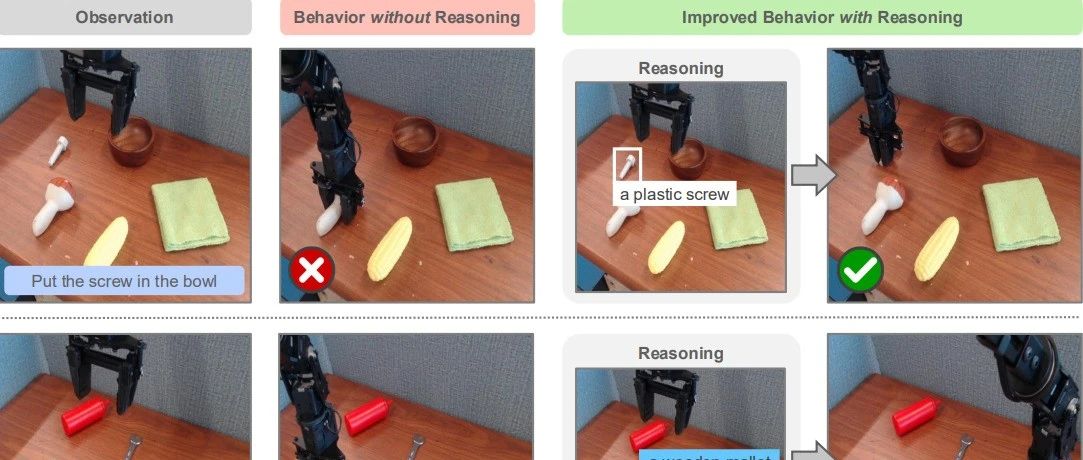
Core Insights - The article discusses the development of efficient training strategies for embodied reasoning in robotics, specifically focusing on the ECoT (Embodied Chain-of-Thought) framework and its lightweight variant, ECoT-Lite, which enhances policy generalization without the need for extensive additional data collection [3][8][30]. Group 1: Motivation and Background - The need for robots to generalize across diverse real-world scenarios has been a long-standing focus in the field of robotics, with various architectures like RT-X and RT-1 showing improved generalization capabilities through extensive training on diverse datasets [2]. - Traditional methods to enhance policy generalization involve collecting more robot datasets, often through tedious human remote control operations [3]. Group 2: ECoT Framework - ECoT improves policy performance by breaking down robot action prediction into a series of reasoning steps, such as identifying object locations and planning sub-tasks, which significantly enhances generalization to new scenes and tasks without requiring additional demonstration data [3][4][5]. - Despite its promise, ECoT incurs significant costs, including the need for detailed reasoning instructions in training data and slower inference speeds due to the extended reasoning steps [3][5]. Group 3: ECoT-Lite Development - ECoT-Lite introduces simpler and lighter alternatives to ECoT, focusing on better representation learning, improved learning processes, and enhanced expressiveness while avoiding the drawbacks of conventional chain-of-thought reasoning [6][8]. - ECoT-Lite achieves state-of-the-art performance on widely used benchmarks like LIBERO, surpassing traditional VLA models by 10-19% while increasing inference speed from 1-1.2Hz to over 3.5Hz [8]. Group 4: Experimental Results - The experiments demonstrate that ECoT-Lite significantly improves performance across various tasks, achieving approximately 90% accuracy on the LIBERO-90 dataset, which is higher than previous state-of-the-art results [54][56]. - Reasoning dropout and reasoning pre-training strategies were found to be particularly effective, with reasoning dropout providing a speed advantage while maintaining high performance [58][92]. Group 5: Implications and Recommendations - The findings suggest that while ECoT is the most performant method, it is also the slowest, making ECoT-Lite variants more practical for real-time applications [90]. - Recommendations include using full ECoT for maximum performance, reasoning dropout for fewer task domains, and reasoning pre-training for more diverse tasks or when unpaired reasoning data is available [92].