
养生风

Search documents
小时候最不爱吃的丑菜,又在江浙沪火起来了
3 6 Ke· 2026-01-26 03:11
Core Insights - The article highlights the rising popularity of "black tatsoi" (黑塌菜), a leafy vegetable from Rugao, Jiangsu, which has become a sought-after item in markets, surpassing traditional prices for vegetables and even meat [5][9] Group 1: Market Dynamics - Black tatsoi is currently priced at 5 yuan per jin, down from 7-8 yuan last year, indicating a shift in market demand and supply dynamics [1] - The vegetable has gained significant attention, with reports of it being sold for 9.39 yuan for 400 grams during festive seasons, showcasing its premium status [4] - The local government and commercial brands have played a crucial role in promoting black tatsoi, leading to its recognition as a "longevity vegetable" [7][9] Group 2: Cultural Significance - Black tatsoi has a long-standing cultural presence in Jiangsu, often associated with traditional winter dishes and health benefits [6][10] - The vegetable's unique taste and texture, especially after frost, have made it a staple in local cuisine, with historical references to its consumption in literature [6][10] - The rise in its popularity is also linked to the health and wellness trend, as it is perceived to contribute to longevity due to its nutrient-rich profile [8][9] Group 3: Agricultural Practices - The cultivation of black tatsoi has expanded significantly, with standardized planting practices being implemented across 20,000 mu, enhancing its marketability [10] - The soil in Rugao is believed to be rich in selenium and minerals, providing an ideal environment for growing black tatsoi, which contributes to its health benefits [8] - The vegetable has been recognized as a national geographical indication product, further solidifying its status in the agricultural sector [10]

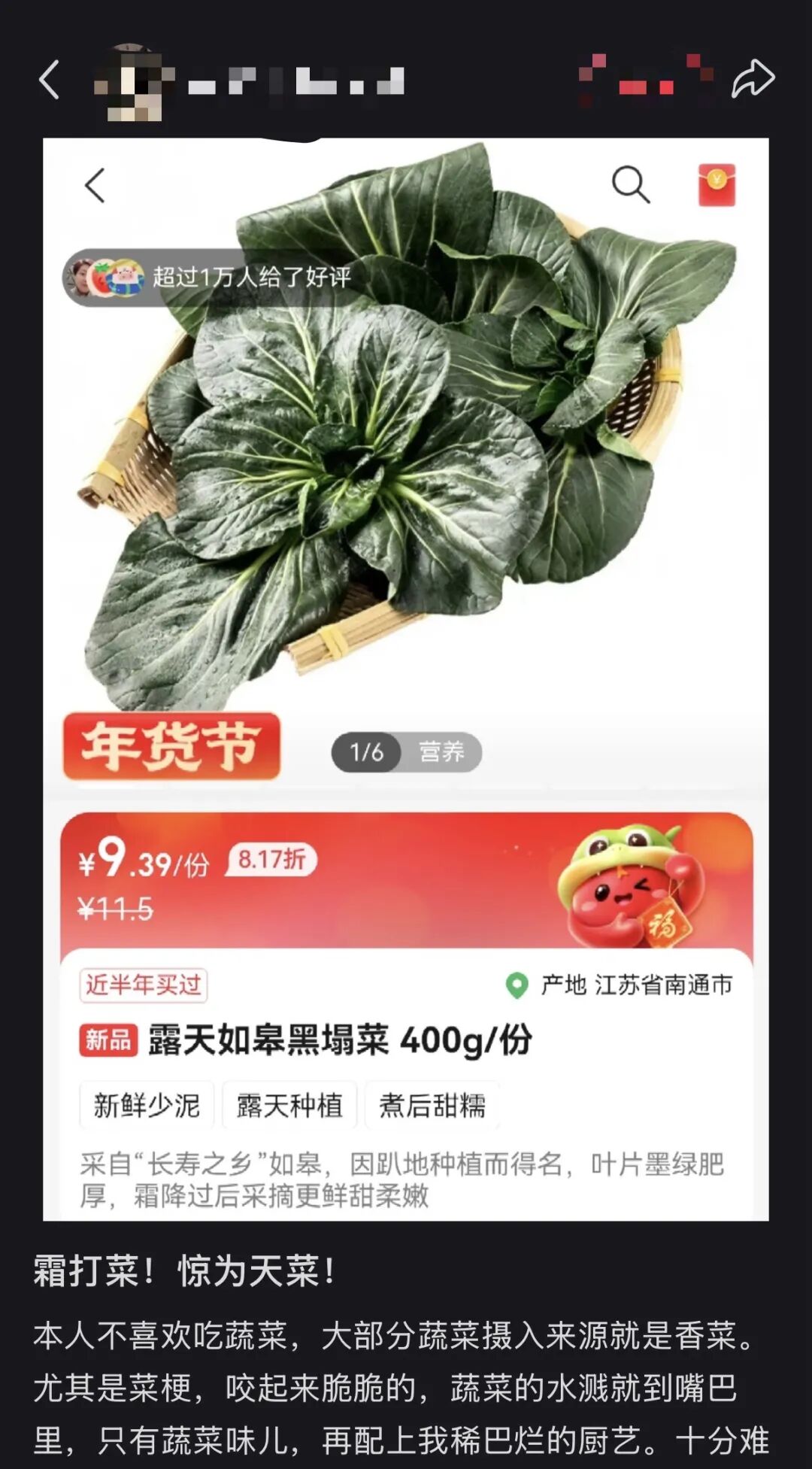
小时候不爱吃的丑菜,又在江浙沪火起来了?
3 6 Ke· 2026-01-07 09:35
Core Viewpoint - The rise in popularity of "Heitaicai" (black tatsoi) from Rugao, Jiangsu, has transformed it into a sought-after vegetable, with prices surpassing those of meat, driven by health trends and effective marketing strategies [4][6][8]. Group 1: Market Dynamics - In early December, local farmers in Rugao sold Heitaicai for 1.5 yuan per jin, with a total sale of 3,000 yuan [1]. - In Shanghai, Heitaicai is currently priced at 5 yuan per jin, down from 7-8 yuan last year, indicating a shift in market dynamics [1][3]. - The price of Heitaicai has reached 9.39 yuan for 400 grams during festive seasons, highlighting its premium status [3]. Group 2: Cultural Significance - Heitaicai is traditionally consumed in Jiangsu and has been associated with local customs and health benefits, often referred to as "longevity vegetable" [6][8]. - The vegetable's unique taste and texture, especially after frost, contribute to its cultural significance in winter meals [5][6]. - The popularity of Heitaicai has led to a resurgence in its consumption, with many people reminiscing about their childhood experiences with the vegetable [10][11]. Group 3: Agricultural Practices - Rugao has standardized the cultivation of Heitaicai, with 20,000 acres dedicated to its production, enhancing its status as a geographical indication product [8]. - The local soil, rich in selenium and minerals, is believed to contribute to the health benefits associated with Heitaicai [7]. Group 4: Marketing and Branding - The rise of Heitaicai can be attributed to effective branding and promotion by local businesses, such as He Fu Ramen, which has introduced the vegetable to a wider audience [8][10]. - Social media has played a significant role in popularizing Heitaicai, with many users sharing their experiences and recipes [6][8].