农改超

Search documents
悬崖上的永辉
虎嗅APP· 2026-02-06 00:08
Core Viewpoint - Yonghui Supermarket is facing significant financial challenges, with a projected net loss of 2.14 billion yuan in 2025, marking a 45.6% increase year-on-year, and has reported losses for five consecutive years. The company attributes these losses to major operational strategy adjustments, including store renovations and closures, which have resulted in direct losses of 1.2 billion yuan [4][8]. Group 1: Company Background and Growth - Yonghui Supermarket was founded in 1995 by brothers Zhang Xuansong and Zhang Xuanning, starting with a micro-profit model. The brand was officially established in 1998 and gained momentum in 2000 by leveraging the "Agricultural Reform Supermarket" policy, leading to rapid growth [6][7]. - By 2010, Yonghui became the first "fresh food stock" listed on the Shanghai Stock Exchange, and by 2020, it achieved a record revenue of 93.2 billion yuan, marking its peak in the industry [7][8]. Group 2: Recent Challenges and Strategic Changes - Since 2021, Yonghui has entered a prolonged period of losses, with figures of 3.944 billion yuan in 2021, 2.763 billion yuan in 2022, and 1.329 billion yuan in 2023. The company has attempted a major transformation called "Fat Reform" to address these issues, which involves comprehensive changes in product structure, shopping experience, and organizational framework [8][9]. - The "Fat Reform" has led to significant financial costs, including a projected loss of 2.14 billion yuan for 2025, with 910 million yuan attributed to asset write-offs and 300 million yuan due to loss of gross margin from store renovations [9][10]. Group 3: Market Dynamics and Competitive Landscape - The retail landscape has shifted dramatically, with the rise of e-commerce and community group buying, which have significantly impacted traditional retail models. The community group buying market in China surpassed 830 billion yuan in 2023, with user numbers increasing from 212 million in 2017 to 845 million [10][11]. - Yonghui's traditional advantages in fresh food are being eroded by new competitors offering lower prices and more efficient supply chains. The company struggles to compete with both discount stores and experiential retailers, leading to a loss of customer traffic [11][13]. Group 4: Future Directions and Strategic Imperatives - Yonghui's transformation should not aim to replicate the success of competitors like Fat Donglai but rather focus on establishing a unique shopping proposition that differentiates it from other channels. This involves creating an emotional connection with consumers and offering distinctive value beyond price [17][18]. - The company must navigate its complex organizational structure and historical burdens to find a new positioning that resonates with consumers in a rapidly evolving market. The challenge lies in identifying what unique reasons consumers will have to choose Yonghui over other retail options [18].


“农改超”后,“卖菜哥”有了舒心摊位
Xin Lang Cai Jing· 2026-01-24 21:42
Core Viewpoint - The transformation of the Daxin Agricultural Market into the new Xinshi Huiju Supermarket has significantly improved the shopping environment and business conditions for vendors, leading to increased customer satisfaction and business success for local merchants [1][2][3] Group 1: Market Transformation - The Daxin Agricultural Market, operational for nearly 20 years, faced issues such as poor layout, outdated facilities, and disorganized management, prompting its inclusion in the Suzhou municipal improvement project for 2024 [2] - The "Agricultural Market Upgrade" plan was implemented, reserving over 20 stalls for original market vendors to ensure their livelihoods during the renovation [2] - The new supermarket features a spacious layout, improved lighting, and a clear division of fresh produce areas, along with modern amenities like central air conditioning [2] Group 2: Vendor Experience - Vendors, including Wang Zhiyong, were temporarily relocated to a nearby tent during renovations but expressed excitement about the improvements upon returning to the new market [2] - The new management includes standardized equipment such as "trustworthy scales" for each stall and mandatory clear pricing for all products, enhancing consumer trust [2] - The upgraded market has attracted more customers, resulting in increased sales for vendors, allowing them to invest in personal projects such as home renovations [3] Group 3: Community Engagement - Wang Zhiyong, known as the "Vegetable Brother," has also taken on a role as a community volunteer, organizing events and providing support for underprivileged families and individuals in the area [3] - The vendor's commitment to community service reflects a growing trend among local businesses to engage in social responsibility initiatives [3]
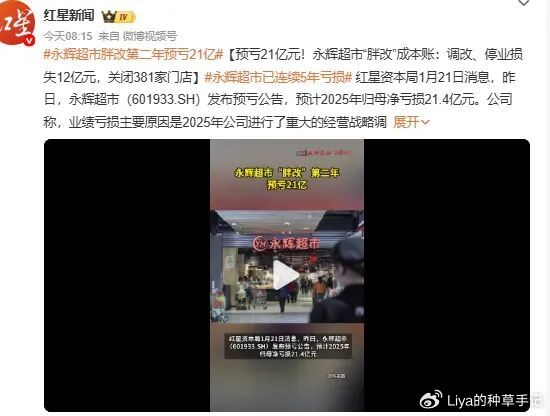
“胖改”第二年巨亏21亿,中国超市一哥天塌了!
Xin Lang Cai Jing· 2026-01-22 20:13
Core Viewpoint - Yonghui Supermarket has announced a projected net loss of 2.14 billion yuan for early 2026, marking its fifth consecutive year of losses, with its market value plummeting from 100 billion yuan to 40 billion yuan [1] Group 1: Company History and Growth - Yonghui Supermarket, founded by the Zhang brothers in the 1990s, initially thrived by capitalizing on the "agricultural reform supermarket" trend, opening its first fresh supermarket in 2000 and disrupting traditional retail with a direct sourcing model [4] - At its peak, Yonghui controlled fresh produce waste rates at around 5%, significantly lower than the industry average of 20%-30%, and established a nationwide supply chain that connected directly with farmers [4] - After going public in 2010, Yonghui expanded rapidly, reaching over 1,000 stores and achieving a revenue peak of 93.2 billion yuan, solidifying its position as the "first stock in fresh produce" [4] Group 2: Challenges and Decline - The turning point for Yonghui occurred in the second half of 2020 when community group buying intensified, leading to a significant market disruption that severely impacted Yonghui's customer base [5] - In 2021, Yonghui reported its first loss since its IPO, with a loss of 3.944 billion yuan, and cumulative losses from 2021 to 2024 reached 9.5 billion yuan, while revenue declined to 67.57 billion yuan by 2024 [5] - The company's previous aggressive expansion strategies resulted in operational inefficiencies, with new business models like Super Species and Yonghui Mini failing to gain traction and further dragging down performance [5] Group 3: Restructuring Efforts - In May 2024, Yonghui initiated a significant restructuring effort termed "Fat Reform," aiming to emulate the successful strategies of competitor Fat Donglai [5][6] - The restructuring involved deep modifications to 315 stores, closing 381 underperforming locations, and implementing changes such as lowering shelf heights and widening aisles [6] - Despite some positive indicators, such as an average customer traffic increase of over 80% in restructured stores, the overall losses remained substantial due to asset write-offs and renovation costs [9][10] Group 4: Fundamental Issues - The core issue for Yonghui lies in its superficial imitation of Fat Donglai's model without understanding the underlying principles, such as effective supply chain management and employee engagement [12] - Unlike Fat Donglai, which focuses on regional supply chain advantages and product quality, Yonghui's nationwide operations lead to higher logistics costs and insufficient supply chain integration [12][13] - The restructuring efforts, while aggressive, may not address the fundamental challenges of product quality and supply chain efficiency, which are critical for long-term success in the retail industry [16]