刚性和改善性住房需求

Search documents
【财经分析】天津优化公积金贷款政策 支持刚性和改善性住房需求
Xin Hua Cai Jing· 2026-01-27 06:35
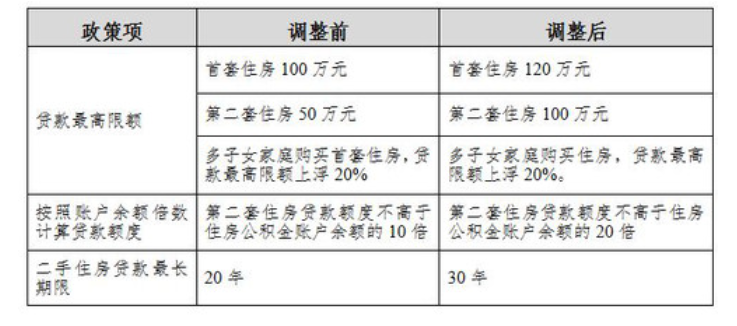
Core Viewpoint - The new housing provident fund loan management measures in Tianjin aim to enhance support for rigid and improvement housing demands, particularly focusing on credit support for upgrading needs, which is expected to stimulate the market for new homes and facilitate the sale of old properties [1][2]. Group 1: Policy Adjustments - The new policy will increase the maximum loan limits for first and second homes from 1 million and 500,000 to 1.2 million and 1 million respectively. For families with two or more children, the limits will rise to 1.44 million and 1.2 million [3][4]. - The calculation of loan amounts for second homes will change, allowing loans to be up to 20 times the balance of the housing provident fund account, up from the previous limit of 10 times [3][4]. - The maximum loan term for second-hand housing will be extended from 20 years to 30 years, reducing the financial burden on borrowers [4][7]. Group 2: Market Impact - The adjustments are expected to alleviate financial pressure on families looking to purchase second homes, thereby providing strong credit support for improvement housing demand [4][5]. - The second-hand housing market has become increasingly significant in Tianjin, with transactions rising steadily. In 2023, the number of second-hand residential transactions reached 148,400, and by 2025, it is projected to remain high at 132,500 [7]. - The new policy aligns with national trends recognizing the growing importance of the second-hand housing market, which is expected to enhance overall market activity and stabilize price expectations [8]. Group 3: Implementation and Efficiency - The Tianjin housing provident fund management center has implemented measures to streamline the loan application process, allowing for rapid processing times, with some transactions completed in as little as two hours [8].

南京推动库存商品房纳入房票超市,开启“全城通兑”
Jing Ji Guan Cha Bao· 2026-01-26 09:09
Core Insights - Nanjing government has implemented policies to accelerate the cultivation of new productive forces and promote high-quality development in the real estate sector, including integrating existing inventory commercial housing into a "housing ticket supermarket" for citywide exchange [1] - The policy aims to meet various housing demands, particularly for families with multiple children, by increasing the monthly limit for housing fund withdrawals for rent by 20% [1][2] - The initiative is expected to convert idle commercial housing into resettlement housing, facilitating inventory digestion and alleviating developers' cash flow issues [1] Group 1 - Nanjing's policy includes the promotion of "electronic housing tickets" and "citywide exchange" mechanisms to enhance the circulation of housing resources [1] - The 2023 national housing fund report indicates that the total amount withdrawn for purchasing, building, and renovating self-occupied housing reached 484.09 billion yuan, accounting for 18.22% of total withdrawals [1] - The cumulative housing fund loans across the country reached 7,806.07 billion yuan in 2023, suggesting potential for cross-regional collaboration to further release housing demand in the Yangtze River Delta [1] Group 2 - The policy adjustments in Nanjing are expected to increase monthly rent payment limits for families, aligning with the national policy direction to support rigid and improved housing needs [2] - The increase in withdrawal limits specifically benefits families with multiple children, easing their financial burden [2] - The allowance for intergenerational withdrawals expands the coverage of housing fund access to more family members [2]
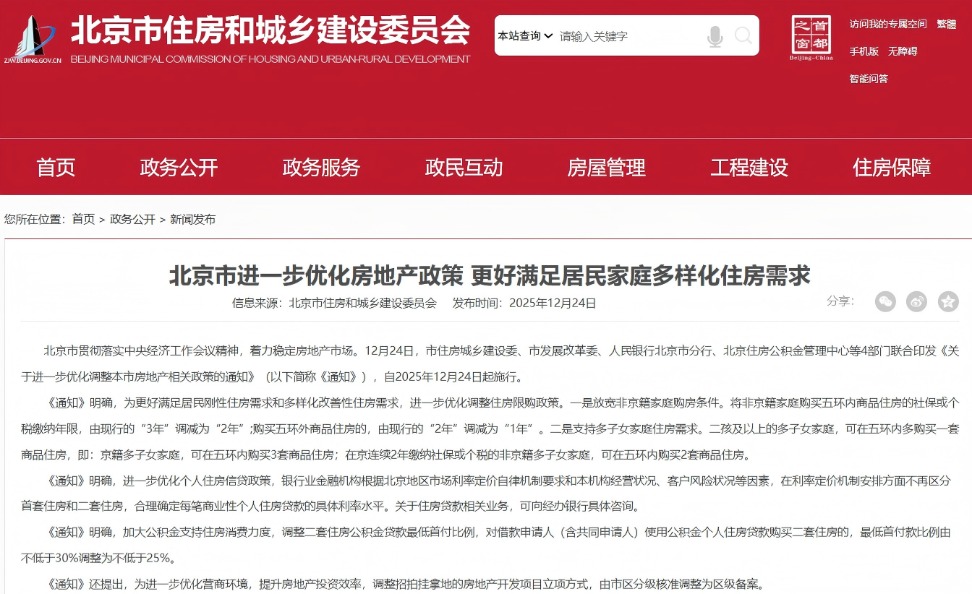
【财经分析】北京房地产新政满足刚性和改善性住房需求 影响或于明年上半年显现
Xin Hua Cai Jing· 2025-12-25 15:29
Core Viewpoint - The recent adjustments to Beijing's real estate policies aim to better meet the housing needs of residents, particularly for first-time buyers and families seeking improved living conditions, with potential impacts expected to manifest in the first half of 2026 [1] Policy Adjustments - The new policy relaxes purchasing conditions for non-Beijing households, reducing the required duration of social security or tax payments from 3 years to 2 years for properties within the Fifth Ring Road, and from 2 years to 1 year for properties outside [4] - Families with two or more children are now allowed to purchase an additional property within the Fifth Ring Road, increasing the total to three for Beijing residents and two for non-residents meeting the new criteria [4] Market Impact - The adjustments are expected to positively influence the market, particularly in the outer areas of the city, aiding in the inventory reduction of new homes [8] - The combination of the new policy and previous adjustments regarding housing loan limits for multi-child families is anticipated to enhance consumer willingness to invest in improved housing [8] Loan Policy Changes - Starting December 24, the distinction between first and second home loan interest rates has been removed, allowing potential interest rate reductions of 20-40 basis points for second home buyers [9] - The minimum down payment for second home purchases using public housing loans has been lowered from 30% to 25%, easing the financial burden on buyers [9] Supply-Side Adjustments - The approval process for real estate development projects has been simplified, shifting from district-level approval to district-level filing, which is expected to enhance investment efficiency in the real estate sector [9][10] - The new policy is projected to alleviate the shortage of quality new housing supply in Beijing, as the streamlined approval process will enable faster project initiation [10] Long-Term Market Outlook - The overall impact of the policy adjustments is expected to be moderate and comprehensive, with effects likely to unfold over the long term rather than creating immediate market spikes [10]