创新未来

Search documents
打醒了美国华盛顿!特朗普即将访华,中方或将拒绝美方的G2提议
Sou Hu Cai Jing· 2026-02-22 09:04
Group 1 - The recent performance of humanoid robots during the Chinese Spring Festival Gala showcased significant advancements in robotics, indicating China's transition from a manufacturing powerhouse to a stronghold in intelligent manufacturing [1][3] - The performance of robots, which included complex movements and recovery from falls, has drawn international attention, with foreign media highlighting the impressive capabilities of Chinese robotics companies [1][3] - The rise of Chinese robotics and AI technology signals a potential shift in global automation standards, with predictions that by 2025, Chinese robots will be capable of performing advanced stunts [1][3] Group 2 - The upcoming visit of Trump to China is seen as a necessity for the U.S. to reassess its trade strategies, particularly in light of the Supreme Court ruling that may require the refund of over $175 billion in tariffs [1][3] - The U.S. is facing the reality that the trade war has not yielded the desired results, as China remains a critical supplier for various industries, including rare earths and pharmaceuticals [3][5] - The technological restrictions imposed by the U.S. have inadvertently accelerated China's advancements in key sectors, such as AI and semiconductor manufacturing, with significant breakthroughs achieved in domestic production capabilities [3][5] Group 3 - The interdependence of the U.S. and Chinese economies suggests that a decoupling would be detrimental to both parties, emphasizing the need for dialogue to resolve trade disputes [5][7] - The focus on innovation in robotics and semiconductor technology indicates that the country is positioning itself to lead in future technological developments, reducing reliance on foreign technologies [7] - The combination of China's technological advancements and the need for the U.S. to engage in constructive dialogue reflects a shift in the dynamics of U.S.-China relations, with implications for global technology trends [7]


这个即将开放的深圳新地标,本身竟是一个巨型科技展品!
Nan Fang Du Shi Bao· 2025-04-29 08:21
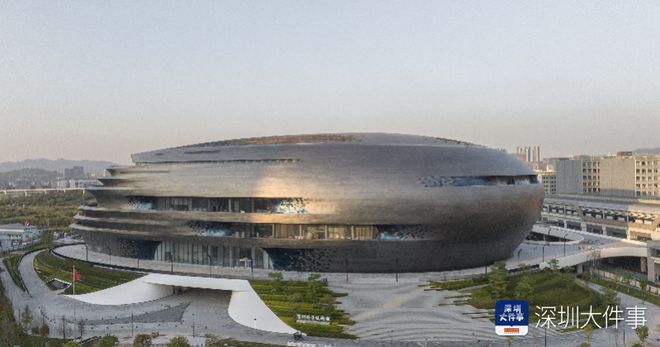
Core Concept - Shenzhen Science and Technology Museum is set to open on May 1, 2025, inviting visitors nationwide to explore a journey of technological discovery [1] Group 1: Museum Overview - The museum is located at No. 8 Guanghui Avenue, Guangming District, Shenzhen, covering a land area of approximately 66,000 square meters and a building area of about 128,300 square meters [3] - The design of the museum is inspired by the vast universe, featuring a streamlined shape that integrates technology and showcases a futuristic feel [3] - The theme of the museum is "Digital Civilization · Innovative Future," focusing on "communication technology" and aims to be the world's first digital civilization science museum [3] Group 2: Exhibition Features - The museum will have permanent exhibition halls on the 2nd to 5th floors, including themes like "Hello, World!", "Beautiful Life", "Smart Industry", and "Exploring the Universe," with a total of 950 exhibits, over 80% of which are innovative and interactive [3] - The museum's architectural design incorporates cutting-edge technology, allowing the exterior to present a "transformative" visual illusion under different weather and lighting conditions [5] - The building's façade consists of 95,888 stainless steel panels in various shapes, achieving a gradient color transition from "Nebula Blue" to "Phantom Gray" [5] Group 3: Innovative Design and Sustainability - The museum breaks traditional static space layouts by innovatively setting up flexible spaces with high ceilings and cantilevers, accommodating large-scale and suspended exhibits [7] - It employs immersive exhibition design, moving away from traditional booth layouts to create unique interactive experience spaces [7] - The museum is built to meet China's three-star green building standards, utilizing eco-friendly materials, energy-saving equipment, and rainwater recycling systems [10] Group 4: Environmental Impact and Future Goals - The museum incorporates "rain gardens + permeable pavements + end rainwater recovery" technology, achieving over 40% utilization of non-municipal water [10] - It focuses on low-carbon initiatives through a combination of passive design, active technology, and intelligent operations, aiming for a full-chain low-carbon approach from design to operation [10] - As a significant cultural facility in Shenzhen, the museum aims to become a globally influential science exploration center, promoting science education in Shenzhen and the Greater Bay Area [11]