创新监管模式

Search documents
杭州空港口岸进出口货运量创历史新高
Mei Ri Shang Bao· 2026-01-27 23:32
Core Insights - In 2025, Hangzhou Airport Port has achieved a significant milestone in international cargo transport, with a total import and export volume of 252,600 tons, marking a year-on-year increase of 10.2% and setting a historical record [1] Group 1: Cargo Volume and Growth - The international cargo volume at Hangzhou Airport has shown a steady "quarterly increase," starting from 53,600 tons in Q1 and surpassing 73,100 tons in Q4, demonstrating strong resilience and vitality in port development [1] - The port's cargo structure is characterized by a "full freighter dominance, supplemented by passenger aircraft belly cargo" model, with cross-border e-commerce leading the way [2] Group 2: Cross-Border E-Commerce Performance - In 2025, the port exported over 209 million cross-border e-commerce items, with a cargo volume of 154,500 tons, accounting for 70% of the total export volume during the same period [2] - The peak periods of "Double 11" and "Black Friday" significantly boosted cross-border e-commerce exports, with December's monthly share reaching 72.7% [2] Group 3: Freight Capacity and Route Expansion - The port has expanded its international cargo routes, adding new freighter routes to Uzbekistan and the Czech Republic, bringing the total to 28 routes with approximately 120 freighter flights weekly [2] - The cargo volume from passenger aircraft belly cargo exceeded 50,000 tons, maintaining an average of over 4,000 tons per month [2] Group 4: Customs Efficiency and Innovations - To ensure efficient customs clearance, innovative regulatory models have been implemented, enhancing the efficiency of cross-border e-commerce customs clearance by 20% [3] - The customs authority has adopted a "7×24 hours" all-weather customs clearance system, significantly improving the speed of fresh product imports [4] Group 5: Fresh Produce Import Growth - In 2025, the port imported 1,492 batches of fresh seafood, totaling 5,606.39 tons, representing a year-on-year increase of 61 times and 81 times, respectively [4] - The import of fruits reached 423.38 tons, with a year-on-year growth of 285.59% [4] Group 6: Process Optimization and Business Environment - The steady increase in cargo volume is attributed to optimized customs processes, including the "direct pickup" model, which has reduced customs clearance time by 3 hours [6][7] - The customs authority has supported businesses through various initiatives, addressing urgent issues faced by enterprises [7]
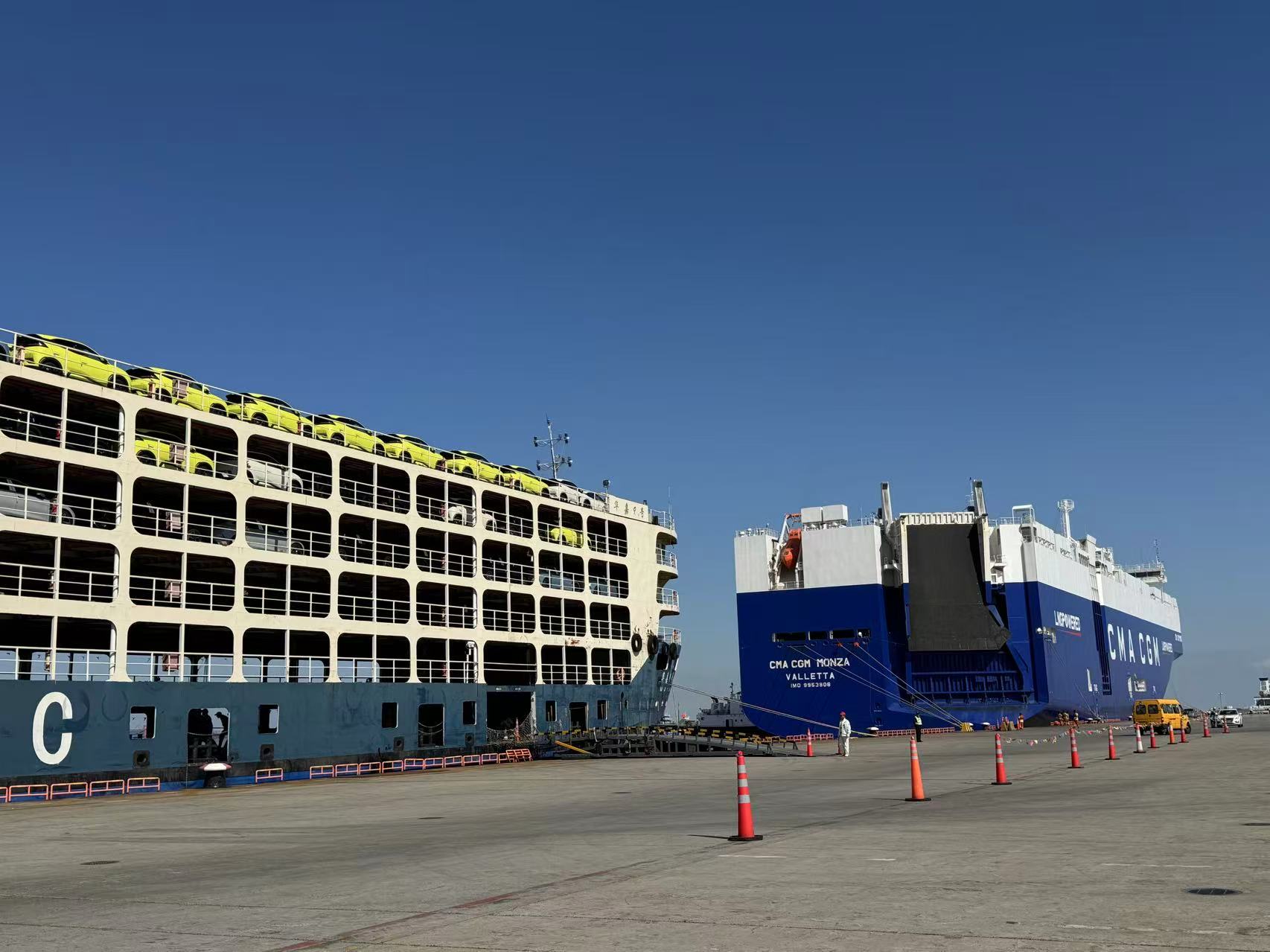
国产汽车加速“出海”,这个码头前8个月出口了近百万辆|活力中国调研行
Di Yi Cai Jing· 2025-09-15 14:01
Core Insights - The article highlights the rapid growth of China's automotive exports, particularly focusing on the role of the Shanghai Waigaoqiao Port and its Haitong Terminal in facilitating this expansion [1][2][3] Group 1: Automotive Export Growth - The Waigaoqiao Port is the largest port in China for automotive imports and exports, with Haitong Terminal handling over 10,000 vehicles daily, peaking at 12,065 vehicles on a single day in June 2023 [5][6] - In the first eight months of 2025, the customs at Waigaoqiao Port reported a total of 962,700 vehicles exported, marking a year-on-year increase of 19.35% [5][12] - The terminal has established 15 international automotive roll-on/roll-off routes, connecting to 289 ports across 131 countries and regions, with a projected throughput of 3.63 million vehicles in 2024, making it the world's largest [5][6] Group 2: Innovations and Efficiency - The Haitong Terminal has implemented an automated storage system with 6,160 vehicle slots, achieving 100% automation in vehicle storage and retrieval, which has significantly improved service quality and reduced storage pressure [6][8] - The customs authority has enhanced the efficiency of vehicle inspections and clearances through a "green channel" system, ensuring zero delays in customs processing [10][11] - The "water-water intermodal" transport model connects inland ports along the Yangtze River with Waigaoqiao Port, optimizing logistics and enhancing the port's strategic position in international shipping [11][12]