
创新药估值体系重构

Search documents
港股IPO持续排队 创新药如何持续跑完“烧钱马拉松”?
Sou Hu Cai Jing· 2025-11-27 23:12
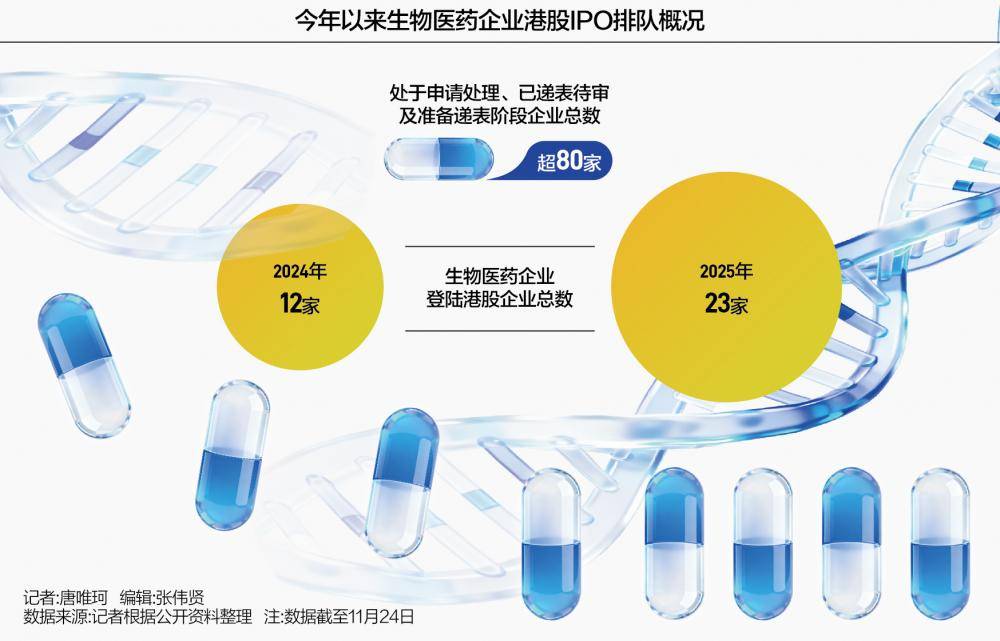
Core Insights - The number of biopharmaceutical companies applying for IPOs in Hong Kong has exceeded 80 this year, marking a historical high [1] - 23 biopharmaceutical companies have successfully listed on the Hong Kong stock market this year, doubling the number from last year [4] - The valuation logic for innovative drugs in Hong Kong is shifting towards a combination of market sentiment and fundamental support, with a focus on the maturity of product pipelines and profitability [2][11] Market Dynamics - The IPO congestion is expected to persist until 2026, with high-quality companies more likely to secure listing opportunities while weaker firms face a cycle of "queue-fail-requeue" [5] - The Hong Kong Stock Exchange's introduction of the "Special Technology Line" has improved the efficiency of the listing process, allowing companies to submit applications confidentially [4] - Recent reforms in the IPO pricing mechanism have reduced the minimum allocation for cornerstone investors, increasing their share and lowering the risk of price breaks [6] Investment Landscape - The financing needs of biopharmaceutical companies drive their willingness to queue for IPOs, as the sector is characterized by high cash burn rates and long development timelines [7] - The differentiation in the IPO market reflects the maturity of product pipelines and the ability to generate revenue, with top-tier companies attracting significant funding while others struggle [7][12] - The rise of the License-out model is bridging the valuation gap between primary and secondary markets, providing stable upfront payments and milestone revenues [14][15] Future Outlook - The sustainability of the innovative drug boom in Hong Kong is supported by the ongoing opportunities for Chinese innovative drugs in international markets, particularly as multinational companies seek to fill gaps due to patent expirations [10] - The expectation is that over 50% of innovative companies will achieve profitability by 2026, driven by improved fundamentals and a shift towards revenue generation [11] - The ongoing transition from generic to innovative drugs in China's pharmaceutical industry is expected to create a strong competitive landscape, with a focus on long-term value creation [16]

港股IPO持续排队,创新药如何持续跑完“烧钱马拉松”?
2 1 Shi Ji Jing Ji Bao Dao· 2025-11-26 12:33
Core Insights - The number of biopharmaceutical companies applying for IPOs in Hong Kong has exceeded 80, marking a historical high, with 23 companies successfully listed this year, doubling last year's figures [1][2] - The valuation logic for innovative drugs in Hong Kong is a combination of market sentiment and fundamentals, with a shift towards more rational valuations following recent corrections [1][3] - The IPO congestion is expected to persist until 2026, with high-quality companies more likely to secure listings while weaker firms may face a cycle of queuing and failure [3][4] Group 1: Market Dynamics - The introduction of the "Specialized Technology Company Route" by the Hong Kong Stock Exchange has improved the efficiency of the IPO process, allowing companies to submit applications confidentially [2] - The tightening of the cornerstone investor lock-up period and the reduction of the minimum allocation for cornerstone investors have intensified the urgency for companies to secure IPO windows [3][5] - The financing needs of innovative drug companies are critical, as drug development is a capital-intensive process requiring significant upfront investment [4] Group 2: Valuation Trends - The post-2021 valuation correction has led to a contraction in the financing scale for many small biotech firms, making the Hong Kong market a vital source of capital [5][6] - There is a clear differentiation in the IPO landscape, with leading companies easily securing large financing while smaller firms struggle [5][6] - The ongoing shift in the valuation system is characterized by a divergence between primary and secondary market valuations, driven by the recognition gap between potential and realized value [7][8] Group 3: Future Outlook - The Chinese innovative drug sector is still in a favorable position for international business development, as many multinational companies face patent cliffs [6][9] - The improvement in the quality of domestic innovative drugs and the mutual recognition of clinical data by regulatory bodies are expected to enhance long-term profitability [6][9] - The trend of license-out agreements is emerging as a key mechanism to bridge valuation gaps, providing companies with stable upfront payments and milestone revenues [8][9]