
创新药投资alpha阶段

Search documents
港股医药重挫!港股通创新药ETF标的指数下探逾6%,诺诚健华跌超10%
Xin Lang Cai Jing· 2025-10-10 02:15
Core Viewpoint - The Hong Kong pharmaceutical sector experienced a significant decline on October 9, with the Hang Seng Biotechnology Index dropping over 5%, influenced by external factors such as U.S. tariff announcements on pharmaceutical products [1][3]. Group 1: Market Performance - The Hang Seng Hong Kong Stock Connect Innovative Drug ETF (520880) saw a decline of over 1% after initially opening up 1.75% [1]. - The Hang Seng Hong Kong Stock Connect Innovative Drug Selective Index fell to a low of 6.14%, with major stocks like Innovent Biologics and China Biologic Products dropping over 10% and 7% respectively [1]. - During the previous week (September 29 - October 3), the index had gained 6.54%, reflecting a positive trend before the recent downturn [1]. Group 2: External Influences - On September 25, U.S. President Trump announced a 100% tariff on any brand or patented pharmaceutical products starting October 1, 2025, unless companies establish manufacturing facilities in the U.S. [1][3]. - This announcement is expected to directly impact Chinese innovative pharmaceutical companies that rely heavily on the U.S. market and do not have manufacturing plants in the U.S. [3]. Group 3: Future Outlook - Analysts from Southwest Securities predict that companies with high dependence on the U.S. market will face short-term pressure, while those utilizing business development (BD) strategies for international expansion will be less affected [3]. - Upcoming industry conferences, such as ESMO (October 17-21) and ASH (December), are anticipated to serve as catalysts for the innovative drug sector [3]. - The fund manager of the Hong Kong Stock Connect Innovative Drug ETF noted that the current market adjustment may provide a buying opportunity for high-quality innovative drug companies [3]. Group 4: ETF Characteristics - The Hong Kong Stock Connect Innovative Drug ETF (520880) is the first ETF tracking the Hang Seng Hong Kong Stock Connect Innovative Drug Selective Index, focusing exclusively on innovative drug research and development companies [4]. - The ETF has shown a year-to-date increase of 119.75%, outperforming other innovative drug indices, and aims to avoid the influence of contract research organizations (CROs) on its performance [5].


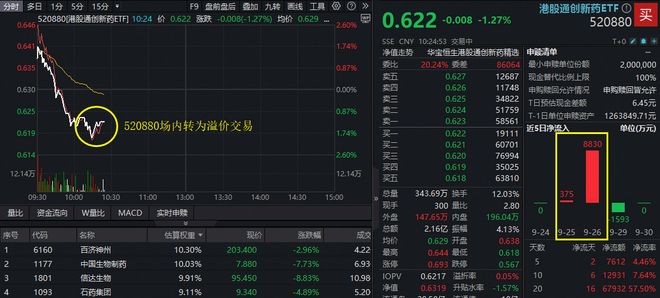
特朗普再挥关税大棒,港股通创新药遭错杀?520880跌2.5%溢价飙升
Xin Lang Cai Jing· 2025-09-26 03:02
Group 1 - The Hong Kong pharmaceutical market experienced a significant decline, with the Hong Kong Stock Connect Innovative Drug ETF (520880) opening down over 2.5% on September 26, 2023, as 35 out of 37 constituent stocks fell, including major players like BeiGene and Innovent Biologics, which dropped over 3% [1][2] - The recent announcement by U.S. President Trump regarding a new round of high tariffs on various imported products, including a 100% tariff on pharmaceutical products, has negatively impacted pharmaceutical stocks in Japan, South Korea, and Australia [3] - Analysts suggest that the impact of the U.S. tariffs on Chinese innovative drug companies is relatively limited, as these companies primarily rely on domestic demand and do not directly export to the U.S. market [4] Group 2 - The Hong Kong Stock Connect Innovative Drug ETF (520880) has seen a surge in net subscriptions, with over 6.4 billion CNY in net inflows across 16 out of the last 20 trading days, indicating strong investor interest despite market volatility [5][6] - The ETF focuses exclusively on innovative drug research and development companies, excluding contract research organizations (CROs), which positions it as a pure play on the innovative drug sector [6][7] - The index tracked by the ETF has shown a year-to-date increase of 119.75% before the recent adjustments, outperforming other innovative drug indices, and is expected to demonstrate stronger performance as the innovative drug market evolves [7][8]
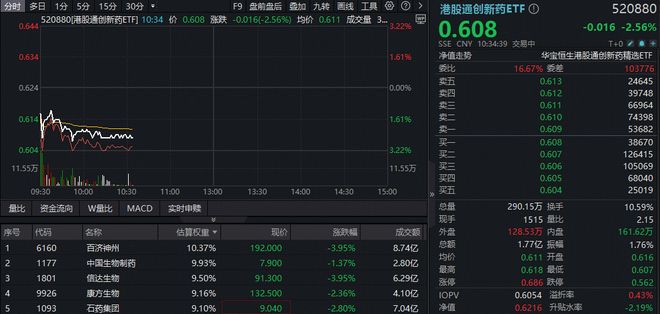
特朗普再挥“关税大棒”,港股通创新药遭错杀?100%创新药研发标的“520880”跌2.5%溢价飙升!
Xin Lang Ji Jin· 2025-09-26 02:46
Group 1 - The Hong Kong stock market for innovative pharmaceuticals opened significantly lower, with the Hong Kong Stock Connect Innovative Drug ETF (520880) dropping over 2.5% [1][3] - Out of 37 constituent stocks, 35 experienced declines, with Kelun-Bio falling over 5%, and major stocks like BeiGene, Innovent Biologics, and 3SBio dropping more than 3% [1][3] - The recent announcement by U.S. President Trump regarding a new round of high tariffs on various imported products, including a 100% tariff on pharmaceutical products, has negatively impacted pharmaceutical stocks in Japan and Australia [3][4] Group 2 - Analysts suggest that the tariff policy will mainly affect multinational pharmaceutical companies reliant on the U.S. market and those exporting brand or patented drugs to the U.S. [4] - Chinese pharmaceutical companies are expected to be less affected, particularly innovative drug research firms, as they primarily utilize IP transfer models and have a low export ratio to the U.S. [4] - The significant adjustment in the Hong Kong Stock Connect innovative drug sector may be more influenced by market sentiment, presenting potential buying opportunities for quality innovative drug companies [4][6] Group 3 - The Hong Kong Stock Connect Innovative Drug ETF (520880) has seen a strong inflow of funds, with net subscriptions exceeding 640 million yuan over the past 20 trading days [6] - The fund manager indicated that the innovative drug investment has entered an alpha phase, where stock selection factors are becoming more significant than market trends [6] - The ETF focuses exclusively on innovative drug research companies, excluding CXO firms, and has shown a cumulative increase of 119.75% year-to-date, outperforming other innovative drug indices [6][7]
创新药投资进入alpha阶段,重点关注精选龙头公司
Xin Lang Ji Jin· 2025-09-19 01:43
Core Viewpoint - The biopharmaceutical sector is currently underperforming due to multiple factors, including a lack of significant business development catalysts and external regulatory concerns, yet it remains crucial to maintain close attention to this sector as favorable macroeconomic conditions are emerging [1][2]. Group 1: Current Market Conditions - The biopharmaceutical sector is facing challenges such as the absence of major business development catalysts and the impact of potential regulatory measures from the Trump administration regarding Chinese innovative drugs [1]. - Recent volatility in stock prices, particularly in Hong Kong and A-shares, indicates a market correction that may lead to a focus on companies with genuine clinical value and performance [2]. Group 2: Investment Opportunities - The current environment presents a unique buying opportunity for high-quality innovative drug companies, as the market is expected to gradually shift towards those with proven clinical efficacy [2]. - The investment landscape for innovative drugs has entered an alpha phase, where stock selection factors are becoming more significant than market trends [2]. Group 3: Asset Rebalancing - The pharmaceutical sector may experience asset rebalancing across three dimensions: U.S.-China asset dynamics, a shift towards large-cap blue-chip companies, and internal balance within the sector, including medical devices and services [3].