利率环境变化

Search documents
道富银行股价大幅波动,机构对银行业绩预期谨慎
Jing Ji Guan Cha Wang· 2026-02-13 19:23
Core Viewpoint - State Street Corporation's stock price experienced a significant decline of 4.03% on February 12, 2026, driven by concerns over earnings during the reporting season, overall adjustments in the financial sector, technical selling pressure, and capital outflows [1] Recent Events - Over the past week, State Street's stock price showed considerable volatility, closing at $134.28 on February 9, dropping to $132.23 on February 10, slightly decreasing to $131.61 on February 11, and then sharply falling to $126.31 on February 12, before rebounding to $127.61 on February 13, resulting in a total price fluctuation of 9.44% with a trading volume of approximately $1.238 billion, indicating active capital speculation [2] Institutional Perspectives - In February 2026, 19 institutions provided ratings on State Street, with 58% recommending buy or hold, 32% suggesting hold, and 10% advising sell, indicating a slight cooling compared to previous periods. Earnings forecasts show several institutions predicting an earnings per share of $2.841 for Q4 2025, with a projected revenue growth of 8.28% year-over-year for Q1 2026, suggesting that medium to long-term growth expectations remain intact [3]
TMGM外汇平台:摩根大通为何大幅减持现金、增持国债?
Sou Hu Cai Jing· 2025-12-17 07:30
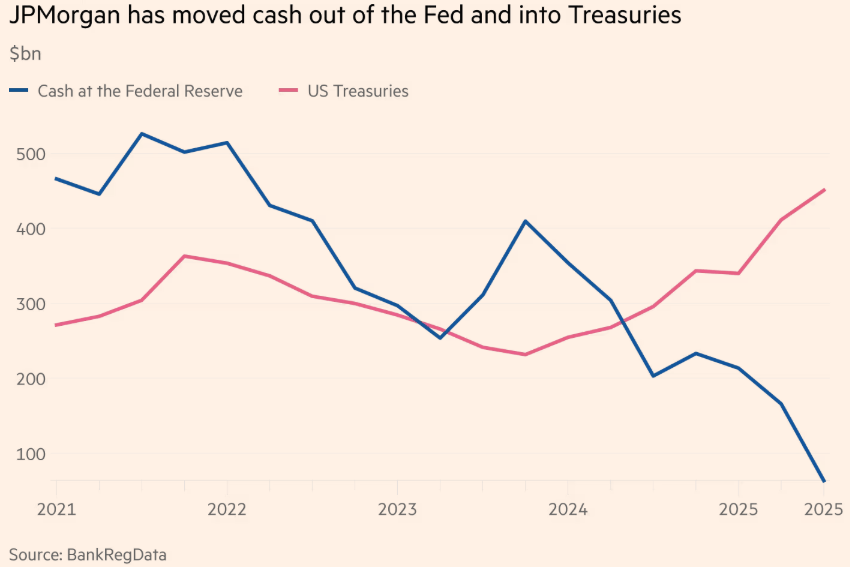
Core Viewpoint - JPMorgan Chase has significantly adjusted its fund allocation over the past year, reducing its cash holdings at the Federal Reserve while increasing its holdings in U.S. Treasury securities, reflecting a proactive strategy to prepare for potential interest rate declines [1][4]. Group 1: Fund Allocation Changes - As of the third quarter of this year, JPMorgan's cash balance at the Federal Reserve has decreased from approximately $409 billion at the end of 2022 to about $63 billion [1]. - Concurrently, the bank's holdings of U.S. Treasury securities have risen from $231 billion to approximately $450 billion, allowing the bank to lock in relatively high yields and mitigate future earnings pressure from potential interest rate declines [1][7]. Group 2: Interest Rate Environment - The interest rate levels have experienced rapid increases and subsequent adjustments over the past two years, with a significant rise in benchmark rates from 2022 to early 2023, followed by a projected rate cut period starting at the end of 2024 [4]. - Financial institutions are adjusting their asset structures by converting some cash assets into fixed-income assets in response to the changing interest rate policies [4]. Group 3: Industry Implications - JPMorgan's fund transfer is substantial, exceeding the total changes in Federal Reserve account balances of thousands of other banks, indicating a common management approach among banks during interest rate cycle changes [7]. - This adjustment reflects a typical strategy of allocating longer-term assets during high-interest phases to balance potential future earnings volatility, contrasting with some peers who increased long-term bond holdings during low-rate periods [7]. - The asset structure adjustment demonstrates the logic of asset reallocation by large banks in response to anticipated changes in the interest rate environment, maintaining liquidity while preparing for future operational conditions [8].


金丰来:金价上行逻辑解析
Xin Lang Cai Jing· 2025-12-15 10:52
Core Viewpoint - Recent rise in gold prices reflects market repricing of interest rate environment and risk sentiment [1][3] - Current increase in gold prices is driven by multiple expectations rather than a single factor [1][3] Macroeconomic Factors - The core impact of interest rate cut expectations is the change in holding costs [1][3] - As interest rate cut expectations strengthen, funds are more likely to flow into inflation-resistant and value-preserving assets [1][3] - Periodic safety events amplify market uncertainty, increasing demand for safe-haven assets, providing additional support for gold prices [1][3] Short-term Influences - Short-term disturbances exist, with some officials signaling tighter policies, leading to a temporary strengthening of the dollar, which suppresses gold prices [1][3] - These signals reflect policy divergence rather than a trend reversal, with the market expected to reassess based on employment and inflation data [1][3] Data Considerations - Upcoming employment report is a key variable influencing short-term trends [4] - A slowdown in the labor market could further solidify easing expectations; conversely, strong data may trigger a technical pullback in gold prices, but not necessarily alter the mid-term structure [4] Technical Structure - Gold prices are currently in a relatively favorable position, remaining above key moving averages with strong momentum indicators, indicating that the bullish trend is not broken [4] - If the key resistance zone is effectively breached, sentiment and funds may resonate, driving prices further upward [4] Long-term Outlook - In the context of interest rate cycles, risk preferences, and technical patterns, gold retains medium to long-term investment appeal [2][4] - Short-term fluctuations are seen as rhythm adjustments, with a focus on the overall trend rather than individual events causing emotional swings [2][4]

下降2900亿?境外机构纷纷减持中国债,大量资金正流向美国?
Sou Hu Cai Jing· 2025-10-02 09:04
Group 1 - Foreign institutions have reduced their holdings in China's interbank bond market by over 300 billion yuan, with a cumulative reduction close to 290 billion yuan, primarily involving government bonds and interbank certificates of deposit [2] - The reduction is not a one-time sell-off but a gradual adjustment of positions, influenced by the changing global interest rate environment [2][6] - In contrast, foreign capital has significantly increased its net purchases of U.S. Treasury bonds, with a net inflow exceeding 300 billion dollars in May 2025 alone, pushing the total foreign holdings of U.S. debt to over 9 trillion dollars [4][10] Group 2 - China has also been reducing its holdings of U.S. Treasury bonds, with a reduction of 25.7 billion dollars in July, bringing its holdings down to 730.7 billion dollars, the lowest level since 2009 [6] - The yield on Chinese government bonds has decreased, with the 10-year yield dropping below 2%, making them less attractive compared to U.S. bonds, which have an average yield around 4% in early 2025 [6][8] - Despite the reduction in holdings, foreign investors still maintain a positive long-term outlook on China's bond market, which has a total balance of 192 trillion yuan and has seen a year-on-year issuance growth of 14% [8][12] Group 3 - The U.S. Treasury market remains the largest globally, with a circulation scale of 28.6 trillion dollars, and foreign investor demand is strong, particularly from private capital [10] - The recent financial instability in the U.S., including the collapse of Silicon Valley Bank, has not significantly shaken the confidence of foreign investors, as the Federal Reserve's interventions have stabilized the situation [12] - The reduction in foreign holdings of Chinese bonds is viewed as a normal market adjustment rather than a crisis signal, with the potential for increased foreign investment in China's bond market due to recent policy changes aimed at enhancing liquidity [14]