动态回撤

Search documents
老王买的基金明明净值涨得更多,凭啥老李说收益和他持平?
私募排排网· 2026-03-23 07:37
Core Viewpoint - The article emphasizes the importance of understanding cumulative net value as a key indicator of a fund's long-term performance, contrasting it with unit net value, which reflects the current trading price of the fund [20]. Summary by Sections Understanding Cumulative Net Value - Cumulative net value is defined as the unit net value plus all dividends and splits since the fund's inception, representing the overall return of the fund [9]. - Unit net value reflects the current trading price after accounting for dividends and splits, while cumulative net value serves as a "historical report card" of the fund's performance [9][10]. Importance of Cumulative Net Value - A higher and more stable cumulative net value indicates better long-term performance and investment management capability of the fund manager [17]. - Investors should not only focus on cumulative net value but also consider dynamic drawdown and alpha returns to assess the fund's overall value proposition [19]. Practical Example - An example illustrates that if a fund has never distributed dividends, its cumulative net value will equal its unit net value. In contrast, a fund that has distributed dividends will show a difference between the two values, highlighting the actual cash returns received by investors [10][18]. Investment Decision-Making - Investors are advised to look for steadily increasing cumulative net values, as fluctuations may indicate instability in long-term returns. A fund with a high cumulative net value but high dynamic drawdown may lead to poor holding experiences [19]. - The article concludes that understanding both unit net value and cumulative net value is crucial for evaluating a fund's true earning potential [22].


基金单位净值越低越想买?先等等,老王差点踩雷了……
私募排排网· 2026-03-21 00:30
Core Viewpoint - The article emphasizes the importance of understanding the concept of "unit net value" in mutual funds, highlighting that a higher net value does not necessarily indicate a more valuable investment, and that the underlying quality and performance of the fund are crucial for investment decisions [3][10][12]. Group 1: Understanding Unit Net Value - Unit net value is defined as the total assets of a fund minus total liabilities divided by the total number of shares [3][4]. - The example of a hotpot restaurant illustrates how unit net value changes with the business's performance, showing that an increase in total assets and liabilities affects the unit net value [5][7]. - The article clarifies that the unit net value reflects the price of each share of the fund on a given day, and it fluctuates based on the fund's performance and management fees [4][10]. Group 2: Evaluating Fund Value - The article stresses that the value of a fund should not be judged solely by its unit net value at the time of purchase, but rather by the fund's underlying quality, market conditions, investment strategies, and management capabilities [10][12]. - A fund's increase in net value can be justified if it results from effective management and sound investment decisions, making it potentially more valuable despite a higher price [10][12]. - The conclusion encourages investors to seek undervalued quality funds rather than simply looking for low net value funds that may not represent true value [13].
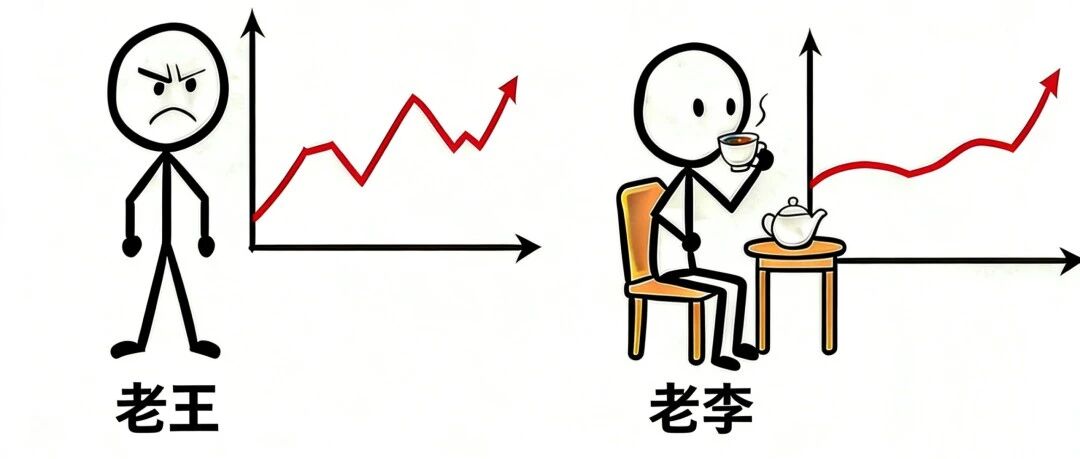
老王懵了:赚一样的收益,为啥我拿得心惊肉跳?
私募排排网· 2026-03-12 10:00
Core Viewpoint - The article emphasizes the importance of understanding dynamic drawdown as a key risk indicator for funds, highlighting that high alpha returns do not guarantee a good investment experience if the drawdown is significant [6][12][18]. Summary by Sections Dynamic Drawdown Explanation - Dynamic drawdown is defined as the percentage change in a fund's net value relative to its previous peak, calculated in real-time as the net value updates [8][11]. - An example illustrates that if a fund's net value rises from 1.0 to 1.2 and then drops to 0.9, the dynamic drawdown is -25% [8]. - If the fund reaches a new high, the dynamic drawdown resets to 0, indicating no drawdown at that moment [10]. Importance of Dynamic Drawdown - Dynamic drawdown serves as a measure of a fund manager's ability to maintain stable returns, contrasting with alpha returns which indicate profit generation [12]. - A smaller dynamic drawdown suggests a more stable net value trajectory and better risk management by the fund manager, while a larger drawdown indicates greater volatility and difficulty in recovering losses [12][17]. Principles for Evaluating Dynamic Drawdown - Investors should consider the overall trend of dynamic drawdown rather than isolated data points, as short-term fluctuations may not reflect the fund's long-term performance [14][16]. - The relationship between dynamic drawdown and returns should be assessed for value; a fund with a lower drawdown but minimal returns may not be a better choice [16]. - Historical dynamic drawdown data should be contextualized within current market conditions, as past performance does not guarantee future results [16]. Conclusion - Dynamic drawdown is calculated as (current net value - previous peak net value) / previous peak net value × 100%, serving as a core indicator of a fund's risk management and investor experience [17]. - A dynamic drawdown closer to 0 indicates a stable fund performance, while significant deviations suggest deeper adjustments and weaker risk management capabilities [17].