阿尔法收益

Search documents
老王买的基金明明净值涨得更多,凭啥老李说收益和他持平?
私募排排网· 2026-03-23 07:37
Core Viewpoint - The article emphasizes the importance of understanding cumulative net value as a key indicator of a fund's long-term performance, contrasting it with unit net value, which reflects the current trading price of the fund [20]. Summary by Sections Understanding Cumulative Net Value - Cumulative net value is defined as the unit net value plus all dividends and splits since the fund's inception, representing the overall return of the fund [9]. - Unit net value reflects the current trading price after accounting for dividends and splits, while cumulative net value serves as a "historical report card" of the fund's performance [9][10]. Importance of Cumulative Net Value - A higher and more stable cumulative net value indicates better long-term performance and investment management capability of the fund manager [17]. - Investors should not only focus on cumulative net value but also consider dynamic drawdown and alpha returns to assess the fund's overall value proposition [19]. Practical Example - An example illustrates that if a fund has never distributed dividends, its cumulative net value will equal its unit net value. In contrast, a fund that has distributed dividends will show a difference between the two values, highlighting the actual cash returns received by investors [10][18]. Investment Decision-Making - Investors are advised to look for steadily increasing cumulative net values, as fluctuations may indicate instability in long-term returns. A fund with a high cumulative net value but high dynamic drawdown may lead to poor holding experiences [19]. - The article concludes that understanding both unit net value and cumulative net value is crucial for evaluating a fund's true earning potential [22].


基金单位净值越低越想买?先等等,老王差点踩雷了……
私募排排网· 2026-03-21 00:30
Core Viewpoint - The article emphasizes the importance of understanding the concept of "unit net value" in mutual funds, highlighting that a higher net value does not necessarily indicate a more valuable investment, and that the underlying quality and performance of the fund are crucial for investment decisions [3][10][12]. Group 1: Understanding Unit Net Value - Unit net value is defined as the total assets of a fund minus total liabilities divided by the total number of shares [3][4]. - The example of a hotpot restaurant illustrates how unit net value changes with the business's performance, showing that an increase in total assets and liabilities affects the unit net value [5][7]. - The article clarifies that the unit net value reflects the price of each share of the fund on a given day, and it fluctuates based on the fund's performance and management fees [4][10]. Group 2: Evaluating Fund Value - The article stresses that the value of a fund should not be judged solely by its unit net value at the time of purchase, but rather by the fund's underlying quality, market conditions, investment strategies, and management capabilities [10][12]. - A fund's increase in net value can be justified if it results from effective management and sound investment decisions, making it potentially more valuable despite a higher price [10][12]. - The conclusion encourages investors to seek undervalued quality funds rather than simply looking for low net value funds that may not represent true value [13].

老王懵了:赚一样的收益,为啥我拿得心惊肉跳?
私募排排网· 2026-03-12 10:00
Core Viewpoint - The article emphasizes the importance of understanding dynamic drawdown as a key risk indicator for funds, highlighting that high alpha returns do not guarantee a good investment experience if the drawdown is significant [6][12][18]. Summary by Sections Dynamic Drawdown Explanation - Dynamic drawdown is defined as the percentage change in a fund's net value relative to its previous peak, calculated in real-time as the net value updates [8][11]. - An example illustrates that if a fund's net value rises from 1.0 to 1.2 and then drops to 0.9, the dynamic drawdown is -25% [8]. - If the fund reaches a new high, the dynamic drawdown resets to 0, indicating no drawdown at that moment [10]. Importance of Dynamic Drawdown - Dynamic drawdown serves as a measure of a fund manager's ability to maintain stable returns, contrasting with alpha returns which indicate profit generation [12]. - A smaller dynamic drawdown suggests a more stable net value trajectory and better risk management by the fund manager, while a larger drawdown indicates greater volatility and difficulty in recovering losses [12][17]. Principles for Evaluating Dynamic Drawdown - Investors should consider the overall trend of dynamic drawdown rather than isolated data points, as short-term fluctuations may not reflect the fund's long-term performance [14][16]. - The relationship between dynamic drawdown and returns should be assessed for value; a fund with a lower drawdown but minimal returns may not be a better choice [16]. - Historical dynamic drawdown data should be contextualized within current market conditions, as past performance does not guarantee future results [16]. Conclusion - Dynamic drawdown is calculated as (current net value - previous peak net value) / previous peak net value × 100%, serving as a core indicator of a fund's risk management and investor experience [17]. - A dynamic drawdown closer to 0 indicates a stable fund performance, while significant deviations suggest deeper adjustments and weaker risk management capabilities [17].
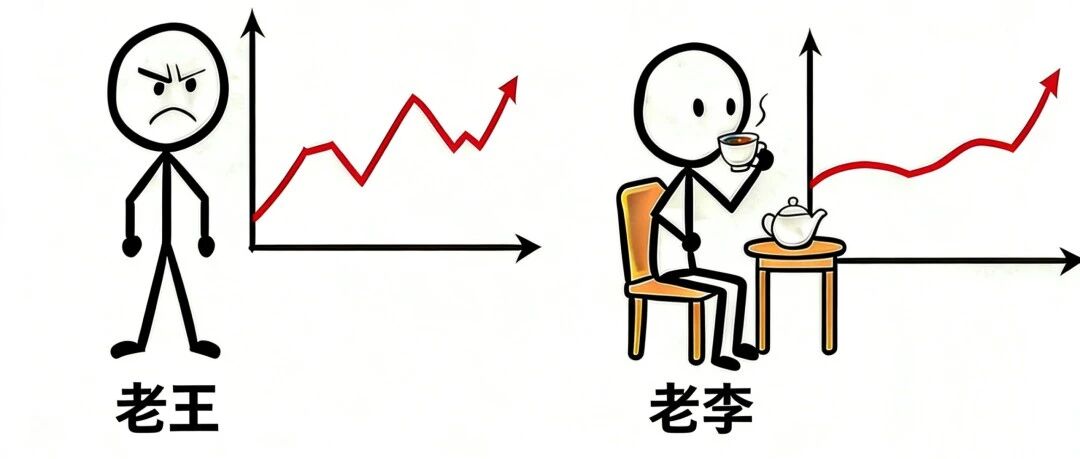
老王最近有点郁闷,全都是因为“α”
私募排排网· 2026-03-05 10:00
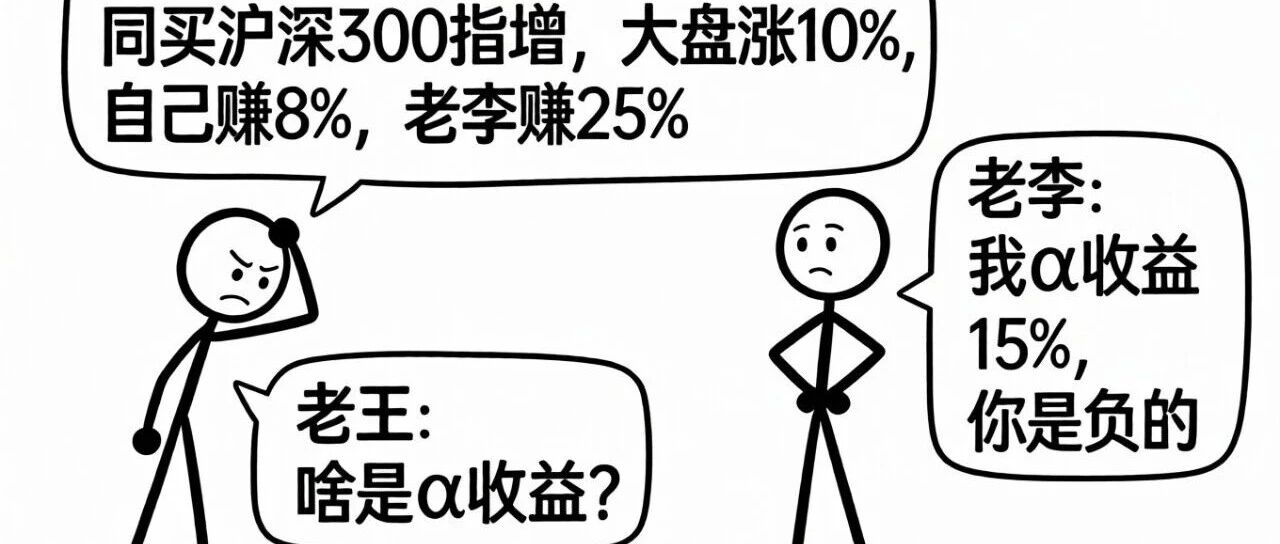
Core Viewpoint - The article explains the concept of Alpha Return (α), which represents the excess return generated by a fund manager beyond the benchmark return, highlighting its importance in evaluating fund managers' performance [6][12][14]. Group 1: Understanding Alpha Return - Alpha Return (α) is defined as the excess return over the benchmark, indicating the portion of return that exceeds the market performance [6][12]. - For example, if the CSI 300 index rises by 10% and a fund earns 25%, the additional 15% is the Alpha Return, showcasing the fund manager's skill [7][9]. - The formula for calculating Alpha Return is: Alpha Return (α) = Actual Fund Return - Benchmark Return [12][14]. Group 2: Implications of Alpha Return - A positive Alpha Return (> 0) indicates that the fund manager has outperformed the benchmark, demonstrating strong capabilities in generating excess returns [15]. - Conversely, a negative Alpha Return (< 0) suggests that the manager has underperformed relative to the benchmark, warranting further observation [16]. - It is essential to evaluate Alpha over the long term, considering performance against benchmarks and associated risks, rather than focusing solely on short-term numbers [17].
摩根大通称新兴市场对冲基金录得2022年以来最佳单月表现
Xin Lang Cai Jing· 2026-02-19 10:54
Core Insights - Emerging market hedge funds recorded their strongest monthly performance in over three years in January, with alpha returns contributing to more than half of the total returns [1][2] - The return rate for emerging market hedge funds in January was 4.9%, marking the best single-month performance since November 2022 [1][2] - The beta of emerging market hedge funds has steadily increased over the past year and is currently at the upper end of its historical range [1][2] Fund Flows - There has been strong capital inflow into exchange-traded funds (ETFs) focused on Korean stocks, exceeding 100% of the assets under management [1][2] - Latin American, African, and Middle Eastern stock ETFs are also receiving significant attention [3] - In contrast, the inflow into emerging market fixed income funds and other regional funds has been more moderate [4]
国泰基金李昇:慢牛趋势,把握时代机遇
Zhong Guo Ji Jin Bao· 2026-02-18 10:53
Core Viewpoint - The article emphasizes the optimistic outlook for the A-share market in 2025, highlighting the importance of high-quality development in public funds and the role of technology innovation as a key driver for capital market improvement [1][4]. Group 1: Market Performance and Trends - In 2024, the A-share market demonstrated resilience with a deep V-shaped recovery, marked by significant fluctuations due to external factors, but stabilized by long-term capital inflows and timely monetary policy adjustments [1]. - The Shanghai Composite Index historically surpassed the 4000-point mark, supported by a strong spring market in January 2025, leading to continuous new highs and a sustained market profitability effect [1]. - The market is expected to enter a consolidation phase after consecutive increases, but the long-term upward trend remains intact, with potential for new highs post-Spring Festival [4]. Group 2: Policy and Regulatory Developments - The China Securities Regulatory Commission (CSRC) initiated a series of reforms aimed at promoting high-quality development in public funds, including the release of action plans and guidelines to enhance investment clarity and reduce costs [2]. - These reforms are designed to stabilize investment styles and improve the overall investor experience, thereby increasing the long-term sense of gain and satisfaction for investors [2]. Group 3: Strategic Focus Areas for Fund Management - The company aims to enhance its capabilities in supporting national strategies, particularly in fostering high-level technological self-reliance and innovation, by developing relevant equity products [2]. - There is a focus on identifying alpha opportunities in a market characterized by rapid rotation and complex driving factors, necessitating deeper investment research and a disciplined approach to capturing excess returns [3]. - The implementation of dual-track reforms for performance benchmarks and fee structures is expected to improve product transparency and investor engagement, while diversified asset allocation strategies will help mitigate risks and enhance stability [3].
解码平安背后的机构共识与时代贝塔
Ge Long Hui· 2026-01-27 07:01
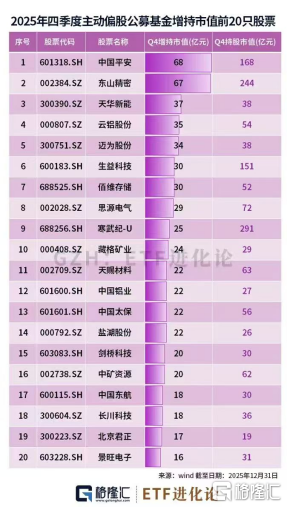
Core Viewpoint - The capital market is witnessing a significant shift towards a concentrated focus on high-growth sectors, particularly those centered around AI computing power, as large funds pursue certainty in investment opportunities [1] Group 1: Fund Holdings and Market Trends - The latest public fund quarterly reports reveal a clear shift in holdings, indicating a consensus among large investors on certain high-growth sectors [1] - China Ping An (601318.SH/2318.HK) has emerged as a key focus for funds due to its low valuation, high dividend cash flow, and expectations of macroeconomic recovery [1] - In Q4 2025, China Ping An saw an increase in holdings by public funds, with a market value increase of 68 billion yuan, bringing total holdings to 168 billion yuan [2] Group 2: Performance and Market Reactions - On January 26, 2025, despite overall market pressure, China Ping An's A-shares and H-shares rose over 3%, reflecting strong market sentiment and alignment with public fund holdings [4] - The analysis of the quarterly reports serves as a critical starting point for understanding institutional allocation trends and predicting market style and structural changes for 2026 [6] Group 3: Value Discovery and Investment Logic - The insurance sector, led by China Ping An, has seen a systematic increase in holdings over the past year, marking a return to the core focus of institutional investors [8] - The market consensus has evolved from initial undervaluation to a recognition of the unique business model and long-term alpha capabilities of China Ping An [21] - The policy direction encouraging long-term capital into the market has provided dual benefits for the insurance sector, enhancing liquidity and valuation environments [22] Group 4: Strategic Positioning and Future Outlook - China Ping An's strategy of integrating financial services with healthcare and elderly care is positioned to capitalize on long-term societal trends, opening up significant market opportunities [24] - The company's focus on AI and advanced technologies is enhancing operational efficiency and solidifying its competitive advantages [25] - The sustained increase in public fund holdings reflects a premium on China Ping An's ability to generate stable long-term returns, transitioning its value perception from a rate-sensitive stock to a composite value asset [26]

美银给出黄金6000美元疯狂目标 其逻辑何在?
Jin Tou Wang· 2026-01-25 01:20
Core Viewpoint - Bank of America has a bullish outlook on gold prices, predicting a target of $6,000 per ounce by spring 2026, which is the most aggressive forecast among major institutions [1][2] Group 1: Price Predictions - The average gold price is expected to reach $4,538 per ounce by 2026, with a bullish target of $5,000 per ounce achievable if investment demand increases by 14% [1] - In a more optimistic scenario, if investment demand grows by 55%, gold prices could potentially rise to $8,000 per ounce [1] Group 2: Supply and Demand Fundamentals - Major North American gold mining companies are projected to see a 2% decline in production, while all-in sustaining costs may rise by 3% to approximately $1,600 per ounce [2] - The total EBITDA for the industry is expected to grow by 41% to $65 billion [2] Group 3: Investment Trends - High-net-worth investors currently allocate only 0.5% of their portfolios to gold, significantly lower than the recommended 20-30% allocation [2] - Central banks are anticipated to continue increasing their gold reserves, which could provide additional demand if their gold holdings rise from the current 15% to an optimized level of 30% [2] Group 4: Market Analysis - The current gold price is near the psychological level of $5,000, with a strong technical structure supporting further upward movement [3] - If gold can maintain support in the $4,944–$4,950 range, the likelihood of breaking through the $5,000 barrier increases [3] - Despite indicators showing an overbought market, any pullbacks that do not breach key support levels may be viewed as buying opportunities [3]
长期有效因子往往在于多数人的误区!对话少数派周良:慢牛行情中最具性价比的四类机会
Xin Lang Cai Jing· 2026-01-13 07:37
Core Viewpoint - The company has successfully integrated quantitative methods with active investment strategies, leading to a unique investment framework that emphasizes the identification of market mispricings and behavioral biases [2][3][38]. Group 1: Investment Strategy - The investment framework combines subjective logic with quantitative verification, allowing for clearer investment logic and data validation [2][38]. - The approach includes quantitative initial selection followed by subjective refinement, leveraging the strengths of both methods to enhance research efficiency [2][38]. - The strategy also involves subjective timing decisions supported by quantitative stock selection, recognizing that market shifts occur infrequently and require experienced judgment [2][38]. Group 2: Market Insights - The company identifies that excess returns often arise from the misjudgments of the majority, suggesting that understanding these biases can lead to profitable investment opportunities [3][38]. - The firm has shifted its focus from large-cap value stocks to a diversified product line that includes small-cap, growth, and dividend value stocks, reflecting a broader market approach [3][39]. - The company emphasizes the importance of recognizing structural changes in the market, such as the potential shift of the stock market becoming the main wealth effect arena, driven by low interest rates and asset scarcity [11][38]. Group 3: Risk Management - Following a significant downturn in small-cap stocks in early 2024, the company implemented protective measures, including deep out-of-the-money put options to hedge against extreme tail risks [40][51]. - The firm acknowledges the challenges of predicting extreme market events and emphasizes the need for robust risk management strategies to mitigate unforeseen impacts [40][51]. Group 4: Team Structure and Efficiency - The investment team consists of ten members, focusing on enhancing research efficiency through quantitative methods while reducing time spent on less impactful fundamental analysis [29][41]. - The company prioritizes hiring individuals with a proactive attitude and a diverse background, fostering a culture of independent thinking and continuous learning [30][41]. Group 5: Future Market Outlook - The company anticipates a slow bull market in China over the next three to five years, driven by economic transformation and favorable valuation conditions [26][27]. - Key investment opportunities are expected to arise in small-cap stocks, growth stocks, and dividend-paying assets, with a focus on the unique alpha potential of small-cap stocks in the Chinese market [26][27].

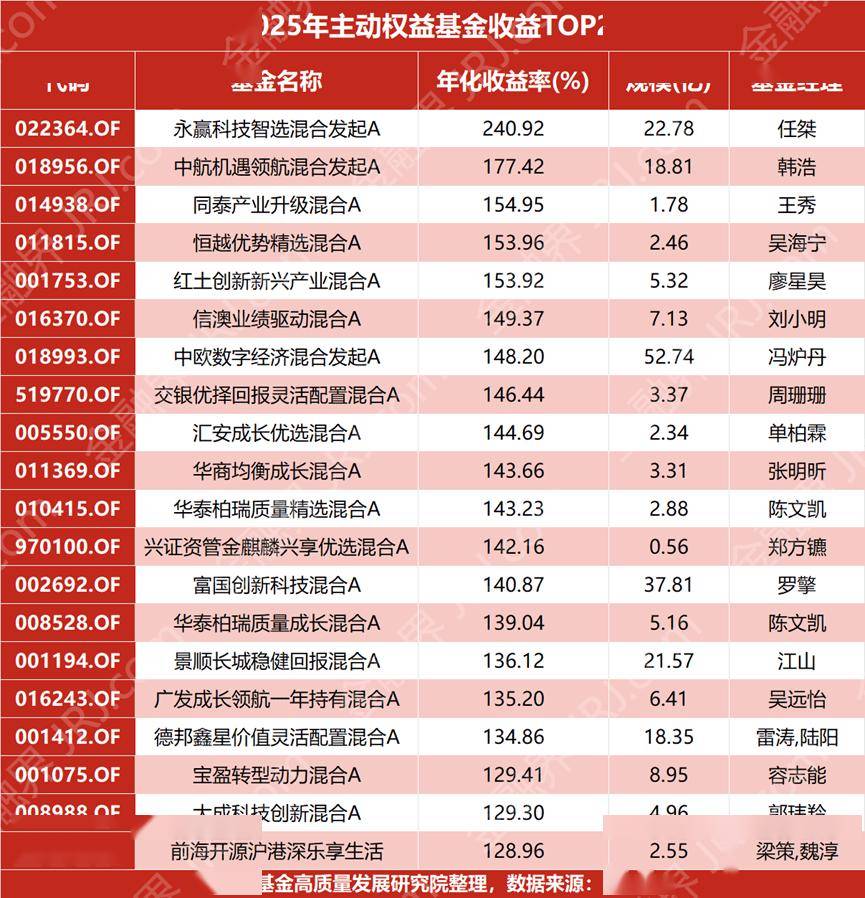
主动权益基金2025年排行榜揭晓!翻倍基达80只,热门赛道+超额收益能力成核心推手
Sou Hu Cai Jing· 2026-01-01 09:42
Core Insights - The 2025 public fund performance ranking highlights that actively managed equity funds have become the market's focal point due to impressive returns, with 80 funds doubling their value, driven by structural market trends and the expertise of fund managers [1] Group 1: Market Performance - The A-share market provided a favorable environment for equity investments, with major indices showing significant gains: the Shanghai Composite Index rose by 18.41%, reaching a 10-year high with 11 consecutive days of gains; the Shenzhen Component Index increased by 29.87%, and the ChiNext Index surged by 49.57% [1] - The market exhibited clear structural themes, with technology, non-ferrous metals, and commercial aerospace sectors leading the way, particularly the AI industry chain, which saw substantial growth across various segments [1] Group 2: Fund Performance - The emergence of double-return funds reflects a concentrated focus on high-growth sectors, with fund managers demonstrating strong trend judgment and sector exploration capabilities, leading to a significant divergence in performance based on sector allocation [2] - A total of 5 funds achieved returns exceeding 150%, while 12 funds fell within the 130%-150% range, indicating a strong correlation between concentrated sector holdings and fund performance [2][5] Group 3: Sector Characteristics - High-growth sectors, particularly technology, non-ferrous metals, and commercial aerospace, provided a stable revenue foundation for the 80 double-return funds, confirming their common investment direction [3] - The technology sector, especially the AI industry chain, experienced significant growth, with leading stocks in sub-sectors like optical modules, PCBs, and servers showing remarkable price increases, resulting in returns that far exceeded industry averages for well-positioned funds [4] Group 4: Management Strategies - The concentration of holdings in top-performing funds (those with returns over 150%) was notably high, as these funds abandoned traditional weak sectors in favor of core growth areas, amplifying the benefits of high-growth sectors [5] - The orderly rotation of market hotspots throughout the year allowed fund managers to adjust sector weightings in response to industry trends, capturing both mainline opportunities and short-term gains, thereby enhancing overall returns [6]