
化工板块

Search documents
化工板块冲高回落,化工行业ETF易方达(516570)等产品受资金关注
Sou Hu Cai Jing· 2026-02-26 11:25
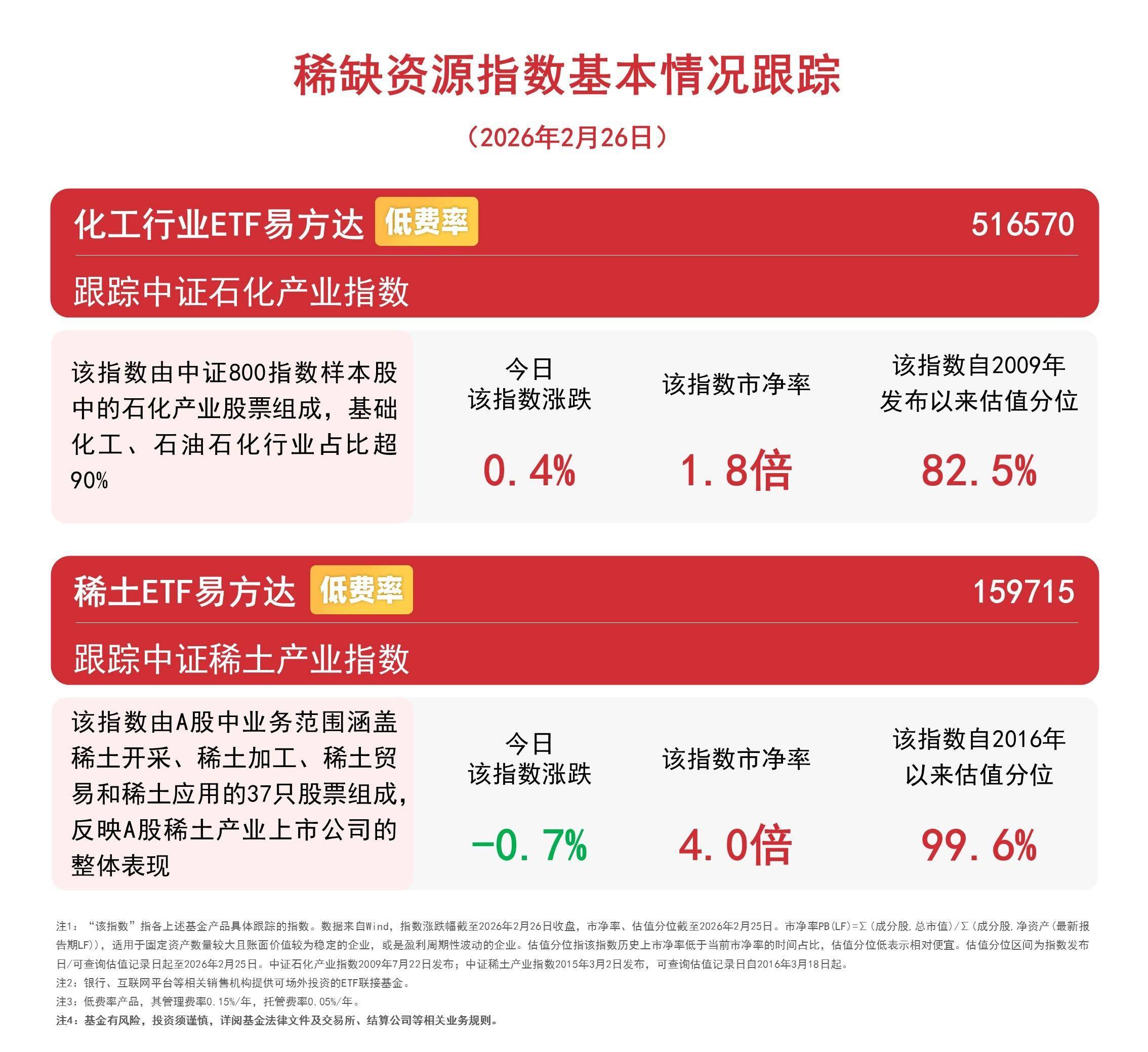
Group 1 - The China Petroleum and Chemical Industry Index rose by 0.4% while the China Rare Earth Industry Index fell by 0.7% [1] - The chemical industry ETF, E Fund (516570), has seen a net inflow of over 65 million yuan in the last three trading days [1]

ETF规模速报 | 创业板ETF易方达净流入超10亿元,A500ETF南方净流出超6亿元
Mei Ri Jing Ji Xin Wen· 2026-02-12 01:42
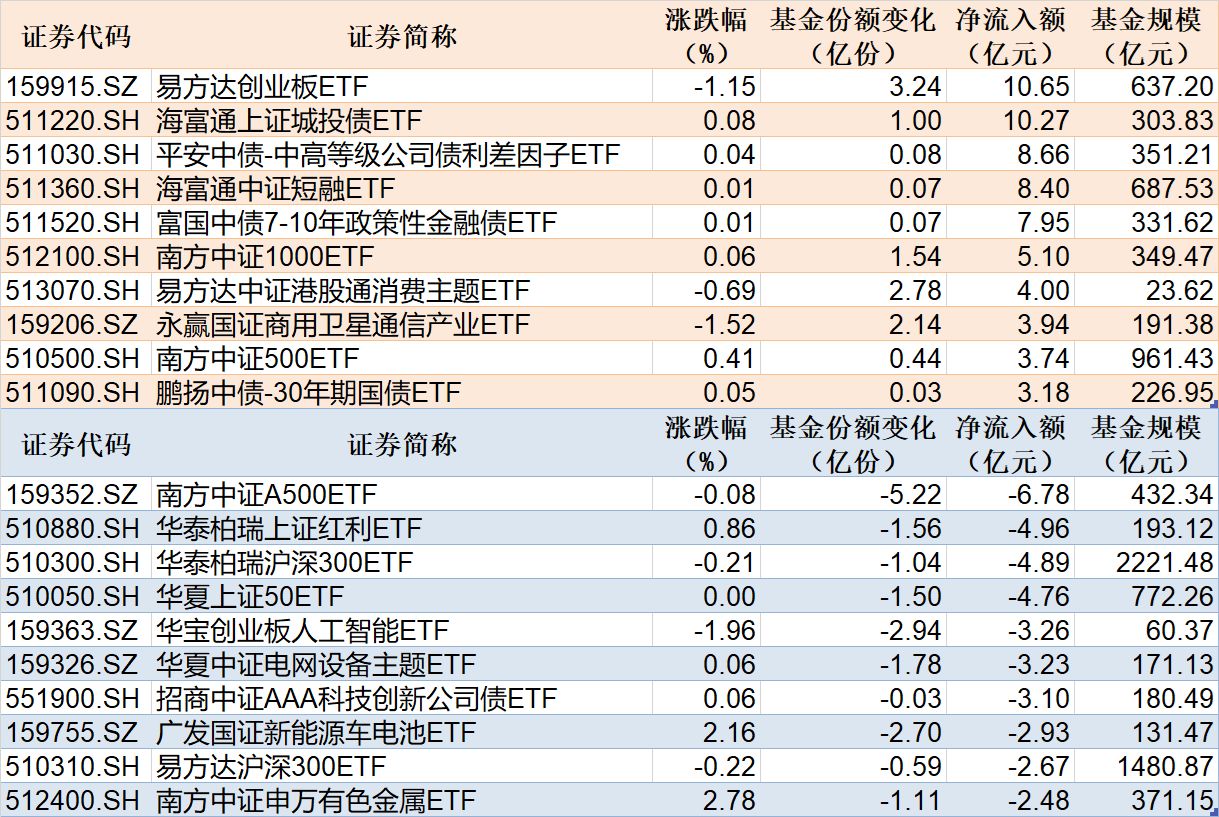
Market Overview - The three major indices showed mixed performance, with the ChiNext Index and the STAR 50 Index both declining over 1% [1] - The chemical sector has recently shown strength, particularly in the fiberglass concept, while the film and cinema sector experienced a collective decline [1] ETF Market Activity - On February 11, the non-monetary ETF market saw significant inflows, with the E Fund ChiNext ETF increasing by 324 million shares and a net inflow of 1.065 billion yuan [1] - The Hai Fu Tong Shanghai City Investment Bond ETF also saw an increase of 100 million shares with a net inflow of 1.027 billion yuan [1] - The Ping An Zhongdai High-Grade Corporate Bond Spread Factor ETF had an increase of 8 million shares and a net inflow of 866 million yuan [1] Fund Performance - The E Fund ChiNext ETF had a decline of 1.15%, despite the increase in shares and net inflow [2] - The Hai Fu Tong Shanghai City Investment Bond ETF had a slight increase of 0.08% with a net inflow of 1.027 billion yuan [2] - The Ping An Zhongdai High-Grade Corporate Bond Spread Factor ETF increased by 0.04% with a net inflow of 866 million yuan [2] Fund Outflows - The Southern CSI A500 ETF saw a reduction of 522 million shares and a net outflow of 678 million yuan [2] - The Huatai-PB Shanghai Dividend ETF experienced a decrease of 156 million shares with a net outflow of 496 million yuan [2] - The Huatai-PB CSI 300 ETF had a reduction of 104 million shares and a net outflow of 489 million yuan [2] Top ETF Inflows - The top 20 ETFs by net inflow for the month include the Huatai-PB Hang Seng Technology ETF with 3.885 billion yuan and the Hai Fu Tong CSI Short-term Bond ETF with 3.852 billion yuan [4] - Other notable inflows include the Huatai-PB Hang Seng Internet Technology ETF with 2.872 billion yuan and the E Fund ChiNext ETF with 1.772 billion yuan [4] Overall Market Statistics - As of February 11, the total ETF shares in the market reached 33,335.10 billion shares, with a total scale of 54,141.40 billion yuan [4] - The information sector saw the largest increase in shares, with four funds tracking it, while the largest thematic increase was in the CSI Robotics Index, tracked by nine funds [4]



三大指数涨跌不一,5只基金单日涨超4%
Mei Ri Jing Ji Xin Wen· 2026-02-11 13:49
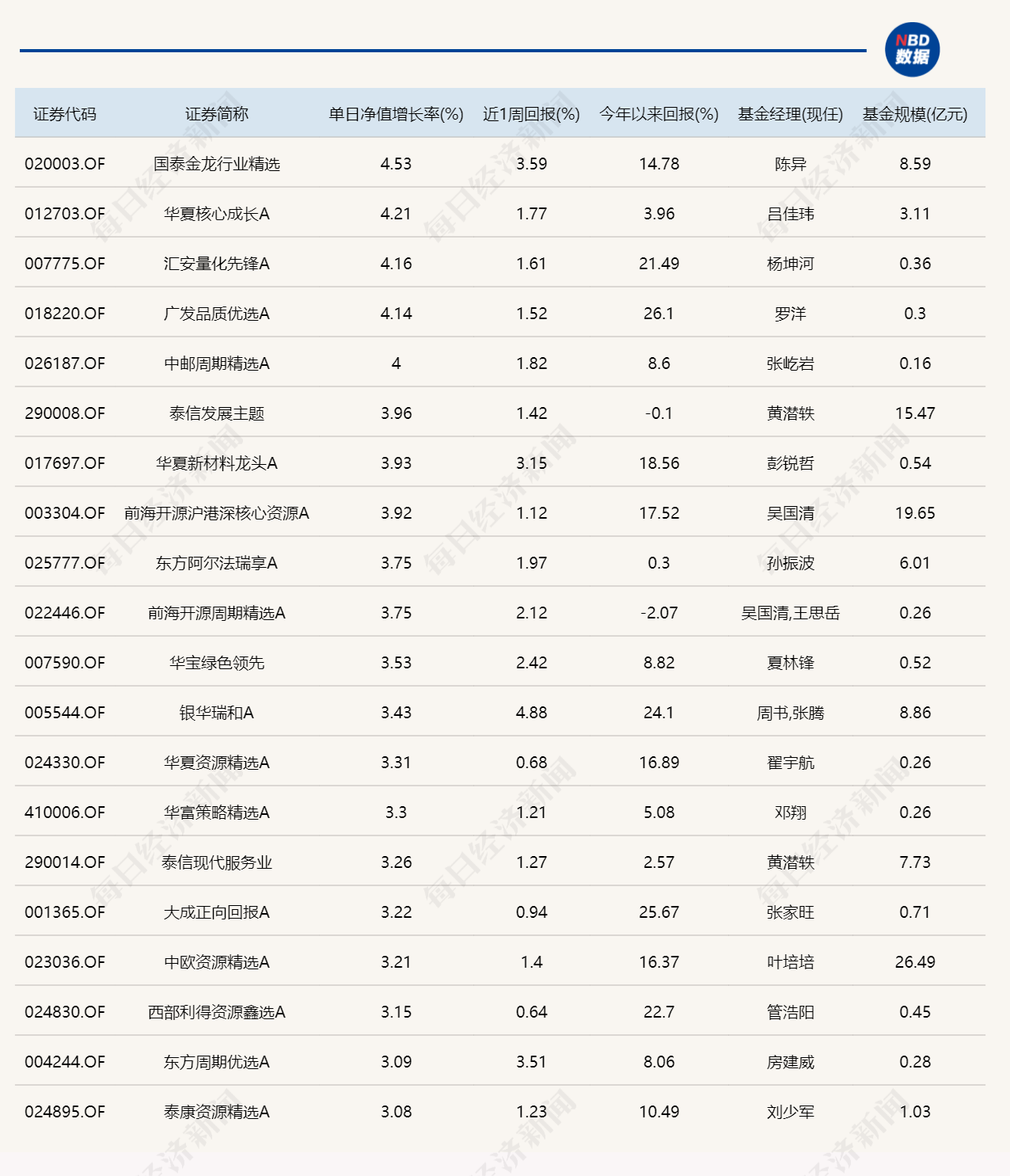
Market Overview - On February 11, the three major indices showed mixed results, with the ChiNext Index and the Sci-Tech 50 Index both declining over 1% [1] - The chemical sector has recently shown strength, with the fiberglass concept rapidly rising, while the non-ferrous metals sector also performed actively [1] - The film and cinema concept saw a collective decline, with over 3,200 stocks in the market experiencing a drop [1] - The trading volume in the Shanghai and Shenzhen markets decreased by 121.3 billion yuan compared to the previous trading day, falling below 2 trillion yuan for the first time in 31 trading days [1] Fund Performance Top Performing Funds - The top performing fund, Guotai Jindong Industry Selection, had a daily net value growth rate of 4.53%, with a year-to-date return of 14.78% [3] - Other notable funds include Huaxia Core Growth A with a daily growth of 4.21% and a year-to-date return of 3.96%, and Huian Quantitative Pioneer A with a daily growth of 4.16% and a year-to-date return of 21.49% [3] Underperforming Funds - The worst performing fund, E Fund Vision Growth A, saw a daily net value decrease of 3.29% and a year-to-date return of 7.86% [4] - Other underperformers include E Fund Pioneer Growth A with a decline of 3.24% and a year-to-date return of 8.33%, and Qianhai Kaiyuan Hong Kong Deep Strong Domestic Industry with a decrease of 2.63% and a year-to-date return of 13.7% [4] Company News - Jushi Group clarified that it has not signed any 4.58 billion yuan project in Hainan and emphasized that it has not made any statements regarding being a "new leader in commercial aerospace" [7] - The company reported a cumulative order amount of 9.9651 million yuan in the commercial aerospace sector for 2025, with a smaller portion expected to be recognized as revenue, accounting for less than 0.50% of the company's total revenue for that year [7] - The company noted that its stock price has significantly deviated from its fundamentals, indicating potential market sentiment overheating and irrational speculation risks [7]

市场早盘高开高走,中证A500指数上涨1.63%,2只中证A500相关ETF成交额超64亿元
Sou Hu Cai Jing· 2026-02-09 03:59
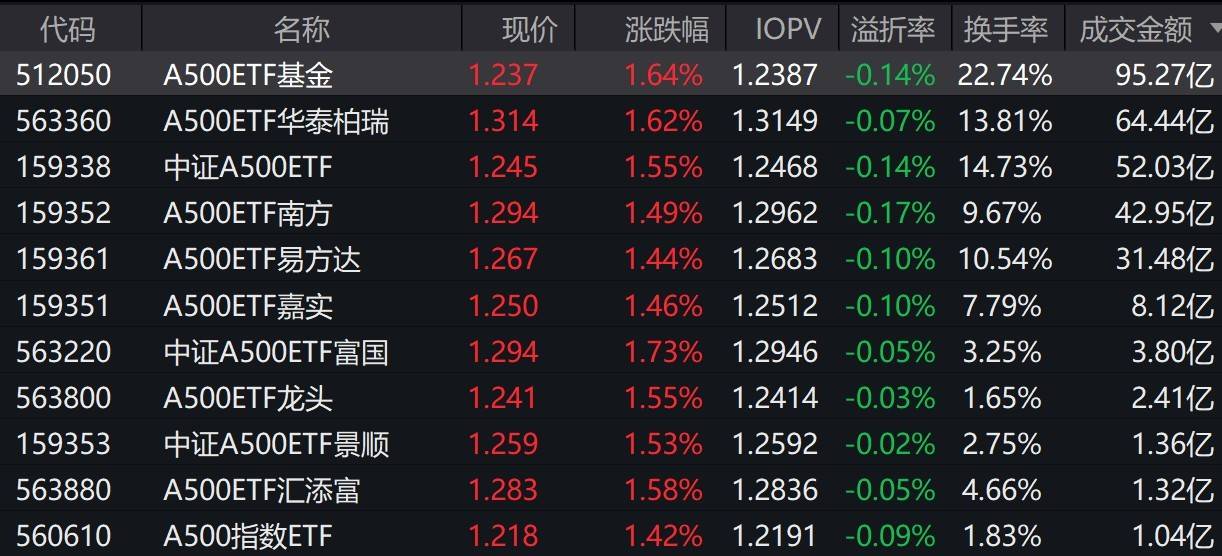
Market Performance - The market opened higher with the Shanghai Composite Index rising over 1% and the CSI 500 Index increasing by 1.63% [1] - The photovoltaic sector experienced a significant surge, while computing hardware concepts collectively strengthened, and AI applications and the chemical sector showed active performance [1] - Conversely, oil and gas stocks exhibited weaker performance [1] ETF Trading Activity - Multiple ETFs tracking the CSI 500 Index saw gains of over 1%, with 11 ETFs having transaction volumes exceeding 100 million yuan, and 2 surpassing 6.4 billion yuan [1] - The A500 ETF Fund and A500 ETF Huatai Baichuan recorded transaction volumes of 9.527 billion yuan and 6.444 billion yuan, respectively [1] Market Sentiment and Outlook - Some brokerages indicated that external disturbances have not substantially impacted the fundamentals of Chinese industries, and the concentrated cooling operations have concluded [1] - Market sentiment has been fully released, and adjustments are considered adequate, suggesting that the A-share spring market rally may continue after the Spring Festival [1]
券商晨会精华:A股资金面韧性仍存
Xin Lang Cai Jing· 2026-02-04 00:04
Market Overview - The market rebounded with the Shanghai Composite Index and ChiNext Index both rising over 1%, and the Shenzhen Component Index increasing over 2% [1] - The total trading volume in the Shanghai and Shenzhen markets was 2.54 trillion yuan, a decrease of 40.5 billion yuan compared to the previous trading day [1] - Over 4,800 stocks in the market saw gains, with notable performances in the commercial aerospace and space photovoltaic sectors [1] Sector Highlights - The commercial aerospace sector experienced significant growth, with stocks like Jili Rigging, Tongyu Communication, and Shenjian Co. hitting the daily limit [1] - The space photovoltaic concept continued to strengthen, with companies such as Guosheng Technology and Jinjing Technology also reaching the daily limit [1] - The chemical sector was active, with Hongbaoli achieving two limits in three days and Wanfeng Co. hitting four consecutive limits [1] - Precious metals showed a rebound, with Hunan Gold achieving six limits in seven days [1] - The AI application sector remained active, with Zhejiang Wenhu Interconnection achieving five limits in eleven days [1] Financial Insights - Huatai Securities noted that the resilience of the capital market remains, despite a decrease in trading activity and net outflows from ETFs [2] - CITIC Securities highlighted that the capacity price mechanism could significantly boost domestic energy storage installations, projecting a 84% year-on-year increase in new energy storage installations to 183 GWh by 2025 [2] - CITIC Jiantou stated that the global commercial aerospace sector is entering a new phase focused on large-scale deployment and ecosystem construction, with China leveraging policy support and capital to drive structural upgrades [2]
瓶片短纤数据日报-20260123
Guo Mao Qi Huo· 2026-01-23 02:40
Group 1: Report Industry Investment Rating - No relevant information provided Group 2: Core Viewpoints of the Report - The PX market continues to be strong, and the strength of the chemical sector boosts the PTA price. The downstream PTA and polyester demand fundamentals are robust. The support for the PX price comes from the significant repair of the PTA industry's profit, with the PTA processing fee rising to 300 yuan. The net profit of PX raw materials is higher than the gasoline blending income, which encourages capacity release. FJDH's 1 million - ton plant restarts, and the price difference between PX and mixed xylene remains above $150. The domestic PTA output continues to climb to match the growth of domestic demand and exports. A new PTA plant in India is about to be put into operation, which will further boost PX demand. The PX - naphtha price difference has dropped to $360. The domestic PTA maintains high - level operation, domestic demand has declined, and the production cuts of polyester factories have a negative feedback on PTA. The PTA consumption remains high, but mainstream polyester co - production has advanced maintenance and is selling PTA raw materials, and the basis has weakened rapidly. Short fibers and bottle chips follow cost changes [2] Group 3: Summary by Related Catalogs Price Changes - PTA spot price increased from 5085 to 5155, with a change of 70 [2] - MEG domestic price increased from 3570 to 3660, with a change of 90 [2] - PTA closing price increased from 5154 to 5298, with a change of 144 [2] - MEG closing price increased from 3689 to 3847, with a change of 158 [2] - 1.4D direct - spun polyester staple fiber price increased from 6465 to 6570, with a change of 105 [2] - Short - fiber basis decreased from 23 to 10, with a change of - 13 [2] - 3 - 4 spread decreased from 40 to 48, with a change of - 8 [2] - Polyester staple fiber cash flow increased from 240 to 246, with a change of 6 [2] - 1.4D imitation large - chemical fiber price remained unchanged at 5250 [2] - The price difference between 1.4D direct - spun and imitation large - chemical fiber increased from 1215 to 1320, with a change of 105 [2] - East China water bottle chip price increased from 6119 to 6222, with a change of 103 [2] - Hot - filling polyester bottle chip price increased from 6119 to 6222, with a change of 103 [2] - Carbonated - grade polyester bottle chip price increased from 6219 to 6322, with a change of 103 [2] - Outer - market water bottle chip price increased from 815 to 825, with a change of 10 [2] - Bottle - chip spot processing fee increased from 575 to 588, with a change of 13 [2] - T32S pure polyester yarn price remained unchanged at 10550 [2] - T32S pure polyester yarn processing fee decreased from 4085 to 3980, with a change of - 105 [2] - Polyester - cotton yarn 65/35 45S price remained unchanged at 16700 [2] - Cotton 328 price increased from 15445 to 15520, with a change of 75 [2] - Polyester - cotton yarn profit decreased from 1575 to 1478, with a change of - 98 [2] - Primary three - dimensional hollow (with silicon) price remained unchanged at 7150 [2] - Hollow staple fiber 6 - 15D cash flow decreased from 406 to 316, with a change of - 90 [2] - Primary low - melting - point staple fiber price remained unchanged at 7760 [2] Market Conditions - Short - fiber: The short - fiber main futures rose 150 to 6640. In the spot market, the prices of polyester staple fiber production plants increased and those of traders showed a warm upward trend. Downstream buyers purchased as needed, and on - site transactions were limited. The price of 1.56dtex*38mm semi - bright natural white (1.4D) polyester staple fiber in the East China market was 6470 - 6650 yuan for cash on delivery, tax - included self - pick - up; in the North China market, it was 6590 - 6770 yuan for cash on delivery, tax - included delivery; in the Fujian market, it was 6470 - 6650 yuan for cash on delivery, tax - included delivery [2] - Bottle chips: The mainstream negotiation price of polyester bottle chips in the Jiangsu and Zhejiang markets was 6150 - 6300 yuan/ton, with the average price rising 120 yuan/ton compared with the previous working day. PTA and bottle - chip futures were strongly operating, the cost - side support increased significantly, the supply - side offers successively raised quotes, the market spot supply was tight, downstream terminals were temporarily on the sidelines, and the market negotiation center rose [2] Operating Rates and Sales - Direct - spun staple fiber load (weekly) increased from 86.77% to 88.84%, with a change of 2.07% [3] - Polyester staple fiber sales rate increased from 40.00% to 78.00%, with a change of 118.00% [3] - Polyester yarn startup rate (weekly) increased from 70.00% to 70.32%, with a change of 0.32% [3] - Regenerated cotton - type load index (weekly) decreased from 55.44% to 54.81%, with a change of - 0.63% [3]
2026年01月主动权益基金配置月观点:周期热度持续,关注化工主题基金-20260108
Orient Securities· 2026-01-08 04:13
Report Industry Investment Rating No relevant information provided in the report. Core Views of the Report - In December 2025, the growth style dominated, with the China Securities Value Index rising 1.05% and the China Securities Growth Index rising 4.08%. The mid - cap style was significantly superior, with the CSI 300, CSI 500, and CSI 1000 rising 2.28%, 6.17%, and 3.56% respectively. The cyclical sector maintained trading activity, while the trading heat of the technology and manufacturing sectors cooled slightly, and the consumer and financial real - estate sectors showed some trading heat [5][8][9]. - In December 2025, the Wande equity - biased fund index rose 3.06%. Funds focusing on commercial aerospace and military themes such as Yongying High - end Equipment Selection A and Qianhai Kaiyuan Greater Ocean recorded large increases. From the monthly win - rate perspective, high - win - rate active equity funds had obvious growth attributes, and Huaxia Zhaoxin Hongrui A maintained a 100% monthly win - rate in the past year and half - year [5][15][16]. - In January 2026, the mid - cap blue - chip market is expected to rise. Short - term focus can be on the mid - cap blue - chips in the cyclical sector, especially the chemical sector. Recommended funds include China Europe Chemical Industry A, Galaxy Value Growth A, etc. [5][20][22]. - China Europe Chemical Industry A has significant product positioning advantages, can provide active excess returns in the chemical sector, and its investment ideas are closely related to the comparison of sub - industry prosperity in the chemical industry [5][24]. - In 2026, the low - volatility fund portfolio has 18 funds, and the new - star fund portfolio has 16 products, including 3 technology - themed, 3 cyclical - themed, 3 manufacturing - themed, 5 pharmaceutical - themed, 1 consumer - themed, and 1 financial - themed products [5][30][32]. Summary by Relevant Catalogs 1. Market Style Change Tracking: Mid - cap Rise, Growth Strength - In December 2025, in terms of style indices, the growth style dominated, and the mid - cap style was significantly superior. The cyclical sector maintained trading activity, while the technology and manufacturing sectors' trading heat cooled slightly, and the consumer and financial real - estate sectors showed some trading heat [5][8][9]. 2. Multi - perspective Fund Tracking: Continued Heat in Commercial Aerospace - From the market hot - spot fund perspective, in December 2025, the Wande equity - biased fund index rose 3.06%. Funds focusing on commercial aerospace and military themes recorded large increases. Some funds focusing on the technology innovation field also performed well due to increased related holdings [15]. - From the monthly win - rate perspective, high - win - rate active equity funds had obvious growth attributes, and Huaxia Zhaoxin Hongrui A maintained a 100% monthly win - rate in the past year and half - year [16]. 3. January 2026 Allocation Suggestion: Mid - cap Blue - chips, Focus on Chemicals 3.1 Mid - cap Blue - chips, Cyclical Sector is King - The mid - cap blue - chip market is expected to rise. Short - term focus can be on the mid - cap blue - chips in the cyclical sector, especially the chemical sector. Recommended funds include China Europe Chemical Industry A, Galaxy Value Growth A, etc. [20][22]. 3.2 Focus on China Europe Chemical Industry A - It has significant product positioning advantages, can provide active excess returns in the chemical sector, and its investment ideas are closely related to the comparison of sub - industry prosperity in the chemical industry [24]. - The fund manager's investment framework is to build an industrial map, select potential high - prosperity sub - industries based on supply - demand patterns and industry prosperity, and then choose undervalued and high - performance - elastic targets [25]. - The chemical industry is expected to benefit from overseas interest - rate cuts and domestic economic stabilization in the next 1 - 2 years. The supply inflection point has gradually emerged, and overseas chemical enterprises are withdrawing, which will promote the domestic fine - chemical industry [27][28]. - In the chemical sector, two types of opportunities are favored: cyclical opportunities in sub - industries with improved supply - demand patterns, and growth opportunities in fine - chemical products with high import dependence and upstream materials driven by downstream technological breakthroughs. The cyclical inflection point may be in the second half of 2026, and it's time to gradually allocate bottom - oriented pro - cyclical varieties [29]. 4. Fund Portfolio Tracking 4.1 Bottom - position Portfolio - Low - volatility Funds - Low - volatility funds can be used as the bottom - position of asset allocation portfolios. In January 2026, 18 low - volatility funds were selected, with stable excess returns, low - risk, and low - volatility characteristics [30]. 4.2 Satellite Portfolio - New - star Funds - In January 2026, the new - star fund portfolio included 16 products, covering technology, cyclical, manufacturing, pharmaceutical, consumer, and financial themes [32].

聚烯烃日报:供需仍是宽松格局,聚烯烃延续弱势-20251015
Hua Tai Qi Huo· 2025-10-15 05:17
Report Industry Investment Rating No relevant content provided. Core Viewpoints - The supply and demand of polyolefins remain in a loose pattern, and the polyolefin market continues to be weak. For PE, post - holiday inventory accumulation, weakened cost support from falling crude oil, and new device production increases drive the price down. For PP, it is mainly dragged down by the weakening of crude oil and propane prices. The overall supply - demand situation is loose, and the cost support is weak [1][2][3]. - Suggested strategies include cautious short - selling hedging for both L and PP in the single - side trading; L01 - L05 and PP01 - PP05 reverse spreads in the inter - period trading; and narrowing the spread of PP01 - 3MA01 when it is high in the inter - variety trading [4]. Summary by Directory 1. Polyolefin Basis Structure - The closing price of the L main contract is 6918 yuan/ton (-65), and the closing price of the PP main contract is 6602 yuan/ton (-91). The LL North China spot price is 6970 yuan/ton (-30), the LL East China spot price is 7000 yuan/ton (-80), and the PP East China spot price is 6640 yuan/ton (-30). The LL North China basis is 52 yuan/ton (+35), the LL East China basis is 82 yuan/ton (-15), and the PP East China basis is 38 yuan/ton (+61) [1]. 2. Production Profit and Operating Rate - PE operating rate is 83.9% (+1.9%), and PP operating rate is 77.7% (+1.1%). PE oil - based production profit is 461.2 yuan/ton (-81.6), PP oil - based production profit is -188.8 yuan/ton (-81.6), and PDH - based PP production profit is 110.3 yuan/ton (+209.4) [1]. 3. Non - standard Price Difference of Polyolefins No specific data analysis provided in the given text. 4. Import and Export Profits of Polyolefins - LL import profit is -28.2 yuan/ton (-39.0), PP import profit is -524.0 yuan/ton (+23.8), and PP export profit is 19.9 US dollars/ton (+2.3) [1]. 5. Downstream Operating Rate and Downstream Profits of Polyolefins - PE downstream agricultural film operating rate is 35.6% (+2.8%), PE downstream packaging film operating rate is 52.9% (+0.5%), PP downstream plastic weaving operating rate is 44.3% (+0.4%), and PP downstream BOPP film operating rate is 60.7% (+0.5%) [1]. 6. Polyolefin Inventory - For PE, post - holiday inventory of major plastic producers has accumulated significantly. For PP, there is an expectation of inventory digestion after the holiday, and traders are actively selling at discounted prices [2][3].