
医药产业并购

Search documents
华润系收购版图再扩张:江中药业高溢价收购精诚徽药
2 1 Shi Ji Jing Ji Bao Dao· 2025-10-20 10:34
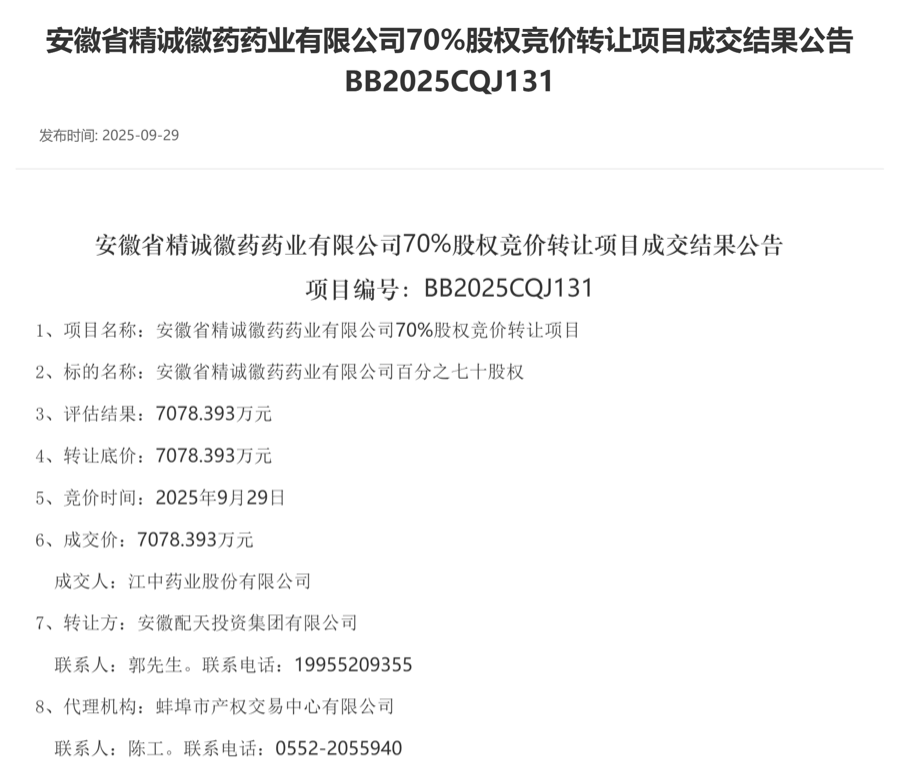
Core Viewpoint - China Resources' integration in the pharmaceutical sector is accelerating, with Jiangzhong Pharmaceutical acquiring 70% of Anhui Jingcheng Huyao for 70.78 million yuan, gaining actual control and consolidating financial statements [1][12] Group 1: Acquisition Details - Jiangzhong Pharmaceutical's acquisition of Anhui Jingcheng Huyao is notable for its high premium, with the assessed value of the target company at 101.12 million yuan, reflecting a 140.86% increase over its net assets of 41.98 million yuan [1] - Anhui Jingcheng Huyao, established in 2013, focuses on traditional Chinese medicine (TCM) health products, including popular OTC items like Liuwei Dihuang Oral Liquid and Brain Power Syrup [1][8] - The acquisition is part of a broader strategy by China Resources to expand its TCM portfolio and enhance market presence [1][12] Group 2: Financial Performance - Jiangzhong Pharmaceutical reported a revenue of 2.141 billion yuan in the first half of 2025, a decrease of 5.79% year-on-year, while net profit increased by 5.80% to 522 million yuan [4] - The OTC business, which is a major revenue driver, saw a revenue drop of 10.14% to 1.55 billion yuan, indicating greater pressure compared to overall revenue decline [6] - The company has faced declining revenue trends over the past two years, with a 3.78% drop in mid-2024 compared to the previous year [4] Group 3: Market Context and Strategy - The health consumer goods sector is becoming increasingly important, with Jiangzhong Pharmaceutical focusing on developing health products that convert low-frequency medications into high-frequency consumer goods [13][16] - The retail market for health supplements is expanding, with the retail sales of health products reaching 12.394 billion yuan in the first half of 2025, surpassing other medication categories [14] - Jiangzhong Pharmaceutical aims to enhance its product matrix in the health consumer goods sector, with a reported revenue growth of 17.35% in this segment [16] Group 4: Challenges and Future Outlook - The acquisition of Anhui Jingcheng Huyao is influenced by the financial difficulties of its previous owner, which is undergoing bankruptcy restructuring [9][10] - The transfer agreement includes conditions to ensure that key product licenses remain within the local jurisdiction, which may pose operational challenges [17] - Future success will depend on Jiangzhong Pharmaceutical's ability to manage debt risks and optimize production under the constraints of the acquisition [18]


华盖资本许小林:中国医药产业并购时代来临,四大趋势引关注
2 1 Shi Ji Jing Ji Bao Dao· 2025-07-31 07:36
Core Insights - The seminar titled "Breakthrough in Mergers and Acquisitions: Investment and Exit Strategies in the Era of Stock" was successfully held in Beijing, focusing on the trends, opportunities, and challenges in the M&A market, particularly in the pharmaceutical industry [1] Group 1: U.S. Pharmaceutical Industry Development - The U.S. pharmaceutical industry has undergone five stages of development: embryonic (1775-1860), birth (1861-1869), formation (1870-1929), growth (1930-1983), and dominance (1984-present) [2] - By 2024, the U.S. pharmaceutical market is projected to reach nearly $800 billion, accounting for over 45% of the global market, with five of the top ten pharmaceutical companies being U.S.-based [2] Group 2: M&A Logic in U.S. Pharmaceutical Industry - M&A activities in the U.S. pharmaceutical sector have evolved: in the 1980s, they focused on horizontal integration; in the 2000s, they addressed patent cliffs and globalization; post-2010, the focus shifted to acquiring innovative technologies [3] - Pfizer and Danaher are highlighted as exemplary companies in M&A, with Pfizer frequently engaging in significant acquisitions to maintain its market dominance, while Danaher excels in integrating acquired assets to enhance profitability [3] Group 3: Trends in Chinese Pharmaceutical Industry M&A - The Chinese pharmaceutical industry is entering an M&A era, with the scale of M&A in the healthcare sector increasing from $11.25 billion in 2018 to $24.514 billion in 2024, rising from seventh to first in industry rankings [4][5] - The current M&A landscape in China is characterized by six types: vertical integration, biotechnology acquisitions, cross-sector diversification, state-owned enterprise reform-driven strategic M&A, cross-border acquisitions, and digital transformation [6] Group 4: Future Outlook for Chinese Pharmaceutical M&A - The number of pharmaceutical companies in China is expected to decrease from 5,000 to 500, indicating a consolidation trend where many companies will exit the market or be acquired [6] - There will be a significant increase in overseas acquisitions by Chinese companies due to intense domestic competition and the need for international expansion [6] - M&A among listed companies is anticipated to occur frequently, enhancing business chain integrity and strengthening core positions in various segments [6]
