卫星+

Search documents
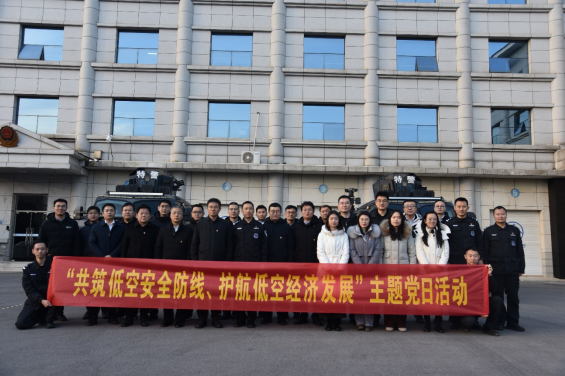
山东省发展改革委工业发展处党支部联合低空经济发展处党支部开展主题党日活动
Zhong Guo Fa Zhan Wang· 2025-12-31 18:36
Core Viewpoint - The event aims to promote the high-quality development of the low-altitude economy in Shandong Province, aligning with the spirit of the 20th National Congress of the Communist Party of China and emphasizing the integration of party building with business development [1]. Group 1: Event Overview - The Shandong Provincial Development and Reform Commission, along with the Provincial Public Security Special Police Corps, organized a themed party day activity focused on "Building a Low-Altitude Safety Defense Line and Supporting Low-Altitude Economic Development" [1]. - The event included a visit to the training base of the Provincial Public Security Special Police Corps, where discussions on "Satellite+" and "Low-Altitude+" police practices took place [3]. Group 2: Practical Insights - Participants conducted field research on police aviation equipment and low-altitude reconnaissance and strike gear, observing demonstrations of interception techniques against target drones [3]. - The event facilitated a deeper understanding of the latest developments in police applications within the low-altitude economy, highlighting the need for collaborative efforts from various parties to advance this sector [3]. Group 3: Future Directions - Attendees expressed that the activity served as both a knowledge enhancement and a practical teaching experience, motivating them to further integrate theoretical learning with business practices [3]. - There is a commitment to enrich the practical pathways for party-led development in emerging industries, with a focus on implementing measures for the advancement of the low-altitude economy in Shandong Province [3].

关于扩展商业航天市场应用场景的建议
Sou Hu Cai Jing· 2025-12-08 14:08
Core Viewpoint - The expansion of commercial aerospace market application scenarios is essential for the transformation and upgrading of the aerospace industry and achieving the strategic goal of becoming a strong aerospace nation. Current challenges include insufficient participation from private enterprises, low penetration in the consumer market, and inadequate international competitiveness, which hinder the formation of a sustainable commercial ecosystem [2][4]. Group 1: Current State of Commercial Aerospace Development - The commercial aerospace industry is rapidly developing, driven by technological advancements and increasing market demand, showcasing significant market potential and social value. The Chinese government has intensified its focus on commercial aerospace, implementing various measures to accelerate market expansion [3][4]. - China has made notable progress in launch services and satellite applications, with the government incorporating satellite internet into "new infrastructure" and promoting large-scale application demonstrations of new technologies and products [3][4]. Group 2: Challenges Facing Commercial Aerospace - The commercial aerospace market is at a critical transformation period, facing challenges such as a lack of private enterprise participation and insufficient penetration in the consumer market. The existing application scenarios are predominantly focused on government and military tasks, with limited engagement in civilian sectors [4][21]. - The current market structure shows a significant "Matthew effect," where state-owned enterprises and leading private companies dominate the satellite application industry, making it difficult for smaller private enterprises to compete [24][25]. Group 3: Driving Factors for Market Expansion - Technological advancements are reshaping the market ecosystem by breaking cost barriers, enhancing service efficiency, and broadening application boundaries, thus driving the expansion of commercial aerospace market application scenarios [15]. - Market demand is accelerating the integration and innovation of traditional application scenarios, leading to the emergence of new application scenarios in communication, navigation, and remote sensing [16]. Group 4: Future Application Scenarios - A list of 12 potential application scenarios for the commercial aerospace market has been identified, focusing on launch services, satellite applications, and the space economy. These scenarios include commercial launch infrastructure, satellite communication, satellite navigation, and space tourism, among others [27][29]. - The commercial launch service market has significant potential, with a focus on low-cost and high-reliability technologies to meet the growing demand for satellite launches and expand the application scenarios of launch services [30][31]. Group 5: Policy Recommendations - Strengthening policy support for commercial launch services is crucial to overcoming infrastructure and technological bottlenecks. This includes encouraging private enterprises to build commercial launch sites and simplifying approval processes for launch permits [42][43]. - It is essential to foster an open and integrated industrial ecosystem for satellite applications by supporting small and medium-sized private enterprises and promoting the development of "satellite+" market applications that integrate with emerging fields [45][46].