原料价格上涨

Search documents
重申食品饮料产业链-把握上游-还是上游
2026-03-13 04:46
Summary of Conference Call on Food and Beverage Industry Industry Overview - The food and beverage industry is expected to face dual pressures from rising upstream costs and weak downstream demand in 2026, leading profits to tilt towards the upstream B-end segments [1][4] - Geopolitical factors and national security concerns are driving commodity prices to remain high, with expectations for continued price increases in raw materials like corn until 2026 [1][2] Key Insights and Arguments - The current price increase logic is primarily driven by upstream factors rather than downstream consumer goods, as the economy is in a structural transition or at the end of a recession [2] - The ability to pass on cost increases to consumers is limited due to the overall L-shaped consumer power, making upstream positions safer [2][4] - The main drivers of the current price increases are geopolitical factors, followed by supply-demand dynamics, particularly in energy prices affecting agricultural products [2][3] Investment Strategies - Investment in the upstream supply chain should focus on three main lines: 1. Identifying companies with price transmission capabilities 2. Focusing on those that can achieve supply-side clearing 3. Targeting companies with low-cost inventory to facilitate profit recovery [5] - Specific areas of interest include: 1. Corn industry chain, especially starch sugars and related products 2. Agricultural processing sectors, particularly tomatoes and cotton 3. Food packaging, where companies producing aluminum sheets may have pricing power [5] Company-Specific Insights Huakang Co., Ltd. - Huakang is positioned to benefit from rising raw material prices leading to supply-side clearing, similar to the pig cycle model [6] - The company is expected to see significant profit improvements by the second half of 2026, with a favorable price point anticipated due to industry supply clearing [6] Guannong Co., Ltd. and COFCO Technology - Guannong's investment logic is currently focused on its stable profits from potassium mining, while its tomato sauce business is expected to benefit from rising raw material prices [7][8] - COFCO Technology is involved in corn starch and biofuel ethanol production, with potential profit improvements linked to rising oil prices and increased ethanol demand [8] Downstream Sector Analysis - The core influencing factor for the downstream sector is consumer demand, which remains weak, particularly for the liquor sector [9] - The first quarter of 2026 will be a critical observation point for the liquor sector, with potential for a trend reversal if earnings downgrades are sufficient [9] Investment Potential in Downstream - Companies with B-end customization capabilities are viewed as having greater investment potential, such as Miaokelan and Yihai International [10] - The focus on B-end clients allows for premium pricing due to higher customization demands, making it easier to implement price increases [10] Overall Investment Rhythm for 2026 - The recommended investment rhythm for 2026 suggests focusing on upstream sectors in the first half and potentially shifting to downstream sectors in the second half, contingent on consumer recovery [10] - Key areas for short-term focus include starch sugar processing, juice processing, wood products, functional sugars, and bio-extraction, with notable companies being Guannong, Huakang, COFCO Technology, and others [10]
中国银河证券:原料价格上行驱动上游纺织景气回升 国内棉花市场进入价格企稳阶段
智通财经网· 2026-03-10 01:26
Group 1 - The upstream core raw material market in the textile and apparel industry is undergoing a supply-demand restructuring, with supply tightening and demand recovering, leading to a new prosperity cycle for wool [1][2] - From July 2025, the wool market entered a new price increase cycle, rising from 1208 AUD/kg to 1716 AUD/kg by February 27, 2026, a 45% year-on-year increase [2] - Global cotton production and consumption are stable, with the 2025/26 market year production expected to reach 26 million tons, a slight increase of 0.81% year-on-year, supporting domestic cotton prices [3] Group 2 - The cost side is supported by rising crude oil prices, with Brent crude increasing from 61 USD/barrel to around 84 USD/barrel, driving up the cost center of the chemical fiber industry [4] - The processing price difference for polyester has steadily recovered from 1000-1100 CNY/ton to 1300-1500 CNY/ton, while nylon prices have room for further increases [4] - The price fluctuations of upstream raw materials directly impact the profit levels of companies in the textile industry, with wool price increases typically leading to higher profit margins for wool spinning companies [5][6]

中国银河证券:原料价格上行驱动上游纺织景气回升 建议关注新澳股份等
智通财经网· 2026-03-09 06:09
Group 1 - The report from China Galaxy Securities indicates that the rising cycle of upstream raw material prices presents clear profit recovery opportunities for leading textile yarn companies due to a contraction in wool supply and a recovery in demand, alongside fluctuating cotton prices and a supportive inventory-consumption ratio [2] - The wool market is entering a new price increase cycle starting from July 2025, with prices rising from 1208 AUD cents/kg to 1716 AUD cents/kg by February 2026, marking a 45% year-on-year increase [3] - The Australian wool production is expected to decline by 12.6% to 245,000 tons in the 2025/26 season, influenced by a significant reduction in the number of sheared sheep and a decrease in the average wool yield per sheep [4] Group 2 - The global cotton production and consumption have remained stable, with the 2025/26 market year production projected at 26 million tons, reflecting a minimal growth of 0.81%, while consumption is expected to remain steady at 25.89 million tons [5] - The inventory-consumption ratio for cotton is projected to be 62% for the 2024/25 season, which is at a lower level compared to the past decade, supporting domestic cotton prices amid expectations of reduced production in Xinjiang [5] - The cost of chemical fiber raw materials is rising due to Brent crude oil prices increasing from 61 USD/barrel to around 84 USD/barrel, establishing a cost center shift and profit recovery logic within the chemical fiber industry [6] Group 3 - The rising wool prices typically lead to increased profit margins for fine wool spinning companies, as they adopt a cost-plus pricing model, allowing for higher product prices during periods of rising wool prices [7] - Cotton is a core cost item for yarn companies, accounting for approximately 70% of raw material costs, and the profit margins of leading yarn companies are positively correlated with cotton prices [7] - The nylon business of leading chemical fiber company Taihua New Materials is expected to see profit margins increase as the price difference between nylon and caprolactam widens, indicating a potential for profit recovery in the chemical fiber industry [7]



中科磁业逆势下跌,业绩预期与板块回调成主因
Jing Ji Guan Cha Wang· 2026-02-14 05:41
Company Performance - Company released a profit forecast on January 29, 2026, expecting a net profit of 29 million to 34.5 million yuan for 2025, representing a year-on-year growth of 75.11% to 108.32% [1] - The net profit for the third quarter of 2025 was 12.7962 million yuan, while the median of the annual forecast (31.75 million yuan) fell short of some investors' expectations for sustained high growth, potentially leading to profit-taking [1] Industry Sector Performance - On February 13, 2026, the rare earth permanent magnet sector index fell by 2.02%, and the non-ferrous metal sector dropped by 3.36%, both underperforming the market (Shanghai Composite Index down 1.26%) [2] - The company experienced a net outflow of main funds amounting to 45.5343 million yuan, which was a significant proportion of the total trading volume, while the financing balance increased by 41.9925 million yuan (an increase of 17.88%) over the past five days, indicating a growing divergence between leveraged funds and main funds [2] Company Valuation - As of the close on February 13, the company's stock price was 60.60 yuan, with a price-to-earnings ratio (TTM) of 190.10, significantly higher than the industry average [3] - The stock price fell below the 5-day moving average (61.666 yuan), and the KDJ indicator showed the J line rising to 73.96, nearing the overbought zone, suggesting some technical selling pressure was released [3] Industry Policy and Environment - Despite recent price increases in rare earth raw materials like neodymium oxide (with a 30-day increase of 30.71%), there are market concerns that high raw material prices may squeeze the profit margins of midstream companies, particularly putting pressure on the company's gross margin (which was 17.28% in the third quarter of 2025) [4]
翔丰华业绩回暖,原料涨价压力下毛利率低至13.06%
Hua Xia Shi Bao· 2025-10-23 03:57
Core Insights - Shanghai Xiangfenghua Technology Co., Ltd. reported significant growth in Q3 2025, with revenue increasing by 31.08% year-on-year and 16.18% quarter-on-quarter, while net profit surged by 26.01% year-on-year and 339.83% quarter-on-quarter, reaching 22.89 million yuan, the highest in five quarters [2][4][5] Financial Performance - For the first three quarters of 2025, the company's revenue grew by 8.16% to 1.131 billion yuan, but net profit decreased by 64.64% to 19.95 million yuan compared to the previous year [2][4] - The gross margin for Q3 2025 improved to 14.04%, up 3.61 percentage points from the previous quarter, contributing to the substantial increase in net profit [4][5] - The company experienced a significant drop in profitability in the first half of 2025, with Q2 net profit at only 5.21 million yuan and Q1 showing a loss of 8.15 million yuan [5] Industry Context - The negative electrode industry is facing an oversupply situation, with companies often taking orders at a loss. Xiangfenghua primarily supplies mid-to-low-end products, which have lower profitability [3][7] - Raw material prices, particularly for petroleum coke, have risen significantly, impacting profit margins. The price of low-sulfur coke increased by approximately 1,500 yuan per ton compared to last year [3][7] - The overall capacity utilization in the negative electrode industry is higher than last year, with the peak production season in Q3 contributing to increased output [6][7] Strategic Developments - Xiangfenghua is expanding its product offerings, including silicon-carbon and silicon-oxygen negative materials, while also exploring international markets [4][8] - The company is investing in high-end production capabilities, with a new integrated production base for artificial graphite negative materials expected to be completed by December 2026 [8]

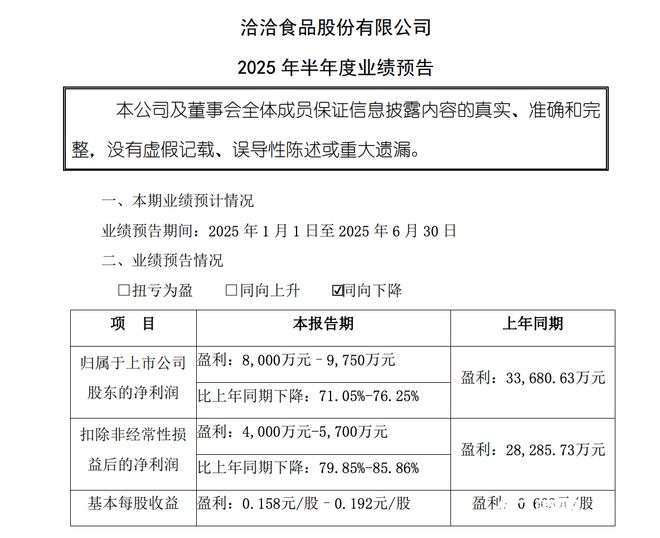
再次面临成本上涨压力,洽洽食品上半年净利润下跌超七成
Nan Fang Du Shi Bao· 2025-07-15 11:11
Core Viewpoint - In the first half of this year, Qiaqia Food's net profit is expected to decline significantly, marking the largest mid-year profit drop since its listing in 2011, primarily due to rising raw material costs [1][4][6]. Financial Performance - The estimated net profit attributable to shareholders for the first half of the year is projected to be between 80 million and 97.5 million yuan, representing a year-on-year decline of 71.05% to 76.65% [1][4]. - The net profit after deducting non-recurring gains and losses is expected to be between 40 million and 57 million yuan, reflecting a year-on-year decrease of 79.85% to 85.86% [1][4]. - Basic earnings per share are projected to be between 0.158 yuan and 0.192 yuan, compared to 0.605 yuan per share in the same period last year [4]. Reasons for Profit Decline - The decline in net profit is attributed to a significant increase in raw material procurement prices, leading to a substantial drop in gross profit margins [1][6]. - In the first quarter, net profit fell by 67.88% to approximately 77.25 million yuan, with revenue decreasing by 13.76% to 1.571 billion yuan [1][5]. Product and Market Dynamics - Qiaqia Food primarily produces and sells nut snacks, with sunflower seeds being the main source of revenue [1][6]. - The gross profit margin for the snack food business decreased by 5.03% to 26.85%, with sunflower seed margins dropping by 7.92% to 25.23% [6]. - The company has previously raised prices on sunflower seed products to cope with cost pressures, but has not announced any new price increase plans for 2023 [6][8]. Future Outlook - Qiaqia Food plans to increase its investment in new sales channels, such as Sam's Club, which saw a revenue growth of 50%-60% [8]. - The company aims to expand its SKU offerings in the snack wholesale channel, although this may compress profit margins due to the low-margin nature of these sales [8].