
参公大集合产品改造

Search documents
参公大集合改造收官战迎关键一役:东财基金如何打好与投资者“共赢”这一仗?
Sou Hu Cai Jing· 2025-12-12 02:37
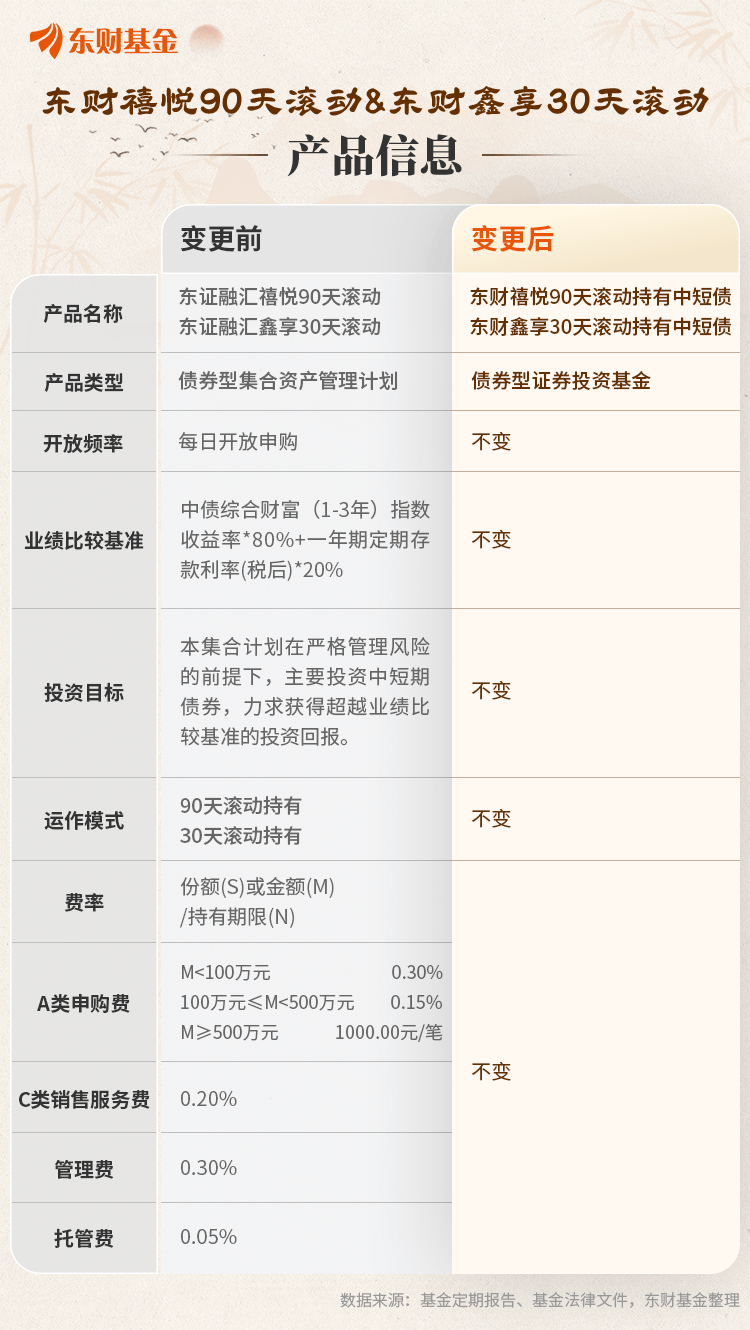
Core Viewpoint - The transition of the asset management plans "Dongcai Xinxing 30 Days" and "Dongcai Xiyue 90 Days" to public funds marks a significant milestone in the transformation of brokerage public collective products, with a combined scale exceeding 9 billion, setting a new record for single transfers in recent times [1][2]. Group 1: Product Transition Details - The core change involves the legal structure and management of the products, which will now be classified as public funds [2]. - Key product elements such as fee rates and performance benchmarks will remain unchanged to minimize investor anxiety [2][3]. - The product names have been updated to "Dongcai Xiyue 90 Days Rolling Bond Fund" and "Dongcai Xinxing 30 Days Rolling Bond Fund" [3]. Group 2: Investor Experience and Communication - The transition process includes automatic conversion of existing product shares to new fund shares, requiring no action from investors, thus avoiding potential transaction costs [4]. - Investors can continue to use the original purchase channels for inquiries, with only the product name and management name updated [4]. - To address potential investor concerns due to lack of timely announcements, Dongcai Fund has implemented a proactive communication strategy to enhance information coverage [5]. Group 3: Investment Management and Strategy - The investment objectives and strategies of the products will remain stable, but the management change allows for enhanced research support from Dongcai Fund's fixed income platform [6]. - The fixed income team will provide comprehensive research support, improving risk-return optimization through systematic methodologies [6]. - The risk control system will be integrated into Dongcai Fund's comprehensive monitoring framework, enhancing the management of various risks [6]. Group 4: Industry Implications - The case of Dongcai Fund illustrates that focusing on investor experience can effectively reduce friction costs during the transformation process [8]. - The transition serves as a practical example of managing investor relations and emphasizes the importance of communication and service in maintaining trust [8].

全部撤回!券商资管申请公募牌照,排队队伍清零!
Zheng Quan Shi Bao· 2025-11-29 04:29
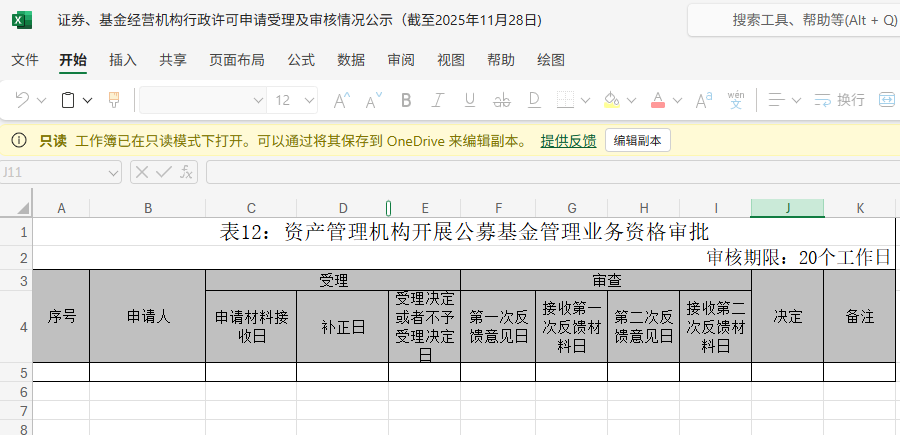
Core Viewpoint - The approval process for public fund management licenses for securities asset management subsidiaries has effectively come to a halt, with no firms currently in the queue for applications, indicating a significant shift in the regulatory landscape for the industry [1][2][3]. Group 1: License Application Status - As of November 28, no securities asset management firms are listed as pending for public fund management licenses, marking a complete withdrawal of applications from the previous week [2][3]. - The initial wave of applications for public licenses was driven by policy relaxations, particularly the "one participation, one control" policy introduced in May 2022, which allowed for a limited increase in the number of public licenses [2][3]. - In 2023, six securities asset management firms submitted applications for public licenses, but only two, China Merchants Asset Management and Everbright Securities Asset Management, were granted licenses [2][3]. Group 2: Regulatory Changes and Industry Impact - The 2018 asset management regulations mandated that securities asset management products transition to public fund management by the end of 2025, leading to a rush among firms to comply [4][5]. - With the deadline approaching, firms that have not obtained public licenses are exploring alternative paths, including changing management to public fund institutions, liquidating products, or transitioning to private fund management [4][5]. - Notably, some firms are transferring their public fund products to affiliated fund companies, while others are engaging in cross-industry management arrangements, which is becoming increasingly rare [5].
全部撤回!券商资管申请公募牌照,排队队伍清零!
Zheng Quan Shi Bao Wang· 2025-11-29 03:29
Core Viewpoint - The application for public fund management licenses by several brokerage asset management subsidiaries has completely ceased, indicating a significant shift in the industry as the deadline for compliance with new regulations approaches [2][3][6]. Group 1: License Application Status - As of November 28, no brokerage asset management companies are in line to apply for public fund licenses, marking a complete withdrawal of applications [3][6]. - Initially, four companies, including Guotai Junan Asset Management, were in the queue for public licenses, but all have now withdrawn their applications [2][6]. - The regulatory environment has shifted, with indications that no new public fund licenses will be granted to brokerage asset management firms [6][8]. Group 2: Regulatory Background - The asset management industry is under pressure to complete the transformation of "public collective" products to comply with regulations by the end of 2025 [7][9]. - The 2018 regulations required brokerage asset management products to align with public fund management standards, leading to a rush for licenses following the easing of restrictions in 2022 [5][7]. Group 3: Industry Response and Future Directions - With the deadline approaching, brokerage asset management firms are exploring various paths, including changing management, liquidation, or transitioning to private fund management [9][10]. - Some firms are transferring their collective products to affiliated public fund companies, while others are opting for private asset management plans [10][11]. - Notably, there are instances of cross-industry management changes, where firms without affiliated fund companies are engaging unrelated fund management firms [10][11].
全部撤回!券商资管申请公募牌照,排队队伍清零!
券商中国· 2025-11-29 03:18
Core Viewpoint - The article highlights the complete withdrawal of several brokerage asset management subsidiaries from the public fund license application process, indicating a significant shift in the industry as the deadline for compliance with new regulations approaches [2][3][6]. Group 1: License Application Status - As of November 28, no brokerage asset management companies are currently in line to apply for public fund licenses, marking a total withdrawal from the application process [3]. - Initially, four companies, including Guotai Junan Asset Management, were in the queue for public fund licenses, but all have now withdrawn their applications [2][6]. - The withdrawal of applications is seen as a response to regulatory signals indicating that no new public fund licenses would be granted to brokerage asset management firms [6]. Group 2: Regulatory Background - The asset management industry is undergoing a transformation due to the 2018 regulations requiring brokerage firms to convert their "public collective" products to comply with public fund standards by the end of 2025 [8]. - The transition has led to various strategies, including changing management to public fund institutions, converting products to private funds, or liquidation [9]. Group 3: Industry Trends - The article notes that only 14 out of 30 brokerage asset management subsidiaries have successfully obtained public fund licenses, with the majority of applications failing to progress [7]. - The trend of transferring management of collective products to affiliated public fund companies is becoming common among brokerage firms, as seen with companies like CITIC Asset Management and GF Asset Management [10]. - Some firms are also exploring partnerships with unrelated fund companies for managing their products, indicating a diversification of management strategies [10][11].

倒计时!37家券商这类产品,加速退出历史舞台
券商中国· 2025-06-30 02:55
Core Viewpoint - The transformation of broker-dealer public collective investment products is entering its final phase, with many firms accelerating their disposal plans and shifting management to public fund companies [2][4][5]. Group 1: Current Status of Broker-Dealer Public Collective Products - As of the end of Q1 this year, there are 37 broker-dealer institutions with over 150 public collective investment products, totaling a scale of 354.9 billion yuan, with 11 products exceeding 10 billion yuan in size, all of which are money market funds [3][12]. - Many broker-dealers are transferring their public collective products to affiliated public fund companies, especially when they lack public fund licenses [5][11]. Group 2: Recent Developments - On June 28, Guotai Junan Asset Management announced plans to transfer three public collective products to Anxin Fund Management, while CICC extended the expiration date of two of its products to November 30, 2025, and is working to change the management to CICC Fund [2][6]. - CICC's previous products received approval from the CSRC to change their registration to CICC Fund, indicating a trend towards compliance with regulatory requirements [7]. Group 3: Regulatory Environment and Future Outlook - The regulatory framework established in 2018 requires broker-dealer public collective products to transition to public fund management, with a focus on compliance and quality development in the public fund industry [8][10]. - The pace of obtaining public fund licenses has slowed, with only a few broker-dealers successfully acquiring such licenses, leading others to explore alternative routes for compliance or liquidation of their products [11][15]. - The recent trend shows that regulatory bodies are less inclined to grant extensive extensions for product deadlines, indicating a push for completion of the transformation process [15].

参公大集合改造加速 公募牌照成业务转型关键
Zheng Quan Shi Bao· 2025-06-29 17:55
Core Viewpoint - The pace of disposal for brokerages' public-like collective products has accelerated, with many firms opting to transfer management to public fund companies and register these products as public funds [1][2][4] Group 1: Current Trends - Brokerages are increasingly transferring their public-like collective products to affiliated public fund companies as a mainstream disposal method [2][6] - On June 28, Guotai Junan Asset Management announced plans to transfer three of its public-like collective products to Anxin Fund Management [1][3] - CICC extended the expiration date of its collective products from June 30, 2025, to November 30, 2025, and plans to change the management to CICC Fund [3][7] Group 2: Regulatory Context - The 2018 regulatory guidelines require brokerages to convert public-like collective products to comply with public fund standards, with various pathways for compliance [4][5] - As of now, only about ten brokerages have obtained public fund licenses, making it easier for them to transition their public-like collective products to public funds [4][6] Group 3: Market Dynamics - As of the first quarter of this year, there are 150+ public-like collective products from 37 brokerages, with a total scale of 354.9 billion [7] - Many brokerages have not disclosed specific plans for the conversion of their public-like collective products, merely extending their expiration dates [7][8] - If these products are not converted by the end of this year, they may face liquidation, as regulatory bodies have not granted widespread extensions [8]
