
和平解决国际争端原则

Search documents
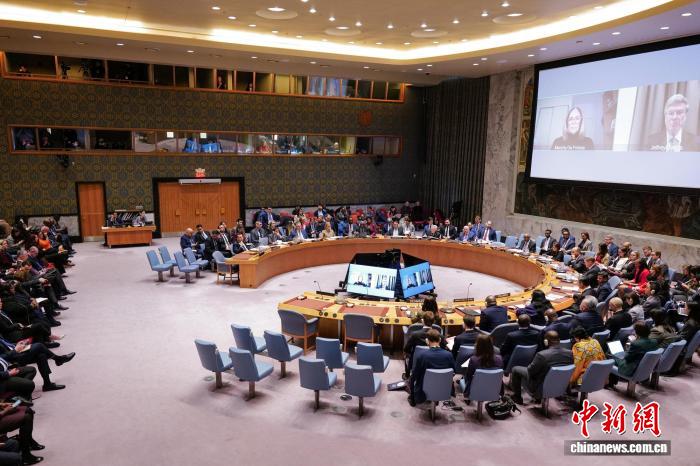
联合国安理会举行紧急会议 多方谴责美国侵犯委内瑞拉主权
Yang Shi Wang· 2026-01-06 14:13
Group 1 - The United Nations Security Council held an emergency meeting regarding the situation in Venezuela, where the UN Secretary-General expressed concern over the U.S. military actions that allegedly violated international law [1] - The Venezuelan representative condemned the U.S. actions as a blatant violation of the UN Charter and demanded the immediate release of President Maduro and his wife, who are under U.S. control [1] - The Chinese representative criticized the U.S. for disregarding international concerns and violating principles of sovereignty, non-interference, and peaceful resolution of disputes, urging dialogue instead [1] - The Russian representative strongly condemned the U.S. armed aggression, claiming the true aim is to control Venezuela's natural resources [1] - The French representative stated that U.S. military actions undermine the principles of peaceful dispute resolution and non-use of force, threatening international peace and security [1] Group 2 - The Brazilian representative warned that the U.S. actions set a dangerous precedent for the international community, calling for strong condemnation of armed intervention in other countries' sovereignty [2] - Representatives from Cuba, Colombia, Chile, Pakistan, Denmark, and South Africa also expressed opposition or condemnation of U.S. interference [2] Group 3 - President Maduro and his wife rejected U.S. criminal charges in a New York court, while protests against U.S. interference occurred outside the courthouse [3] - Delsy Rodríguez was sworn in as acting president of Venezuela, and the government issued a decree for police to search for individuals involved in supporting U.S. armed attacks, implementing military management of the oil industry and other critical sectors [3] Group 4 - Gunfire was reported near the presidential palace in Venezuela due to a drone entering a no-fly zone, with police firing warning shots; the situation was described as calm overall [4]
联合国安理会举行委内瑞拉局势紧急公开会
Zhong Guo Xin Wen Wang· 2026-01-06 03:32
Core Viewpoint - The United Nations Security Council held an emergency public meeting regarding the situation in Venezuela, where multiple countries condemned the U.S. military actions as violations of international law [1][3][4]. Group 1: International Reactions - The UN Under-Secretary-General for Political and Peacebuilding Affairs, DiCarlo, stated that the U.S. military actions on January 3 did not respect international law, as the UN Charter prohibits the use or threat of force against the territorial integrity or political independence of any state [1]. - Russia's permanent representative to the UN, Nebenzya, indicated that the U.S. actions reveal its true intentions to exert unlimited control over Venezuela's natural resources and establish hegemony in Latin America [3]. - China's temporary representative to the UN, Sun Lei, expressed strong condemnation of the U.S.'s unilateral and illegal actions, emphasizing violations of principles such as sovereignty equality and non-interference in internal affairs [3]. - France's temporary representative to the UN, Damadikar, noted that the U.S. military actions undermine the principles of peaceful dispute resolution and non-use of force, threatening the foundation of international order [3]. - Colombia's permanent representative to the UN, Zarabato, strongly condemned the U.S. military actions, stating they pose a serious threat to the international order established after World War II [4]. Group 2: Venezuela's Position - The Venezuelan permanent representative to the UN, Moncada, asserted that the U.S. actions blatantly violate the UN Charter and international law, framing the situation as a threat of colonialism and neo-colonialism [5]. - Moncada demanded the immediate release of Venezuelan President Maduro and his wife, emphasizing that tolerating or downplaying such actions would send a devastating message to the world [5].

中方强烈谴责美方对委的单边、非法、霸凌行径
Xin Lang Cai Jing· 2026-01-05 19:46
Core Viewpoint - The Chinese representative at the UN strongly condemns the unilateral and illegal actions of the United States regarding Venezuela, emphasizing the need for adherence to international law and the UN Charter [1][2]. Group 1: U.S. Actions and International Response - The international community has expressed significant concern over U.S. sanctions and military threats against Venezuela, with calls for peaceful resolution and respect for sovereignty [1][2]. - The U.S. is accused of disregarding international concerns and violating principles of sovereignty, non-interference, and peaceful dispute resolution [1][2]. Group 2: China's Position and Recommendations - China urges the U.S. to acknowledge the overwhelming international call for compliance with international law and to cease actions that undermine Venezuela's sovereignty [2][3]. - The Chinese representative emphasizes that military solutions are not viable and that the U.S. should return to dialogue and negotiation to resolve issues [2][3]. Group 3: Support for Venezuela and Regional Stability - China reaffirms its support for the Venezuelan government and people's rights to defend their sovereignty and dignity [3]. - The importance of Latin American and Caribbean nations in maintaining global peace and stability is highlighted, along with a call for mutual respect and cooperation among nations [3].
中国代表:强烈谴责美方对委内瑞拉的单边、非法、霸凌行径
Yang Shi Xin Wen· 2026-01-05 19:05
Core Viewpoint - China strongly condemns the unilateral and illegal actions of the United States regarding Venezuela, emphasizing the need for respect for international law and the sovereignty of nations [1][2]. Group 1: China's Position on U.S. Actions - China expresses deep shock and strong condemnation of the U.S. sanctions and military threats against Venezuela, highlighting the international community's concerns [1]. - The Chinese representative urges the U.S. to acknowledge the overwhelming calls from the international community to stop infringing on Venezuela's sovereignty and to return to dialogue for political resolution [2]. - Historical lessons indicate that military means are not a solution, as past U.S. actions have led to prolonged conflicts and humanitarian crises in various regions [2]. Group 2: Support for Venezuela and Regional Stability - Venezuela is recognized as an independent sovereign nation with the right to defend its sovereignty and dignity, and Latin American countries have the right to choose their development paths [3]. - China firmly supports the Venezuelan government and people in maintaining their sovereignty and legitimate rights, advocating for respect and non-interference in internal affairs [3]. - The call for the U.S. to change its approach emphasizes the importance of mutual respect and cooperation among nations in the region to maintain peace and stability [3].
中方指出美国4个严重违反
Xin Lang Cai Jing· 2026-01-05 17:41
Core Viewpoint - The United Nations Security Council held an emergency public meeting regarding the situation in Venezuela, where China's representative criticized the U.S. for violating international principles and threatening regional peace and security [1][2]. Group 1: U.S. Actions and International Principles - The U.S. is accused of disregarding international concerns and violating Venezuela's sovereignty, security, and legitimate rights, which undermines the principles of sovereign equality and non-interference in internal affairs [1]. - China's representative urged the U.S. to recognize the overwhelming calls from the international community to adhere to international law and the principles of the UN Charter, and to cease actions that infringe on other countries' sovereignty [1][2]. Group 2: Call for Dialogue and Cooperation - China emphasizes that military means are not a solution and that the abuse of force leads to greater crises, referencing past U.S. military actions in Iraq and Iran that resulted in ongoing conflicts and humanitarian suffering [2]. - China expresses firm support for the Venezuelan government and people in maintaining their sovereignty and security, advocating for a return to dialogue and cooperation based on mutual respect and non-interference [2].