哑铃型市场结构

Search documents
地产经纬丨韧性中求进 上海楼市“哑铃型”市场结构愈发清晰
Xin Lang Cai Jing· 2025-12-24 11:38
Core Insights - Shanghai is the only first-tier city in China where housing prices have increased, reflecting a unique market structure amid complex conditions and steady policy regulation [1][2] New Housing Market - The new housing market in Shanghai has shown a stable performance with a slight upward price trend, supported by an optimized supply structure and improved product quality [2][6] - In 2025, the monthly transaction volume of new residential properties fluctuated between 2,257 and 5,468 units, with March recording the peak at 5,468 units [2] - The price index for new residential properties maintained a month-on-month increase throughout the year, with a high of 0.7% in March and May, and a slight increase of 0.1% in November [2][4] Second-hand Housing Market - The second-hand housing market in Shanghai experienced a continuous price decline throughout 2025, with transaction volumes stabilizing between 18,000 and 23,000 units after reaching a peak of 29,345 units in March [4][6] - The price index for second-hand residential properties began to decline in February, with a notable drop of 0.9% in July and a slight recovery in October and November [4][6] - Low-priced "old and small" properties have become the main choice for buyers, accounting for approximately 60% of recent transactions, while mid to high-end second-hand properties face significant pressure [6][7] Market Structure - The Shanghai real estate market has developed a "dumbbell" structure, characterized by a clear division between the high-end new housing market and the low-end second-hand market [5][7] - High-end residential properties are in high demand, with the top-selling property, Shanghai Yihua Courtyard, achieving sales of 22.03 billion yuan and an average price of 62.23 million yuan per unit [5] - The demand for low-priced second-hand properties is driven by young buyers seeking affordable housing options, despite the lower living quality associated with these properties [6][7] Future Outlook - The "dumbbell" market structure is expected to persist, with ongoing competition in the new housing market and stable demand for low-priced properties in the second-hand market [8] - The continuous increase in high-end supply may lead to intensified competition among developers, necessitating improvements in product quality and service [8] - The overall stability of the Shanghai real estate market reflects the effectiveness of policy regulation and the underlying economic fundamentals, suggesting a potential for healthier and more sustainable development in the future [8]


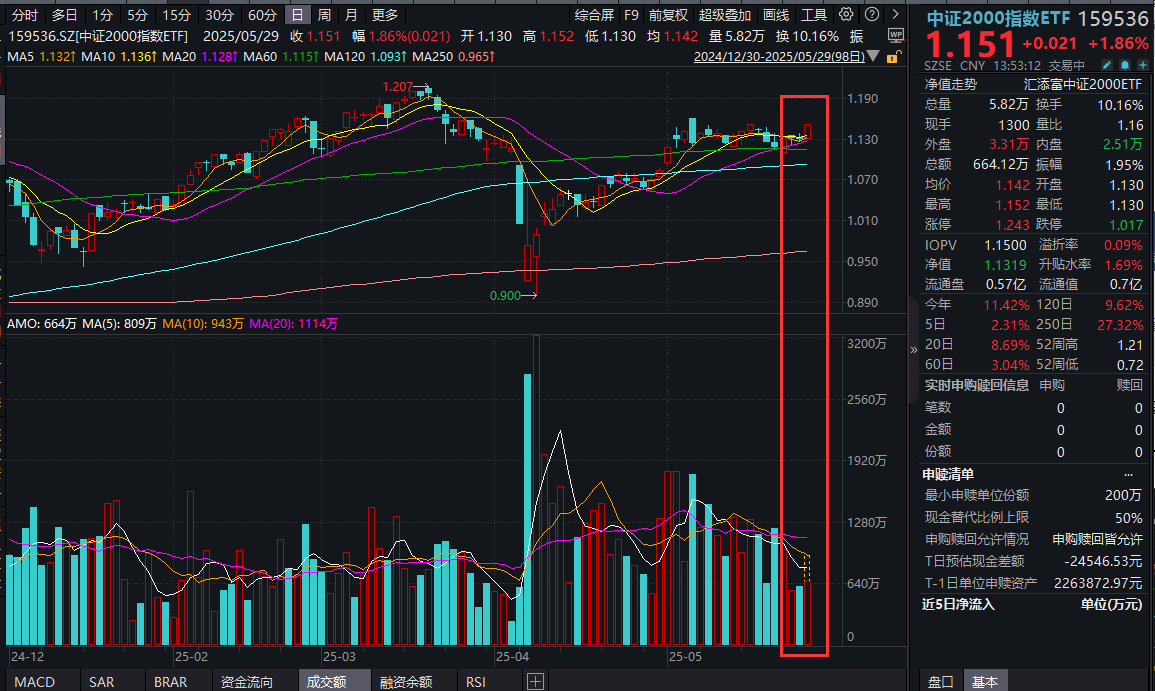
科技股领涨!A股全面普涨,中证2000指数ETF(159536)放量涨近2%,复盘5月,为何会出现大小盘两端强势的哑铃行情?
Xin Lang Cai Jing· 2025-05-29 06:28
Core Viewpoint - The A-share market has shown a collective rebound with over 4,400 stocks rising, particularly in the technology sector and small-cap stocks, highlighted by the significant increase in the CSI 2000 Index ETF (159536) which surged by 1.86% on May 29 [1][3] Market Performance - The CSI 2000 Index ETF (159536) experienced a strong performance with a notable increase in trading volume, surpassing the total trading volume of the previous day [1] - Key stocks within the CSI 2000 Index saw a surge, with companies like Sifang Jingchuang and Tianyang Technology hitting the 20% daily limit up, while others like Qingdao Jinwang and Jinlong Automobile reached a 10% increase [3] - The CSI 2000 Index recorded a monthly increase of 4.14%, outperforming other indices such as the North China 50 (3.54%) and the ChiNext 50 (3.08%) [4] Market Structure - The market has exhibited a "dumbbell structure" with small-cap stocks like the CSI 2000 and North China 50 performing well, while mid-cap indices like the CSI 500 lagged behind [3][4] - This structure is attributed to low implied volatility in the market, leading investors to adopt a dual strategy of investing in large-cap core stocks for defense and small-cap stocks for potential gains [4] Investment Opportunities - The CSI 2000 Index is favored due to its smaller median market capitalization of 4.529 billion compared to the CSI 1000's 10.9 billion, indicating a stronger small-cap focus [4] - The small-cap stocks are expected to benefit from merger and acquisition policies, which can lead to value re-evaluation [4] - If risk appetite continues to improve, small-cap stocks may maintain their advantageous position in the market [5] Economic Factors - Domestic policies are showing resilience, with corporate earnings rebounding despite tariff impacts, supported by ongoing new policies [5][6] - Easing overseas risks, such as the temporary suspension of US-China tariffs, is boosting market sentiment and corporate revenue potential [6] - The market is also benefiting from liquidity support, with measures like reserve requirement ratio cuts expected to enhance market activity [6] Strategic Recommendations - Investors are advised to consider a strategy that combines dividend-paying stocks with small-cap investments to capitalize on the ongoing market trends [6]