商业医疗保险

Search documents
中国药促会宋瑞霖:如果手机价格被管控 就不会有今天的华为
经济观察报· 2025-10-27 11:25
Core Viewpoint - The key to the pharmaceutical industry's leap lies in improving market mechanisms, as highlighted by the comparison with successful companies like Huawei and BYD [2]. Group 1: Market Mechanism and International Comparison - The U.S. has successfully attracted significant investments from major pharmaceutical companies by establishing price benchmarks and tariff threats, leading to 60% of their profits coming from the U.S. market [2]. - In contrast, Europe’s social welfare policies have led to a "decentralization" of the pharmaceutical industry, with major companies like Roche and Novartis choosing to launch new drugs in the U.S. due to its larger and more attractive market [2][3]. - China's per capita spending on innovative drugs is significantly lower than that of Japan, with Japan's per capita spending being 24.4 times higher despite having a GDP 3.9 times that of China [3]. Group 2: Challenges in China's Pharmaceutical Industry - China excels in the invention and transformation stages of the pharmaceutical chain but struggles in the commercialization phase, often acting merely as a "project provider" [4]. - The current pricing negotiation process for innovative drugs in China begins with price reductions, unlike the U.S., where there is a stable pricing period post-launch [3]. Group 3: Recommendations for Improvement - The first recommendation is to reform the approval and evaluation mechanisms for innovative drug reimbursement, suggesting a direct connection between drug approval and insurance coverage [5]. - A proposed solution includes allowing innovative drugs to enter the insurance system at the price of similar existing drugs, with subsequent evaluations based on real-world data to adjust reimbursement prices accordingly [6]. - The second recommendation emphasizes the development of commercial health insurance, which could potentially raise significant funds if the middle class participates [6][7]. Group 4: Financial Implications and Social Equity - If 350 million middle-class individuals in China each spend 800 yuan monthly on commercial insurance, it could generate over 3.4 trillion yuan annually, surpassing current health insurance funding [7]. - Concerns about commercial insurance benefiting only the wealthy are addressed by comparing it to private cars versus public transport, suggesting that it could enhance basic medical coverage for those in greater need [7]. - Achieving reimbursement levels similar to Japan could position the pharmaceutical industry as a true economic pillar, allowing companies to contribute more in taxes and better support public welfare [7].



中国药促会宋瑞霖:如果手机价格被管控 就不会有今天的华为
Jing Ji Guan Cha Bao· 2025-10-27 09:50
Core Viewpoint - The key to the pharmaceutical industry's growth in China lies in improving market mechanisms, as highlighted by the comparison with successful companies like Huawei and BYD in other sectors [1]. Group 1: International Comparisons - The U.S. has successfully attracted significant investments from major pharmaceutical companies by establishing price benchmarks and tariff threats, with 60% of their profits coming from the U.S. market [1]. - In contrast, Europe’s social welfare policies have led to a "decentralization" of the pharmaceutical industry, with major companies like Roche and Novartis choosing to launch new drugs in the U.S. due to its larger and more attractive market [1][2]. - The UK's exit from the EU has resulted in reduced market attractiveness, causing large pharmaceutical companies to reconsider their investments [1]. Group 2: Current State of China's Pharmaceutical Industry - China's innovation drug industry is currently mismatched with its market potential, as evidenced by the low per capita spending on innovative drugs compared to Japan, where per capita spending is 24.4 times higher despite a GDP that is only 3.9 times greater [2]. - The pricing logic for innovative drugs differs significantly between China and the U.S., with China initiating price negotiations at the outset, leading to immediate price reductions upon market entry [2]. Group 3: Challenges in Commercialization - While China excels in the invention and transformation stages of the pharmaceutical chain, it struggles in the commercialization phase, often acting merely as a "project provider" due to insufficient market support [3]. Group 4: Recommendations for Improvement - Two core recommendations were proposed: 1. Reform the entry and evaluation mechanisms for innovative drug insurance, suggesting a direct connection between drug approval and insurance coverage, with a two-year evaluation period based on real-world data [4]. 2. Develop commercial health insurance significantly, with a proposed model that could generate over 3.4 trillion yuan annually if 350 million middle-class individuals contribute 800 yuan monthly [5]. Group 5: Economic Impact - If China's innovative drug payment system could reach the level of Japan's, the pharmaceutical industry could become a true economic pillar, allowing companies to pay more taxes and better support public welfare [5].
南下资金持续加仓 60%涨幅背后思派健康(00314)商业模式获验证?
智通财经网· 2025-06-20 01:55
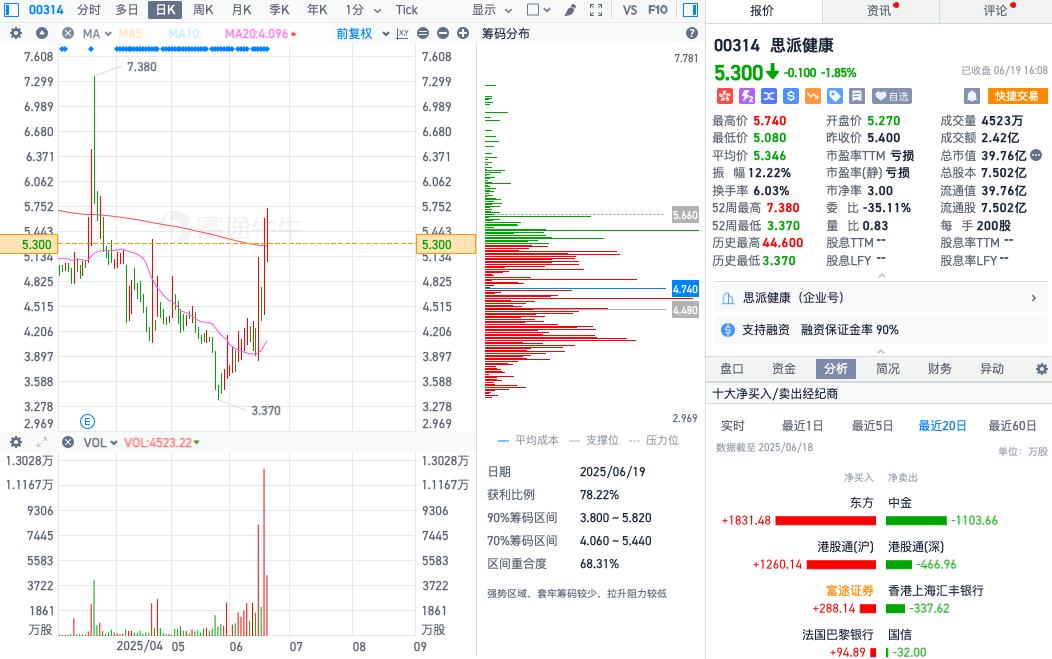
Core Viewpoint - The Hong Kong pharmaceutical sector is experiencing a significant rally, with Sipai Health (00314) showing particularly strong performance, having increased nearly 60% since its low on May 28, 2023 [3][10]. Trading Performance - Sipai Health's stock price surged from a low of 3.37 HKD on May 28 to a high of 5.74 HKD on June 19, with a closing price of 5.3 HKD and a trading volume of 45.23 million HKD on that day [1][3]. - The stock has demonstrated a "volume-price rise" pattern, with daily trading volumes frequently exceeding 1 billion HKD, and a weekly increase of over 30% [4][7]. - The stock's turnover rate exceeded 60% during this period, indicating strong trading activity [4][5]. Institutional Interest - There has been a notable increase in large orders, with significant buying activity from institutional investors, as evidenced by a net inflow of 26.95 million HKD over the past five days [5]. - The proportion of holdings by mainland investors increased from 11.57% on May 29 to 13.22% on June 18, reflecting growing interest from this investor group [5]. Technical Indicators - Technical analysis shows that Sipai Health has broken through key resistance levels and is positioned above all major moving averages, indicating a bullish trend [7]. - The MACD indicator has shown a second bullish crossover above the zero line, and the RSI remains in a strong range of 70-85, suggesting robust upward momentum [7]. Business Model and Market Position - Sipai Health operates a unique business model that integrates medical services, insurance, and health management, which is gaining renewed market attention [10]. - The company has established strategic partnerships with multiple insurance firms, enhancing its profitability through high-margin insurance products [10][12]. - The business model's dual focus on medical services and insurance mitigates risks associated with purely online medical platforms and aligns with industry trends towards cost control and the rise of commercial insurance [10]. Financial Performance - The company's commercial medical insurance service revenue is projected to grow significantly, with a year-on-year increase of 39.6% expected in 2024 [11]. - By the end of 2024, Sipai Health's corporate medical insurance client base is anticipated to reach 476, covering over 1.1 million employees and their families, marking a growth of approximately 45% [11]. Competitive Advantage - Sipai Health's competitive edge stems from its integrated approach, where medical services drive pharmaceutical sales, and insurance needs enhance medical consumption [12]. - The company's ecosystem creates a "flywheel effect," improving business barriers and enhancing overall value [12]. - The current market conditions and the company's strong fundamentals suggest that Sipai Health's valuation recovery may just be beginning, with potential for further price appreciation as market penetration and innovation in pharmaceuticals expand [12].