商业咖啡

Search documents
《咖饮品类发展报告2025》发布:咖饮品牌密集推出茶饮产品,下沉市场成必争地
3 6 Ke· 2025-10-31 12:28
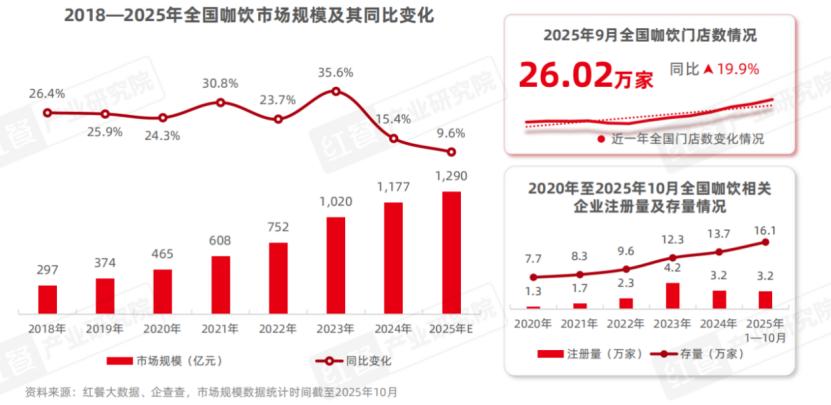
Core Insights - The coffee beverage market in China is expected to reach nearly 130 billion yuan by 2025, driven by increasing consumer acceptance and local product trends [1][2] - Despite market growth, coffee brands face challenges such as high costs, price pressures, and severe product homogenization, leading to decreased consumer loyalty [1][2] - The competitive landscape is intensifying with fast-food chains, tea brands, and convenience stores entering the coffee market [1] Market Growth and Brand Dynamics - The coffee market continues to grow, with the number of coffee shops exceeding 260,000 by September 2025, marking a 19.9% year-on-year increase [2] - Independent coffee shops account for over 60.5% of the total coffee shop count, indicating a strong presence of non-chain brands [6] - Major chain brands like Luckin Coffee and Kudi Coffee are rapidly expanding, with store counts reaching 26,000 and 13,000 respectively [8] Regional Distribution - Eastern, Southern, and Southwestern China lead in coffee shop numbers, accounting for 35.9%, 23.2%, and 14.4% respectively [4] - Regions with less than 10% market share, such as Central and Northern China, are experiencing rapid growth, with all showing over 20% year-on-year increases [4] Consumer Trends and Product Offerings - The coffee beverage segment is diversifying, with a significant increase in ready-to-drink options and a growing trend towards tea products [15][16] - The average consumer spending on coffee has decreased from 41 yuan in September 2023 to 26 yuan in September 2025, influenced by price wars and competition from delivery platforms [20] Challenges for Specialty Coffee Brands - Specialty coffee brands face challenges from low-cost competition and rising operational costs, leading to a constrained profit margin [11] - Strategies to counter these challenges include launching affordable sub-brands, utilizing small store models, and expanding product offerings beyond coffee [12] Strategic Focus on Lower-Tier Markets - Lower-tier cities are becoming critical for coffee brands, with significant growth in store numbers in these areas [18] - Brands like Luckin Coffee and Rong Xiao Qiao are heavily investing in these markets, with a high percentage of their stores located in third-tier cities and below [18] Conclusion - The coffee beverage sector is experiencing growth alongside challenges such as high costs and intense competition, with opportunities emerging from lower-tier markets and supply chain localization [22]