
商业航天发射

Search documents
我国首个,海上液体火箭发射回收试验平台将投用
财联社· 2026-01-21 05:28
Core Viewpoint - The article highlights the significant advancements in China's commercial space industry, particularly focusing on the construction of the first offshore liquid rocket launch and recovery test platform in Haiyang, Shandong, as part of the national goal to accelerate the establishment of a strong space power [1][2]. Group 1: Offshore Launch Platform Construction - The construction of the offshore liquid rocket launch and recovery test platform is underway at the Dongfang Spaceport in Haiyang, Shandong, marking a milestone in China's commercial space endeavors [2]. - The platform features a hydraulic pit that is seven to eight meters deep, equipped with four hydraulic vertical oil cylinders capable of rotating hundreds of tons of liquid rockets from horizontal to vertical positions for launch [3]. - A 17-meter deep flow channel is designed to direct the high-temperature rocket exhaust during ignition, utilizing a circular spray pipe to quickly cool the exhaust and reduce noise, thereby protecting the launch facilities [5]. Group 2: Operational Timeline and Testing - Over 150 workers are engaged in the construction, aiming to complete the platform and begin testing by around February 5, with a mainstream commercial liquid rocket scheduled for launch and recovery tests shortly after the Spring Festival [7]. - The Dongfang Spaceport has previously conducted 22 offshore launch missions using solid rockets, which, while flexible and mobile, have limitations in payload capacity and recovery [9]. Group 3: Advantages of Liquid Rockets - Liquid rockets offer greater payload capacity and the potential for reuse, significantly reducing satellite network costs, positioning them as the primary focus for domestic commercial space launches [11]. Group 4: Comprehensive Industry Layout - The Dongfang Spaceport is strategically located on an artificial island, approximately 3 kilometers from the mainland, ensuring safety due to the absence of fixed residents [12]. - The facility is designed with multiple functional areas, including a launch and recovery test platform and supporting fuel storage areas for liquid oxygen, liquid nitrogen, kerosene, and methane, essential for liquid rocket operations [14]. - As the only offshore launch mother port in China, the Dongfang Spaceport has successfully launched 137 satellites, contributing to a comprehensive industrial ecosystem in Shandong that integrates offshore launch leadership, collaborative rocket manufacturing, and space application expansion [16].

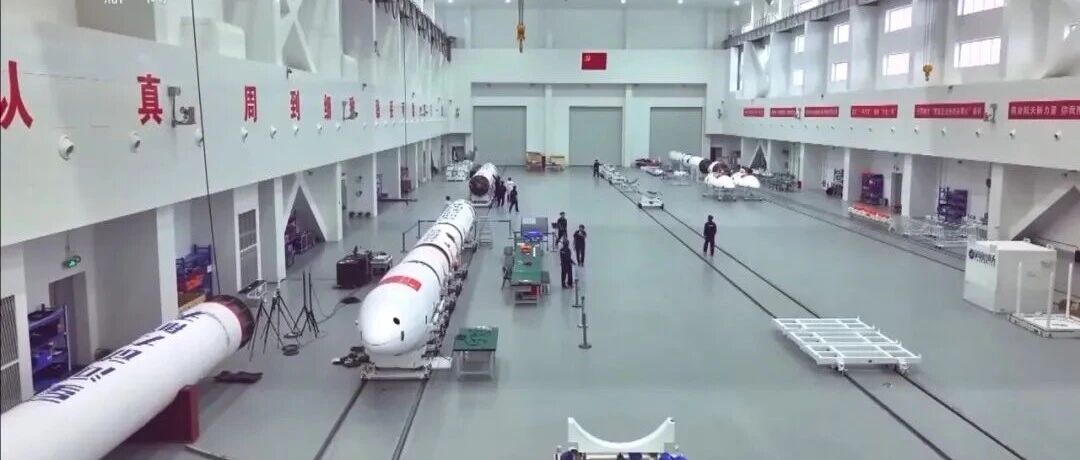
2025年我国商业航天发射达50次
Bei Jing Shang Bao· 2026-01-20 03:21
Core Insights - In 2025, China's commercial space sector is projected to complete 50 launches, accounting for 54% of the country's total space launches for the year [1] - Among these, 25 launches will be conducted using commercial launch vehicles, while the Hainan commercial space launch site will be operational with 9 launches, totaling 10 since its establishment [1] - Additionally, 311 commercial satellites are expected to be placed into orbit, representing 84% of the total satellites launched by China in that year [1]
2026年首次航天发射,印度遭遇失败
Huan Qiu Shi Bao· 2026-01-12 22:41
Core Viewpoint - The recent failure of India's PSLV rocket launch has raised concerns about the deployment of military reconnaissance satellites and has dampened expectations for the PSLV's successful return to form [1] Group 1: Launch Details - The PSLV-DL rocket, with a launch mass of 260 tons and a height of 44.4 meters, was intended to reach an altitude of 505.291 kilometers [2] - The launch took place at 10:18 AM local time at the Satish Dhawan Space Centre, marking India's first satellite launch of 2026 [1][2] - The rocket successfully completed the first two stages of flight and separation, capturing nationwide attention, but failed to achieve orbit after an anomaly occurred during the third stage [2][3] Group 2: Payload Information - The primary payload was the EOS-N1 satellite, developed by the Defence Research and Development Organisation (DRDO), which is designed for strategic defense, agriculture, urban mapping, and environmental monitoring [2] - In addition to EOS-N1, the rocket carried 15 other payloads, including a joint Earth observation satellite developed with Thailand, a satellite from Brazil for rescuing distressed fishing vessels, and a technology demonstrator from a Spanish startup [2] Group 3: Implications and Future Plans - The failure of the PSLV rocket highlights the challenges of complex space missions, even for ISRO's most reliable launch vehicle [3] - ISRO aims to revitalize confidence in the PSLV rocket and plans to celebrate its 101st orbital launch this year [1] - The launch was organized by ISRO's commercial arm, NewSpace India Ltd, marking its ninth mission, as India seeks to enter the commercial space launch market [2]
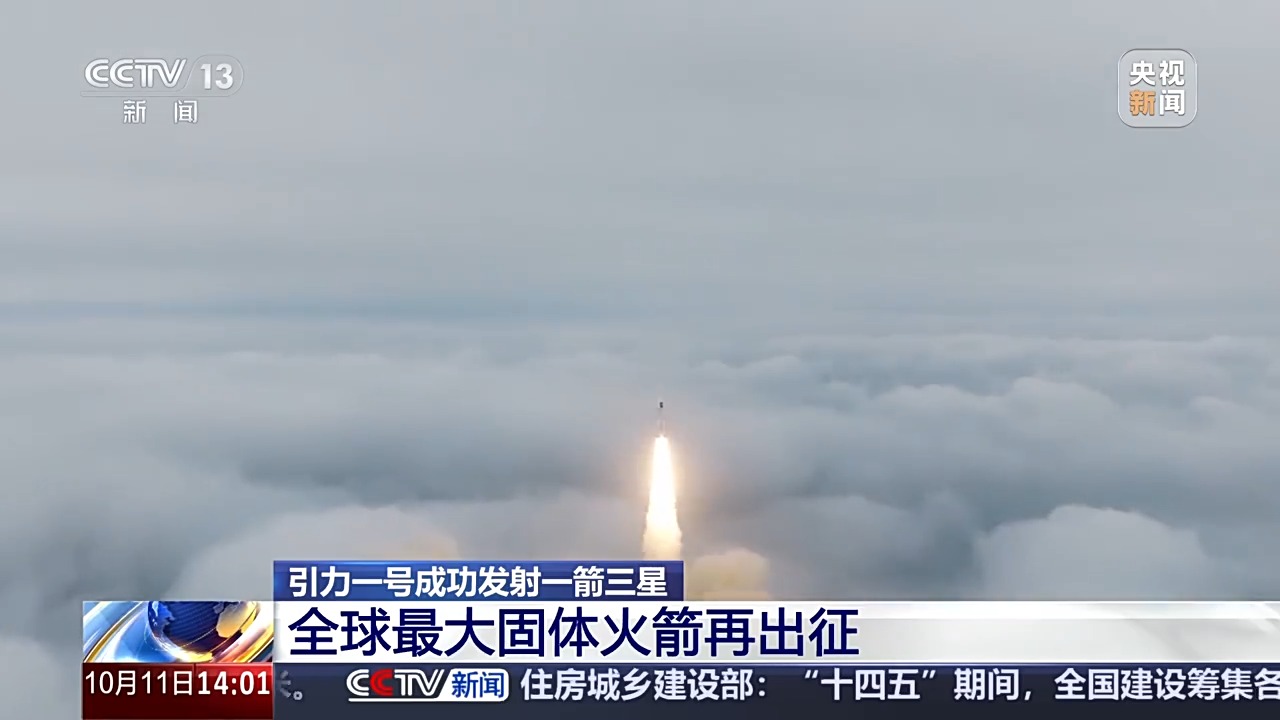
全球最大固体火箭再出征!这次发射都有哪些特点
Yang Shi Xin Wen· 2025-10-11 07:38
Core Viewpoint - The successful launch of the Gravity-1 remote two carrier rocket marks a significant advancement in China's commercial space launch capabilities, demonstrating the rocket's upgraded technology and reliability for future satellite deployment [1][3][5] Group 1: Launch Details - The launch took place at 10:20 AM from the Taiyuan Satellite Launch Center, successfully placing the Jilin-1 Wideband 02B07 satellite and two Tianyu experimental satellites into their designated orbits [1] - This mission represents the second flight of the Gravity-1 carrier rocket, which previously set records as the world's largest solid-fuel carrier rocket and China's largest civil commercial rocket [3] Group 2: Technological Advancements - The Gravity-1 rocket has undergone significant upgrades in both software and hardware since its first flight in January 2024, enhancing its reliability and performance [3][5] - The rocket's launch trajectory has been modified to a sun-synchronous orbit, differing from the 50-degree inclination used in its predecessor, indicating improvements in ballistic design [5] Group 3: Future Implications - The successful launch further validates the reliability of the rocket's design and the stability of its quality control processes, which are crucial for future missions [5] - With a capacity to launch over 400 kilograms of satellites in a "one rocket, ten satellites" configuration, the Gravity-1 rocket is positioned to meet China's growing demand for large-scale low Earth orbit satellite constellation deployments [5]
长征商业发射用户大会在沪召开
Xin Hua She· 2025-09-27 09:00
Core Insights - As of May this year, China's Long March rockets have completed a total of 119 commercial launches, showcasing strong overall performance that ranks among the best in the world [2] Group 1 - The Long March rocket series has established itself as a significant player in the commercial launch market [2] - The performance metrics of the Long March rockets indicate a competitive edge in the global space launch industry [2]