啤酒高端化转型

Search documents
长达近十年,嘉士伯还未甩掉“烫手山芋”拉萨啤酒
Xin Lang Cai Jing· 2025-11-27 01:10
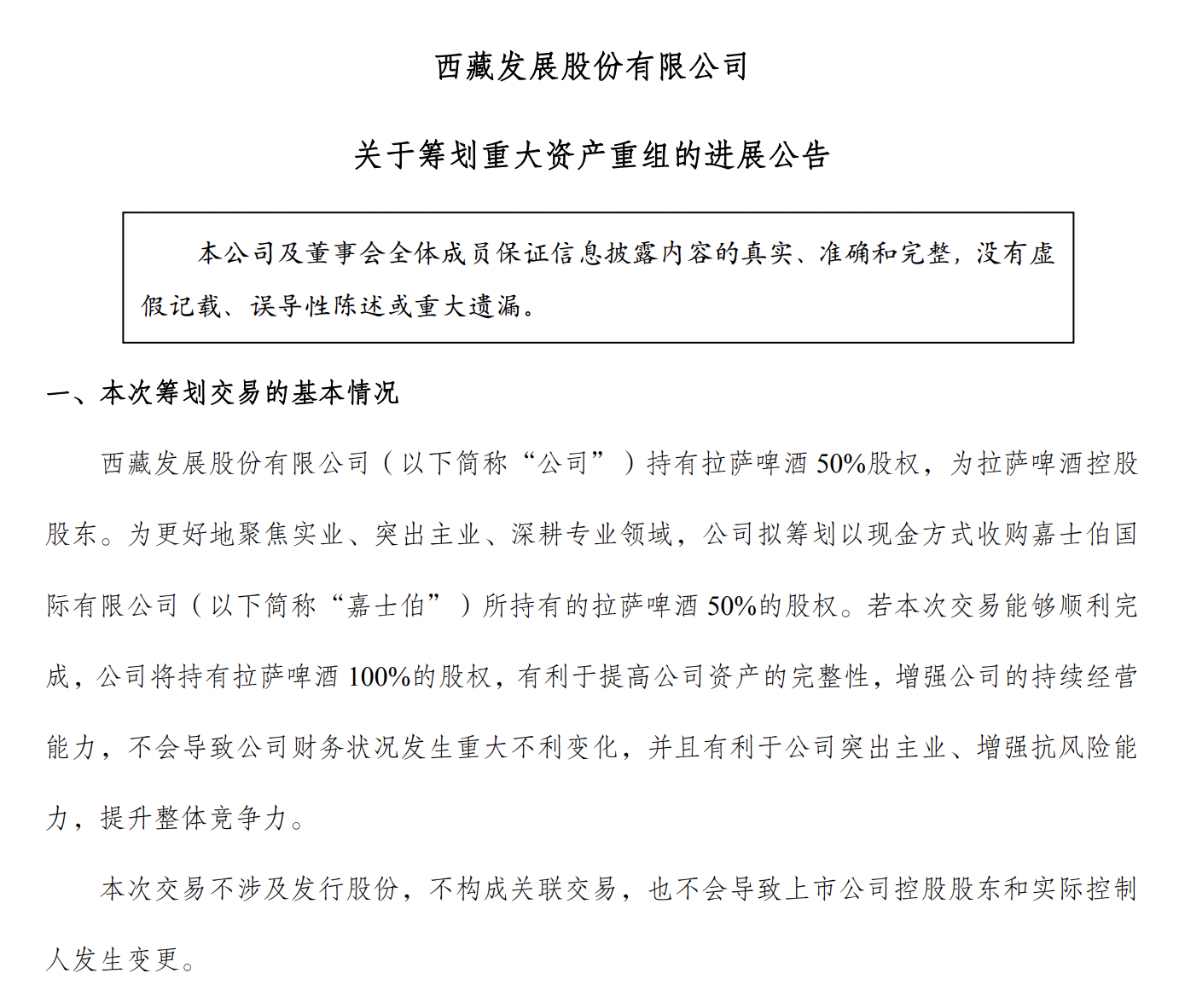
Core Viewpoint - The long-standing equity dispute between Tibet Development (ST Xifa) and Carlsberg over Lhasa Beer is approaching a critical juncture by the end of 2025, with Tibet Development planning to acquire the remaining 50% stake from Carlsberg to achieve full control of Lhasa Beer, enhancing its core business and overall competitiveness [1][4]. Group 1: Background of the Dispute - Lhasa Beer was established in 2004 as a joint venture between Tibet Development and Carlsberg, each holding a 50% stake, with Tibet Development retaining operational control [4]. - The partnership was influenced by the booming Chinese beer market and Carlsberg's strategic shift to invest in western China after 2003 [4]. - Despite initial ambitions, Lhasa Beer has struggled to become an international brand, with Carlsberg expressing intentions to exit as early as 2016 due to unsatisfactory performance and lack of control [5][6]. Group 2: Financial Performance and Challenges - Lhasa Beer experienced declining revenues from 2013 to 2015, with revenues of 447 million, 398 million, and 391 million yuan, and net profits also decreasing during the same period [6]. - In 2022, Lhasa Beer reported a revenue of 337 million yuan, a 21.64% increase year-on-year, and in 2024, revenue reached 421 million yuan, growing by 25.11% [8][9]. - The company has shifted towards high-end products, with the "3650" small bottle beer achieving a revenue increase of 296.50% in 2024 [9]. Group 3: Recent Developments and Future Prospects - The negotiations between Tibet Development and Carlsberg have shifted from confrontation to collaboration, with Tibet Development's board approving the terms for the 50% stake acquisition on July 21, 2025 [11]. - The ongoing restructuring phase for Tibet Development poses risks, including potential bankruptcy, which could affect the planned equity transfer [12]. - The successful acquisition of Lhasa Beer would be crucial for Tibet Development, as it represents a significant portion of its revenue and could enhance market confidence [11].


华润啤酒老帅离场:“勇闯天涯”的开拓者,豪赌白酒留下残局
Guan Cha Zhe Wang· 2025-07-03 06:54
Core Viewpoint - The sudden resignation of Hou Xiaohai, the chairman of China Resources Beer, raises questions about the future direction of the company and its ambitious dual growth strategy in both beer and liquor sectors [1][3][10]. Company Leadership Changes - Hou Xiaohai resigned from his position as chairman and other committee roles effective June 27, 2023, to focus on personal matters [1][3]. - Zhao Chunwu, the executive director and president, will temporarily assume the responsibilities of the chairman during the transition period [3]. Historical Context and Achievements - Hou Xiaohai played a pivotal role in the transformation of China Resources Beer, leading the company to become a market leader through strategic acquisitions and brand development [5][9]. - Under his leadership, the company implemented the "3+3+3" strategy aimed at enhancing product quality and achieving high-end market leadership by 2025 [8][9]. Financial Performance - During Hou's tenure, the company's revenue grew by over 10 billion, and net profit increased nearly fourfold [9]. - However, in 2024, the company reported a revenue of 40.57 billion, a decline of 2.44% year-on-year, and a net profit of 4.739 billion, down 8.03% [9]. Liquor Business Strategy - The liquor segment was seen as a second growth curve for the company, with significant investments exceeding 20 billion in various liquor acquisitions [10][11]. - Despite ambitious plans, the liquor business has not met expectations, with 2024 revenue at 2.149 billion, falling short of the projected growth targets [11][12]. Market Reactions and Future Challenges - The leadership change has sparked market interest, with analysts noting that the company's future direction will depend on strategic planning and organizational capabilities rather than individual leadership [13]. - The new leadership will face challenges in high-end market penetration and integrating beer and liquor operations effectively [13].