国产商用飞机海外市场拓展

Search documents
国产民机常态化“出海”参展,商业运营大规模铺开
Hua Xia Shi Bao· 2026-02-07 04:37
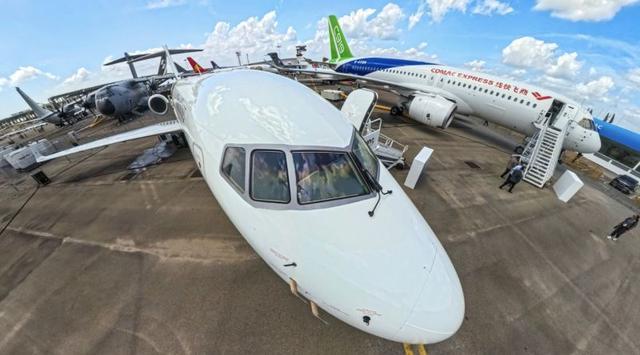
Core Viewpoint - The participation of China Commercial Aircraft Corporation (COMAC) in the 2026 Singapore Airshow highlights its ongoing efforts to expand the international market for Chinese-made commercial aircraft, showcasing models like the C919 and C909 [2][3]. Group 1: Aircraft Showcase and Market Presence - COMAC displayed multiple domestic aircraft, including the C919 and C909, at the Singapore Airshow, marking its second participation in an international airshow after the 2025 Dubai Airshow [2][3]. - The C909 aircraft has been successfully operated in Indonesia, Laos, and Vietnam, with a total of 9 units operating over 20 routes, transporting over 700,000 passengers [3][4]. - As of December 2025, the C909 has been delivered to three overseas customers, with operational routes including 11 by Wings Air, 5 by Laos Airlines, and 3 by VietJet Air [3][8]. Group 2: Aircraft Specifications and Performance - The C909 can carry 78-97 passengers with a range of 2,225-3,700 kilometers, while the C919 accommodates 158-192 passengers with a range of 4,075-5,555 kilometers, both designed for various operational conditions [4][6]. - By the end of 2025, over 200 units of both aircraft types have been delivered, with more than 800 routes opened, serving over 36 million passengers [5][8]. Group 3: Orders and Future Developments - During the airshow, COMAC signed an order for 6 C909 firefighting aircraft with Shanxi Successful General Aviation, enhancing its emergency response capabilities [6][8]. - The C909 medical aircraft was also showcased, designed for various medical applications, indicating COMAC's commitment to diversifying its product offerings [7][8]. Group 4: Operational Growth and Challenges - The C919 fleet has shown significant operational growth, with an average passenger load factor of 84.3% and a monthly flight volume increase of 123.1% year-on-year as of December 2025 [9][10]. - Despite the positive growth, COMAC faces challenges in increasing production capacity and meeting delivery targets, with only 15 units delivered in 2025 against a target of 50 [10].