国产AI芯片发展

Search documents
国产AI芯片,疯狂秀肌肉
3 6 Ke· 2026-01-30 00:25
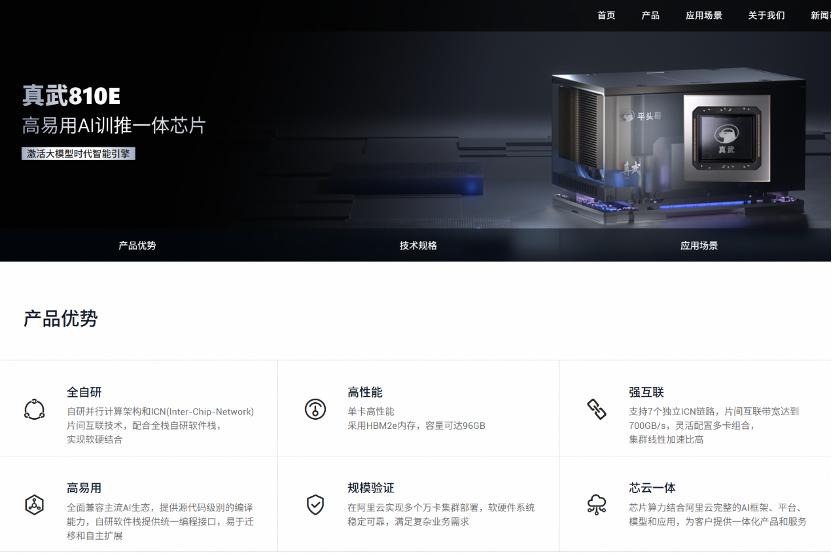
Industry Overview - The AI chip market in China is projected to reach a trillion yuan by 2028, accounting for approximately 30% of the global market, driven by strong demand for high-quality AI computing power [1] - Domestic AI chip manufacturers are rapidly advancing, with multiple announcements regarding new AI chips [1] Company Developments - Alibaba has launched its self-developed high-end AI chip "Zhenwu 810E," which features a fully self-researched architecture, 96GB HBM2e memory, and 700 GB/s inter-chip bandwidth, suitable for AI training and inference [2][5] - The "Zhenwu" PPU chip has been deployed in multiple clusters on Alibaba Cloud, serving over 400 clients, including major organizations like the State Grid and Xpeng Motors [2] - Alibaba's chip performance reportedly surpasses NVIDIA's A800 and is comparable to NVIDIA's H20, indicating a strong market position [4][6] Competitive Landscape - Yixing Intelligent has introduced the first RISC-V AI computing chip, Epoch, which is now in mass production. This chip combines RISC-V and RVV instruction set architectures, enhancing both general and specialized AI computing capabilities [7][10] - Epoch outperforms competitors by 25% to 52% in running models like ResNet-50 and BERT, showcasing significant advantages in key operations [8] - Tianzuo Zhixin has unveiled a four-generation architecture roadmap, aiming to surpass NVIDIA's Hopper architecture by 2025, with subsequent architectures targeting further advancements [12][14] Emerging Technologies - Sunrise, a spinoff from SenseTime, plans to release its first GPGPU chip, Qihang S3, by the end of 2024, focusing on optimizing cost and energy efficiency in real-world applications [16][18] - Suiruan Technology is preparing for an IPO and has developed a complete product system encompassing AI chips, acceleration cards, and AI computing software platforms [19] Market Dynamics - The domestic AI chip industry is experiencing rapid growth following U.S. restrictions on AI chips, with a diverse range of companies emerging across GPU and non-GPU technology routes [20][22] - Companies are adopting different strategies, such as "compatible catch-up" and "innovative surpass," to establish competitive advantages in the AI chip market [22][23]