Epoch

Search documents
从“更快”到“更省”:AI下半场,TPU重构算力版图
3 6 Ke· 2026-02-09 02:47
Core Insights - The rise of Google's TPU (Tensor Processing Unit) marks a significant shift in AI computing, moving from a GPU-dominated era to a new focus on specialized architectures for inference, particularly with the introduction of TPU v7, which has drastically reduced inference costs [1][4][32] Group 1: Market Dynamics - The AI landscape is evolving, with a shift from "training is king" to "inference is king," as the demand for efficient inference services grows [2][4] - Google's TPU v7 has reportedly reduced the cost per million tokens for inference by approximately 70% compared to its predecessor, indicating a competitive edge over NVIDIA's offerings [4][7] - The competition is intensifying, with companies like Anthropic placing significant orders for TPUs, highlighting the commercial viability of specialized chips [7][32] Group 2: Technological Innovations - TPU's architecture is designed for efficiency, focusing on matrix operations essential for AI, which contrasts with the general-purpose nature of GPUs [8][12] - Innovations such as the unique pulsing array architecture and large on-chip SRAM cache significantly reduce energy consumption associated with data movement [8][12] - The introduction of RISC-V architecture in AI chips allows for enhanced programmability and efficiency, aligning with industry trends towards specialized computing [15][16] Group 3: Cost Efficiency - The focus on reducing token costs is paramount, as companies aim to make AI services as affordable as utilities, driving the need for lower inference costs [4][27] - The competitive landscape is shifting towards maximizing efficiency and reducing costs rather than merely increasing computational power [27][32] - Companies like Yixing Intelligent are developing architectures that align with these trends, emphasizing energy efficiency and cost reduction in AI computations [14][20] Group 4: Ecosystem Development - The collaboration between hardware and software is crucial, with companies like Yixing Intelligent integrating open-source technologies to enhance compatibility and ease of use [20][26] - The establishment of ecosystems that support various frameworks (e.g., TensorFlow, PyTorch) is essential for broad adoption and seamless transitions between platforms [10][20] - The development of advanced interconnect technologies, such as ELink, is vital for supporting high-bandwidth, low-latency communication in AI applications [28][30]



从“更快”到“更省”:AI下半场,TPU重构算力版图
半导体行业观察· 2026-02-09 01:18
Core Insights - The article emphasizes the shift from "training is king" to "inference is king" in AI, highlighting the importance of specialized architectures like Google's TPU in reducing inference costs and reshaping the AI computing landscape [1][4][11]. Group 1: Evolution of AI Models - Large models undergo a growth process similar to human development, involving pre-training, fine-tuning, and reinforcement learning to align outputs with human preferences [3]. - The infrastructure for training large models requires high computing power, high memory bandwidth, and strong multi-GPU interconnects, with NVIDIA being the dominant player due to its high-performance GPUs and CUDA ecosystem [3]. Group 2: Cost Efficiency in Inference - After training, the commercial value of AI models lies in scalable inference services, where the cost of inference directly impacts profit margins [4]. - The focus has shifted to reducing inference costs while maintaining performance, with Google's TPU v7 reportedly lowering the cost per million tokens by approximately 70% compared to its predecessor [8][10]. Group 3: Competitive Landscape - The competition in AI computing is evolving, with specialized architectures like Google's TPU emerging as strong challengers to NVIDIA's dominance [10][11]. - A significant order from Anthropic for TPUs indicates a shift towards large-scale commercial deployment of ASIC chips, suggesting potential profit improvements of billions annually through reduced inference costs [10]. Group 4: Technological Innovations - Google's TPU architecture is designed for efficiency, focusing on matrix operations and minimizing unnecessary components, which enhances performance and reduces energy consumption [13]. - Innovations such as the unique pulsed array architecture and large on-chip SRAM caches contribute to TPU's advantages in inference scenarios [18]. Group 5: Software and Ecosystem Development - Google is addressing the software ecosystem by making its TPU compatible with popular frameworks like PyTorch, thereby reducing the cost of transitioning from NVIDIA's ecosystem [15][27]. - The collaboration with various tech giants to support open-source projects like OpenXLA aims to create a unified compilation path across different hardware [15][17]. Group 6: Domestic Chip Manufacturers - Domestic chip companies like Yixing Intelligent are developing architectures that align with the trends of specialized computing, focusing on efficiency and cost reduction [20][22]. - Yixing Intelligent's chips support advanced data formats and architectures that enhance performance while reducing storage costs, positioning them competitively in the market [26][27]. Group 7: Future Directions - The industry is transitioning from a focus on raw computing power to optimizing efficiency and cost-effectiveness, marking a significant shift in the competitive landscape [42]. - The emergence of technologies like ELink for high-speed interconnects indicates a broader trend towards integrated AI infrastructure that encompasses hardware, software, and system optimization [38][40].

国产AI芯片,疯狂秀肌肉
3 6 Ke· 2026-01-30 00:25
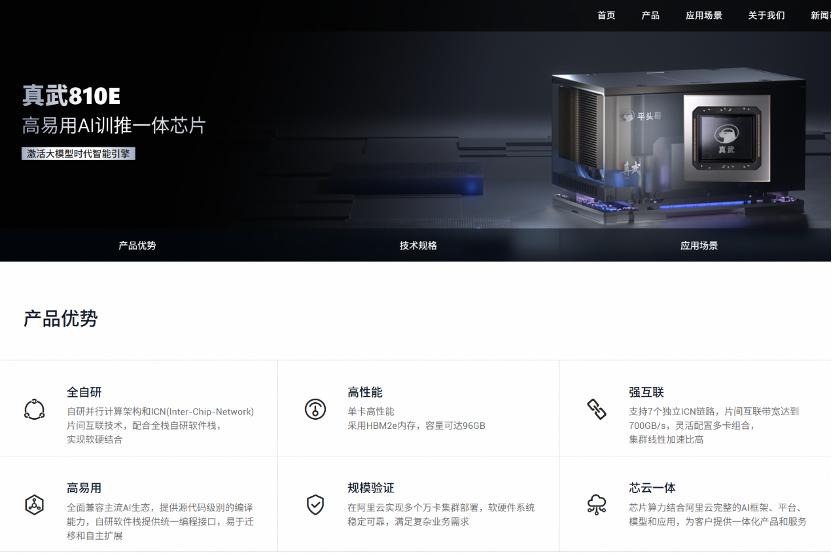
Industry Overview - The AI chip market in China is projected to reach a trillion yuan by 2028, accounting for approximately 30% of the global market, driven by strong demand for high-quality AI computing power [1] - Domestic AI chip manufacturers are rapidly advancing, with multiple announcements regarding new AI chips [1] Company Developments - Alibaba has launched its self-developed high-end AI chip "Zhenwu 810E," which features a fully self-researched architecture, 96GB HBM2e memory, and 700 GB/s inter-chip bandwidth, suitable for AI training and inference [2][5] - The "Zhenwu" PPU chip has been deployed in multiple clusters on Alibaba Cloud, serving over 400 clients, including major organizations like the State Grid and Xpeng Motors [2] - Alibaba's chip performance reportedly surpasses NVIDIA's A800 and is comparable to NVIDIA's H20, indicating a strong market position [4][6] Competitive Landscape - Yixing Intelligent has introduced the first RISC-V AI computing chip, Epoch, which is now in mass production. This chip combines RISC-V and RVV instruction set architectures, enhancing both general and specialized AI computing capabilities [7][10] - Epoch outperforms competitors by 25% to 52% in running models like ResNet-50 and BERT, showcasing significant advantages in key operations [8] - Tianzuo Zhixin has unveiled a four-generation architecture roadmap, aiming to surpass NVIDIA's Hopper architecture by 2025, with subsequent architectures targeting further advancements [12][14] Emerging Technologies - Sunrise, a spinoff from SenseTime, plans to release its first GPGPU chip, Qihang S3, by the end of 2024, focusing on optimizing cost and energy efficiency in real-world applications [16][18] - Suiruan Technology is preparing for an IPO and has developed a complete product system encompassing AI chips, acceleration cards, and AI computing software platforms [19] Market Dynamics - The domestic AI chip industry is experiencing rapid growth following U.S. restrictions on AI chips, with a diverse range of companies emerging across GPU and non-GPU technology routes [20][22] - Companies are adopting different strategies, such as "compatible catch-up" and "innovative surpass," to establish competitive advantages in the AI chip market [22][23]