
国家算力互联互通节点建设

Search documents
工信部推进国家算力互联互通节点建设
Xin Lang Cai Jing· 2026-02-09 20:19
Core Viewpoint - The Ministry of Industry and Information Technology has issued a notice to establish a national computing power interconnection node system, aiming to enhance the efficiency and service level of public computing resources [1] Group 1: National Computing Power Interconnection Node System - The system consists of "1" national computing internet service node, "M" regional nodes, and "N" industry nodes [1] - The operation mechanism is based on "unified identification, unified standards, and unified rules" [1] Group 2: Implementation and Goals - Each node will obtain a unique identification code through the national node, facilitating the entry of computing resources into the market [1] - Nodes will be built according to unified standards and interfaces to achieve interconnectivity [1] - The notice aims to standardize the interconnection and efficient flow of computing resources across different regions and entities, thereby improving the utilization of public computing resources [1] - The Ministry will accelerate the construction of these nodes to promote high-quality development of the computing power industry, supporting the goals of becoming a manufacturing powerhouse, a network powerhouse, and advancing digital China [1]
高盛:15年来最严重的芯片短缺正在逼近!芯片股集体起立,“全芯”科创芯片ETF(589190)放量涨超3%
Xin Lang Cai Jing· 2026-02-09 11:34
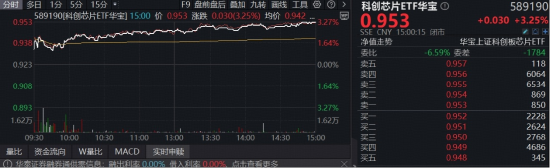
Group 1 - The core viewpoint of the news is the significant rise in the semiconductor sector, particularly in chip stocks, driven by favorable domestic policies and strong demand from major overseas companies [1][2][3] - On February 9, the semiconductor hardware sector experienced a surge, with 47 out of 50 stocks in the Shanghai Stock Exchange Science and Technology Innovation Board Chip Index rising, and 33 stocks increasing by over 2% [1][2] - Chip design stocks led the gains, with notable increases such as Chipone Technology rising by 14.87%, and other companies like Lattice Semiconductor and Cambricon Technologies also showing strong performance [1][3] Group 2 - The Huabao Science and Technology Chip ETF (589190) opened high and closed up over 3%, recovering its 5-day moving average with increased trading volume [1][2] - The recent policy from the Ministry of Industry and Information Technology on February 6 aims to promote the construction of a national computing power interconnection node system, which is expected to boost the industry [2][3] - Major overseas companies like Nvidia, Google, and Amazon are significantly increasing their capital expenditures, which is expected to drive demand for ASIC chips and benefit the core computing hardware supply chain [3][11] Group 3 - Goldman Sachs has raised its forecast for DRAM supply shortages, predicting a shortfall of 4.9% in 2026 and 2.5% in 2027, indicating a more severe supply issue than previously expected [3][11] - The Shanghai Stock Exchange Science and Technology Innovation Board Chip Index has shown an annualized return of 17.93% since its inception, outperforming other semiconductor indices [5][14] - The index's maximum drawdown is lower compared to similar indices, indicating a better risk-reward profile [5][14]

工信部:组织开展国家算力互联互通节点建设工作 提升整体算力水平
智通财经网· 2026-02-06 07:32
Core Viewpoint - The Ministry of Industry and Information Technology (MIIT) of China has announced the establishment of a national computing power interconnection node system to enhance the efficiency and service level of public computing resources, promoting high-quality development in computing power [2][4]. Group 1: Overall Requirements - The initiative is guided by Xi Jinping's thoughts and aims to implement the new development concept, focusing on building computing power interconnection nodes in key strategic areas and industries [2]. Group 2: Work Content - The national computing power interconnection node system consists of one national computing internet service node and multiple regional and industry nodes [3]. Group 3: Construction Goals - Regional and industry nodes will be established to meet the high demand for computing power, creating a mechanism for supply and demand matching, and facilitating standardized interconnection and efficient application of computing resources [4]. Group 4: Construction Content - Regional nodes will have a unified service platform providing comprehensive support services such as identification registration, interconnection scheduling, and data monitoring. Key components include computing internet service centers, resource aggregation, selection, identification management, operation monitoring, and security management systems [5]. - Industry nodes will have their own service platforms to provide market-oriented services for resource aggregation, identification, and selection, connecting to regional nodes [5]. Group 5: Operating Mechanism - The nodes will operate under a mechanism of "unified identification, unified standards, and unified rules," ensuring that all nodes obtain a unique identification code through the national node and adhere to standardized construction and interface connections [6]. Group 6: Node Application - Regional nodes are to be jointly applied for by local communication management bureaus and industrial and information departments, while industry nodes are recommended by local departments in collaboration with communication management bureaus [7]. - Each provincial administrative region can apply for one regional node, and each industry can generally apply for one industry node [7]. Group 7: Application Conditions - Applicants must specify the construction and operation entities, with the construction entity having a registered capital of no less than 50 million yuan and the operational entity holding relevant telecommunications business licenses [7]. Group 8: Material Requirements - Applicants must fill out the application form according to the national computing power interconnection node construction plan and submit it to the MIIT by April 1, 2026 [8]. Group 9: Review Method - The review of regional nodes will be organized by the MIIT, while industry nodes will undergo initial review by local communication management bureaus or industrial departments before being submitted for final review [9].