图论

Search documents
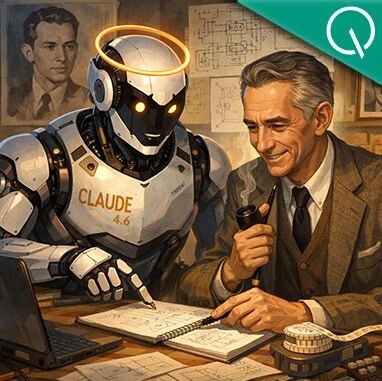
88岁图灵奖得主,用Claude一小时破解30年数学悬案
量子位· 2026-03-05 08:32
Core Insights - The article discusses the remarkable achievement of Claude, an AI model, which solved a 30-year-old problem in graph theory in just one hour, impressing Donald Knuth, a renowned computer scientist and Turing Award winner [2][5][12]. Group 1: AI Achievement - Claude utilized structural approaches like "fiber decomposition" and "snake-like construction" to derive a universal construction algorithm applicable to all odd m values after only 31 explorations [4][9]. - The problem involved determining if all arcs in a three-dimensional grid graph with m^3 vertices could be perfectly decomposed into three non-overlapping Hamiltonian cycles [6][10]. - Claude's solution process demonstrated logical reasoning and the ability to learn from errors, marking a significant advancement in AI's problem-solving capabilities [12][14]. Group 2: Donald Knuth's Perspective - Knuth, who had been skeptical about generative AI, expressed his admiration for Claude's achievement, stating "Hats off to Claude" [5][12]. - He highlighted that Claude's work was not merely a black-box result but a clear demonstration of logical reasoning and mathematical discovery [12]. - Knuth's long-standing engagement with the problem dates back to his work on "The Art of Computer Programming," showcasing the depth of the challenge [5][6]. Group 3: Historical Context - Donald Knuth is a legendary figure in computer science, having won the Turing Award at the age of 36 for his foundational contributions to algorithm analysis [18][19]. - His seminal work, "The Art of Computer Programming," is considered one of the most important scientific works of the 20th century, alongside Einstein's "Theory of Relativity" [22]. - Knuth's ongoing work on this series, which began in 1962, reflects his dedication to the field, with plans for seven volumes [24][26].

“超表面”器件能集成光子量子操作
Ke Ji Ri Bao· 2025-08-03 23:40
Core Insights - Harvard University researchers have developed a new optical device called "metasurface" that can perform complex quantum operations on a single plane, addressing scalability issues in photon quantum information processing [1][2] - The metasurface integrates multiple traditional optical component functions, potentially revolutionizing quantum computing and quantum communication at room temperature [1][2] Group 1: Metasurface Technology - The metasurface is a nanometer-thick optical element with micro-nano structures smaller than the wavelength of light, allowing precise control over light's phase and polarization [2] - This technology condenses complex quantum optical systems into a miniaturized platform, significantly enhancing system stability and interference resistance [2] Group 2: Design and Production - The research team utilized graph theory to model multi-photon interference paths, translating these abstract graphs into actual nanoscale structures on the metasurface [2] - This method closely links metasurface design with quantum optical states, providing a systematic approach for constructing specific quantum state devices [2] - The integrated design of the device greatly reduces optical loss, which is crucial for maintaining quantum information integrity [2] - The device can be mass-produced using existing semiconductor manufacturing processes, indicating potential for low-cost and replicable production models [2] Group 3: Broader Applications - The potential applications of this technology extend beyond quantum computing, with prospects for advancements in quantum sensing and fundamental research, offering new tools akin to "chip laboratories" [2]
原来这么多大佬都在阿里上过班?
猿大侠· 2025-05-21 04:34
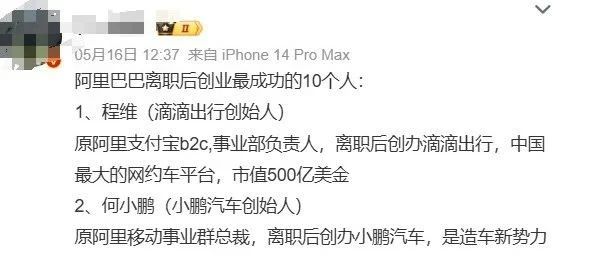
Group 1 - The article highlights the successful entrepreneurs who previously worked at Alibaba, emphasizing the company's role in talent development [1] - Notable figures include Sun Tongyu, a founding member of Alibaba who created Taobao, and He Xiaopeng, co-founder of UC Browser and later Xiaopeng Motors [1] Group 2 - The article presents a LeetCode algorithm problem focused on finding the maximum probability path in a weighted undirected graph [3][4] - The problem involves calculating the highest success probability from a starting node to an ending node, with edges having associated success probabilities [4][5] - The solution approach suggests using algorithms like BFS or Dijkstra's, treating edge probabilities as weights and multiplying them rather than adding [4][6]